Comparative study of Depression- Anxiety and Stress among Cancer patients

In this research, the depression, anxiety and stress levels among Cancer patients in their initial and final stages are being measured and compared. For this the patients are divided into two groups: one consisting of cancer patients in their initial stages who are undergoing treatment and the other of patients in their final stages of cancer. Each group consists of thirty male cancer patients from Apollo Cancer Centre, Filmnagar, Hyderabad. These patients are administered the Depression, Anxiety and Stress scale and their corresponding levels of depression, anxiety and stress levels are measured and compared.

INTRODUCTION

A benign tumor is basically harmless whereas a malignant tumor is dangerous and may spread to other parts of the body. The malignant tumor is better known as cancer which is a class of disease in which a group of cells display uncontrolled growth, invade and destruct adjacent tissues and spread to other parts of the body through blood. Depending on the type, location and extent of growth of cancer, different methods of treatment and cure are used according to the stage of cancer. Multiple staging scales are in use. TNM staging is most commonly used. The descriptions of TNM can be grouped together into a simpler set of five progressive stages as 0, I, II, III and IV, based on severity. In the first three stages also known as initial stages, chemotherapy, radiation therapy and surgery are the most common methods of treatment. When cancer reaches the final stage, it is usually no longer treatable and the patient is not expected to live long. People who no longer respond to cancer have to face the fact that they will probably die soon. The person may be in pain, in bed or able to walk only a few steps or may be confused. Different people react in different ways to this stage. They may avoid others and retreat into themselves showing signs of depression as is evident to people around them.

Depression is a general term that has been used to describe transient feelings, a psychological disorder and a health problem that is characterized by a group of related symptoms (Beeber, 1998). Depression is a state of emotional dejection (Sr. Christine Fernandes, 2007). Anxiety is a mood-state characterized by marked negative affects, bodily symptoms of tensions and apprehension about the future (American Psychological Association, 1994). Anxiety is also closely related to depression (Barlow, Chorpita, and Turovsky, 1996; Mineka, Watson, and Clark, 1998). Stress is a condition or feeling experienced when a person perceives that ” demands exceed the personal and social resources the individual is able to mobilize. Stress is a state of tension that is created when a person responds to the demands and pressures that come from work, family and other external sources (Dr. Hans Selye, Stress Management Society, 2009). All people will experience reactions of sadness and grief periodically throughout diagnosis, treatment, and survival of cancer. When people find out they have cancer, they often have feelings of disbelief, denial, or despair. They may also experience difficulty in sleeping, loss of appetite, anxiety, and a preoccupation with worries about the future. These symptoms and fears usually lessen as a person adjusts to the diagnosis.  People who face a diagnosis of cancer will experience different levels of stress and emotional upset.

They may develop high levels of depression, anxiety and stress when going through the process of diagnosis and treatment which include radiation and chemotherapy which may result in symptoms like nausea, fatigue, hair loss, mood swings and pain. They shall need to adjust themselves to these side effects. They are also uncertain of the outcome of the treatment and also of their future. However, incase the treatment is stopped due to their unresponsiveness, then they know for sure what their future holds. Hence they may not be in a constant state of worry over the outcome of their treatment and its side effects. So they may have lower levels of anxiety, stress and depression. This is the basis of the present research in which the depression, anxiety and stress levels of the patients in their initial stages and those in the terminal stages of cancer are measured and compared.

Hence, the hypothesis of this study is that the levels of anxiety, depression and stress are comparatively lesser in patients who are in the terminal stage of cancer than those in the initial treatable stages.

METHODOLOGY

The sample group consists of male cancer patients of Apollo Cancer Centre, Hyderabad. The sampling is convenience sampling through simple random assignment where two experimental groups of 30 cancer patients each, who are in their initial and terminal stages respectively are used. The main statistical methods used are t-ratio and Pearson’s Product Moment Method.

RELEVANCE

Sadness and grief are normal reactions to the crises faced during cancer, and will be experienced at times by all people. Because sadness is common, it is important to distinguish between normal levels of sadness and depression. (Watson, Greer, Rowden, Gorman, Robertson, Blissand and Tunmore, 1991).There have been several studies on the increase in DAS in cancer patients while undergoing diagnosis, medication and treatments( Nordin, Berglund, Glimelius, Sjödén; 2000). However, there have been no researches comparing DAS levels of people in different stages of cancer. The number of people with cancer is on the rise. The study of depression, anxiety and stress levels at different stages in cancer may contribute to and help in increasing the optimal levels of coping among patients

EVALUATION

In order to keep track of all the different variables, only male patients of Apollo hospitals are being taken as a sample. Finding at least 30 patients in their terminal stages of cancer at once may prove challenging. Permission is to be taken not only from the hospital but also from the patient’s family before conducting the study.

CONCLUSION

Hence, in this study, convenience sampling is used in selecting patients from Apollo hospital according to simple random sampling into two groups who are administered the DAS scale to compare their levels. There may be some inconvenience while collecting samples. Since research with these conditions has not been conducted particularly in India and specifically among cancer patients in different stages of illness, this research may prove useful in conducting further researches and in developing and maintaining maximum optimal environmental conditions for the patient’s mental wellbeing.
Zinc Molybdenum in Development of Esophageal Cancer


Authors:


S S Ray,


1


D Das,


2


T Ghosh


3


and A K Ghosh


2 **


Abstract


Purpose

There are several hot spots of esophageal cancer (EC) throughout the world. The deficiencies of Zn & Mo in human system play an important role for the development of esophageal cancer. The present study was aimed to investigate the role of soil and drinking water in terms of Zn & Mo contents in the development of a hot spot for EC.


Methods

Soil and drinking water (underground water) samples were taken from Eastern Cape, South Africa (a hot spot) and West Bengal, India (a cold spot) and analyzed for Zn & Mo contents using Atomic Absorption Spectrophotometer.


Results

Our results show that both soil and drinking water of Eastern Cape, South Africa were significantly deficient in Zn & Mo contents with respect to West Bengal, India. This deficiency is circulated to human system through food grain and drinking water.


Conclusion

Apart from other environmental risk factors the deficiencies of Zn & Mo in soil and drinking water contribute much for the development of EC in Eastern Cape, South Africa.


Keywords

Esophageal cancer; Zinc & molybdenum; Eastern Cape, South Africa; West Bengal, India.


Introduction:

Almost every endemic disease has its distinct pattern of geographical distribution. This variation of the distribution pattern may be due to the exposure of living system to the geographical environmental factors like geomorphology, geochemical structure, litho logy, soil, food grain, water and so on. Different elements in the soil is lixiviated in water and easily absorbed by plants. As a result, the qualities of food, ground water, micro-organisms activity, plant growth are also affected [1, 2]. So, the quality of drinking water and soil play a vital role in biogeochemical processes and have a close relationship to the development and distribution of endemic diseases [3

– 7

].

Like other diseases, the incidence of EC has a striking variation in geographical distribution throughout the world [8, 9]. There are three areas in the world having a high incidence of esophageal cancer: Transkei of South Africa, Linxian Province of China and the Caspian Littoral region. The area having the highest incidence is Transkei of South Africa and often seen as the epicenter of the disease in Africa [10]. EC accounted for 41.8% and 31.3 % of the total cancers reported during the 1998-2002 period for males and females, respectively [11]. The ASR for EC in this region (31.3 per 100 000 males and 18.0 per 100 000 females) is much higher than the national average when compared with those reported by the National Cancer Registry (NCR) during the period 1998-1999 [12] (11.3 per 100 000 males and 4 per 100 000 females).

On the other hand, West Bengal, a state in Eastern India the incidence of EC is 3.1/100000 and 2.9/100000 (crude rate) for males and females respectively [13], which is much lower in comparison to that of Eastern Cape, South Africa or other global hotspots.

It has been reported that soil of high risk area for EC is deficient in some element and overdosed in some elements [14]; but till now there is no conclusive report about Zn & Mo content in soil & drinking water in of a hot spot for EC.

However, this geographical distribution of the endemicity of EC leads us to explore the content of Zn & Mo in soil & water which is also directed by our earlier study [15] as well as others [16 – 20].


Materials and Methods:

Soil & drinking water (ground) were taken from Eastern Cape, South Africa and West Bengal, India for the analysis of Zn and Mo content. The number of samples was thirty for both soil & water taken from each country.

Zn and Mo were analyzed according to the standard methods of American Public Health Association [21]. Both soil & water samples were repeatedly digested in aqua-regia then filtered and make up the volume. The filtrate was analyzed by AAS (GBC make 908 Model). A blank was run similarly in each case.


Results and discussion:

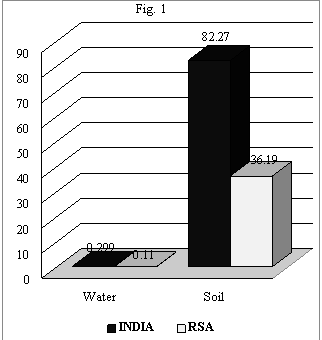
Our study shows that the soil of RSA is significantly deficient in Zn & Mo with respect to India (both Zn & Mo: p <0.0001) (Fig.1 & Fig.2; Table-1 & Table-2). This picture has also been reflected in case of water (both Zn & Mo: p <0.0001) (Fig.1 & Fig.2; Table-1 & Table-2), but the deficiency is more prominent than that of soil.

Table-1: Comparison Level of Zn & Mo in water and soil between INDIA & RSA.

Level of Zn in ppm

Level of Mo in ppm

INDIA

(Mean ± SD)

RSA

(Mean ± SD)

p-value

INDIA

(Mean ± SD)

RSA

(Mean ± SD)

p-value

Water

0.299±0.07

0.11±0.12

2.63×10

-10

0.85±0.5

0.18±0.1

4.9×10

-10

Soil

82.27±23.48

36.19±11.27

1.45×10

-14

118.31±27.96

85.62±16.56

3.67×10

-7

SD: Standard Deviation


Fig. 1: Comparison of the level of Zn in water and soil between INDIA & RSA.

Fig. 2: Comparison of the level of Mo in water and soil between INDIA & RSA.

The sources of the mineral elements for plants, animals and human are soil and water which pass through the food chain to humans [22]. Therefore, deficiencies of elements in soil and groundwater are circulated to human system through food chains and also create deficiencies in human system. Our earlier study indicated that the levels of Zn & Mo in hair of normal RSA population were strongly reduced with respect to normal Indian population and this picture was reflected in case of food grains also [15].

So, the deficiencies of Zn & Mo in water and food grain contribute much for the development of EC in RSA, a hotspot.


References:

1 . de Vries, W.; Romkens, P.F.; Schutze, G. (2007) Critical soil concentrations of cadmium, lead, and mercury in view of health effects on humans and animals. Reviews of Environmental Contamination and Toxicology 191: 91-130.

2. C.G. Popescu, (2011) Relation between vehicle traffic and heavy metals content from the particulate matters. Romanian Reports in Physics 63: 471–482.

3. Shu D-L. (1980) Drinking water and liver cancer. J Chin Prev Med 14: 65–73.

4. Lin N-F. (1991) Medical Environmental Geochemistry. Jilin Science and Technology Publishing House. Changchun City of China. pp.125–256.

5. Tang J. (1994) Study on Medical Geography in China: Formulationof Local Standards and Comprehensive Evaluation of Water Quality in Epidemic Areas of Jiashi Disease in Xinjiang. China Medico-Pharmaceutical Science and Technology Publishing House. Beijing. pp 225–231.

6. Lin NF, Tang J, Bian JM (2004). Geochemical environment and health problems in China. Environ Geochem Health 26: 81-8.

7. Mwanda WO, Orem J, Remick SC, et al (2005). Clinical characteristics of Burkitt’s lymphoma from three regions in Kenya. East Afr Med J 82: 135-43.

8. Stoner,G.D. and Rustgi,A.K. (1995) Biology of esophageal squamous cell carcinoma. Gastrointest Cancers Biol Diagn Ther 8: 141–6.

9.

Kuwano H

,

Kato H

,

Miyazaki T

,

Fukuchi M

,

Masuda N

,

Nakajima M

,

Fukai Y

,

Sohda M

,

Kimura H

,

Faried A

. (2005). Genetic alterations in esophageal cancer. Surg Today 35: 7-18.

10. SAGAR PM (1989) A etiology of cancer of the oesophagus: geographical studies in the footsteps of Marco Polo and beyond. Gut 30: 561-64

11. Somdyala NIM, Bradshaw D, Curtis B, Gelderblom WCA. (2007) Cancer incidence in selected municipalities of the Eastern Cape Province, 1998-2002: PROMEC Cancer Registry Technical Report. South African Medical Research Council, Cape Town.

12. Mqoqi N, Kellet P, Sitas F, Jula M. (2004) Incidence of histologically diagnosed cancer in South Africa, 1998-1999. National Cancer Registry of South Africa, National Health Laboratory Service: Johannesburg.

13. National Cancer Registry, (

www.canceratlasindia.org

) (2000) Indian Council of Medical Research New Delhi, India.

14.

Rheeder JP

,

Marasas WF

,

Farina MP

,

Thompson GR

,

Nelson PE

(1994) Soil fertility factors in relation to oesophageal cancer risk areas in Transkei, southern Africa.

Eur J Cancer Prev

3: 49-56.

15. Ray SS, Das D, Ghosh T and Ghosh A K (2012) The levels of zinc and molybdenum in hair and food grain in areas of high and low incidence of esophageal cancer: a comparative study. Global Journal of Health Science 4: 168-75.

16. Mellow MH, Layne EA, Lipman TO, Kaushik M, Hostetler C, Smith JC Jr. (1983) Plasma zinc and vitamin A in human squamous carcinoma of the esophagus. Cancer 51:1615–20.

17. Barch DH, Iannaccone PM (1986) Role of zinc deficiency in carcinogenesis. Adv Exp Med Biol 206: 517–27.

18. Yang CS. Research on esophageal cancer in china: a review. Cancer Res (1980) 40: 2633-44.

19. Rogers MA, Thomas DB, Davis S, Vaughan TL, Nevissi AE (1993) A case-control study of elements levels and cancer of the upper aerodigistive tract.Cancer. Epidemiol Biomarkers Prev 2: 305 – 12

20. Luo X, Wei HJ, Hu G, Shang AL, Liu YY, Lu SM. (1981) Molybdenum and Esophageal Cancer in China. Fed Proc; April.

21. Standard methods for the examination of water and wastewater. (1998) 20th edn.

American Public Health Association

,

Washington, DC

.

22. Gerald F. Combs (2005) : Geological Impacts on Nutrition. In: “Essentials of Medical Geology: Impacts of the Natural Environment on Public Health”, O. Selinus, B. Alloway, J.A. Centeno, R.B Finkelman, R. Fuge, U. Lindh and P. Smedley (Eds.), Elsevier, London, Paris. Pp 161-178.

Targeting Challenging Behaviors Exhibited by Young Children with Autism Spectrum Disorder


Abstract

Challenging behaviors are form of a notable part of Autism Spectrum Disorder (ASD) symptomatology. Pertinent to the conspicuous disparity in the popularity of ASD between males and females, the purpose of this study is to compare the presence and severity of challenging behaviors between boys and girls. Hypothesis: Girls with Autism Spectrum Disorder will have more severe challenging behaviors than boys. This study will employ a quantitative comparative design to measure the prevalence and severity of challenging behaviors among diagnosed children (aged 5-10 years) with ASD. The Autism Spectrum Disorder-Behavior Problems for Children (ASD-BPC) scale will be the principal instrument of measurement of the challenging behaviors. Descriptive and inferential statistics will be used to summarize and draw conclusions from the data. The results of this study will shed light on whether, professional counselors and therapists need to use different interventions in the management of ASD in girls and boys. Furthermore, the findings will provide useful insights to parents and teachers of ASD children on the most effective coping strategies.


Targeting Challenging Behaviors Exhibited by Young Children with Autism Spectrum Disorder


Introduction


Background

Autism spectrum disorder refers to several “neurodevelopmental disorders characterized by core deficits in social interaction and communication impairments, restricted, and repetitive behaviors” (Kirkovski, Enticott& Fitzgerald, 2013). Generally, the condition affects 1 in every 50 children in the United States (Blumberg et al., 2013). The manifestation of symptoms in ASD is heterogeneous with some children having severe intellectual disability while others may have above-average level of intelligence. According to prevalence reports, ASD predominantly affects males with a male to female ratio of about 4:1 (Baio et al., 2018).

The gender disparity in diagnosis has been contested by various researchers citing low sensitivity of assessment scales to ASD in girls (Kreiser& White, 2013). Other studies have described theories explaining the gender difference in the prevalence of ASD (Harrop et al., 2014). Yet, there is no concrete explanation of the large male: female ratio.  However, the knowledge gaps extend further than the diagnosis of ASD; a few studies have explored the differences in manifestation of symptoms among male and female children. One of the typical signs and symptoms of ASD is the presence of challenging behaviors. Challenging behaviors in ASD include self-injury, aggression, verbal tantrums and other socially inappropriate behaviors (Beighley et al., 2013). Based on the reported occurrence difference, it is important to study how ASD symptoms may vary between boys and girls.


Problem Statement

ASD is one of the most common developmental disorders in the United States affecting more boys than girls in the ratio of 4:1 respectively. Even though females are affected less frequently than males, girls require a greater symptom threshold for clinicians to settle for an ASD diagnosis (Harrop et al., 2015). This implies that diagnosed cases of ASD in females are more likely to present with severe symptoms. In fact, other reports indicate that the sex ratio becomes evenly distributed in moderate to severe ASD.

Challenging behaviors form a notable part of ASD symptomatology even though they are not a basis for diagnosis (Hattier, Matson, Belva&Horovitz, 2011). In fact, children with ASD are more likely to present with challenging behaviors than any other psycho-developmental conditions (Kozlowski et al., 2012). The commonly cited challenging behaviors in ASD include destruction of property, aggression or injury directed to self or peers, tantrums, among others (Beighley et al., 2013; Hattier et al., 2011). These problematic behaviors can exacerbate the core deficits evident in ASD children leading to extrapolated implications on the child’s learning and social development.

While the prevalence of challenging behaviors among ASD children has been studied by various researchers, a few studies have aimed at advancing the glaring gender difference to these behaviors. Specifically, fewer studies have compared the occurrence of challenging behaviors between boys and girls and the results of pertinent literature are not conclusive. The purpose of this study is to determine the effect of gender on the presence and severity of challenging behaviors. This research is relevant because of the potential to provide useful insights on the management of ASD thus enhancing parenting and education.


Literature Review

Findings of previous researchers comparing the presence and severity of challenging behaviors between boys and girls are inconclusive. Kozlowski et al. (2012) compared challenging behaviors among 185 children with High-Functioning Autism (HFA), Asperger’s disorder, and typical development and their multivariate analysis of variance revealed no difference on challenging behaviors between boys and girls. However, the study reported racial differences in the manifestation of problematic behaviors. In a matched boy-girl comparison, Harrop et al. (2014) noted that boys and girls with ASD are more similar than different in terms of their social communication and children involvement in play activities. Nevertheless, some challenging behaviors in ASD (such as tantrums) are indirectly related to social communication.

On the other hand, Amr et al. (2011) explored sex differences among Arab children (aged 4-11 years) with ASD and identified increased instances of challenging behaviors among effected boys. However, Amr et al. (2011) used a relatively small sample of 37 boys and 23 girls. After analysis of data from the Autism360 online database, Baker and Milivojevich (2013) replicated the findings of Amr et al. (2011) that boys have more problematic behaviors compared to girls. The Autism360 is an online database in which ASD adults as well as caregivers of autistic children anonymously describe the ASD manifestations. Baker and Milivojevich used a sample of 1495 boys and 336 girls aged 2-18 years.

While the results of these studies may be valid, Kirkovski, Enticott and Fitzgerald (2013) noted that gender differences in the manifestation of ASD may be better observed in later stages of life, indicating that studies using toddlers may be limited. As evident in the studies, toddlers form a significant part of the study samples. Another cause for concern is the male dominance in prevalence. This disparity has led to the recruitment of fewer female subjects than males. Studies using significantly fewer female subjects compared to males indicates that comparisons made thereof may be limited. In a review by Kirkovski, Enticott and Fitzgerald (2013), the reviewers observed that Murphy, Healy & Leader (2009) reported no difference on challenging behaviors between boys and girls regardless of the obvious proportionate superiority in expression of challenging behaviors in girls. As Kirkovski, Enticott and Fitzgerald (2013) cited, Murphy et al. (2009) recruited 130 ASD boys and 27 girls. The proportion of girls with challenging behaviors was at 7.4% (2 cases out of 27) while for boys it was 2.3% (3 cases out of 130 boys).


Methods


Research Question and Hypothesis

Prevalence studies on (ASD) have indicated that the prevalence of ASD varies significantly between males and females, with the boys-to-girls ratio of about 4:1 (Baker &Milivojevich, 2013). Therefore, it is important to study how ASD symptoms may vary between boys and girls. This study aims at answering the following research question: Do girls with ASD manifest more severe challenging behaviors than boys with Autism Spectrum Disorder? The proposed study will test the following hypothesis: Girls with Autism Spectrum Disorder will have more severe challenging behaviors than boys.


Participants

The target population for this study are all elementary school children (age 5-10 years) diagnosed with ASD in Alabama. The Centers for Disease Control and Prevention (CDC) reported that the population of 8-year old children with ASD as of the year 2010 was 125 (Centers for Disease Control and Prevention [CDC], 2012). This number accounted for ASD children who were 8-years old at the time of data collection. The population of ASD children could be higher as the CDC surveillance program collected data in only nine counties; Blount, Cherokee, DeKalb, Jackson, Jefferson, Madison, Marshall, Shelby, and Tuscaloosa (Centers for Disease Control and Prevention [CDC], 2012). Nevertheless, the CDC report represents the average age of focus of this study (5-10 years).

For generalizability purposes, the sample should be derived from all the elementary schools in Alabama. However, this would not be possible because of resource constraints (time and money). Therefore, the participants will be selected from elementary schools in one county (Pike County).

This study will employ a probability sampling technique; specifically, stratified random sampling. This method is appropriate because of the well-recognized gender disparity in the prevalence of ASD. The male to female ASD ratio is about 4:1 (Baker & Milivojevich, 2013). Therefore, the accessible population will be divided into two strata based on gender, which is male and female.  Thereafter, participants will be randomly selected from the two strata; 80% of the sample from the male stratum and the other 20% from the male stratum. These sub-samples are representative of how the disorder affects the two groups. Because the participants are elementary school children, they will be recruited together with their parents or guardians. Accordingly, the sample will consist of parent-child dyads and only children whose parents give consent to participate in this study will be included.


Sample Size

The Yamane (1967) formula will be used to calculate the required size of the sample.


Where;      n = sample size

N= Total population

e = margin of error at CI of 95% (0.05)

Since N = 125 (Centers for Disease Control and Prevention [CDC], 2012).

n = 125/[1+(125×0.052)]

n= 95


Instruments

The independent variable in this study is gender while the independent variable is the manifestation of challenging behaviors. Challenging behavior is one of the common manifestations of ASD and include self-injury, aggression, verbal tantrums and other socially inappropriate behaviors (Beighley et al., 2013). The study will measure the presence and severity of the challenging behaviors using the Autism Spectrum Disorder-Behavior Problems for Children (ASD-BPC) scale (Matson, Gonzalez & Rivet, 2008). The ASD-BPC scale is one of a three-part tool used to assess for ASD symptomatology, comorbid conditions (psychiatric conditions), and challenging behaviors. The ASD-BPC has been widely utilized in the assessment of challenging behaviors and generally has high validity and reliability (Matson, Gonzalez & Rivet, 2008). The scale consists of 18 elements that assess for challenging behaviors. The parents or guardians will rate each of the 18 elements (challenging behaviors) depending on their presence and severity with 0 indicating that the challenging behavior is not a problem, 1 implying that it is a mild problem and 2 suggesting that it is a severe problem. After the scale is duly rated, the scores are summed up to get the overall score. The range of ASD – BPC is 0 – 36, with lower scores indicating the child behavior is less challenging.


Study Design

The study will employ a quantitative comparative design. According to Boswell and Cannon (2017), the comparative design is appropriate when the researcher has no intention of manipulating or controlling the independent variable with “the dependent variable being the only variable measured in two or more groups” (p. 115). This description perfectly fits with the procedures of the current study.

The study subjects will be divided into two groups of males and females. The presence and severity of the dependent variable (challenging behaviors) will be measured using the ASD-BPC scale. The total scores of all participants (the overall scores in the ASD-BPC scale) in each of the two groups will be added. Descriptive statistics will be used to summarize the data, including the mean score in each of the two groups. The investigator will then compare the means of the two groups to determine whether there is a difference in the presence and severity of challenging behaviors between the males and females. The researcher will then use inferential statistics to ascertain that the difference in the means (if any) is statistically significant, i.e. it did not arise by random chance. To achieve this degree of certainty, the analysis will employ a two-tailed t-test to determine the significance of the difference between the two means.


Audience Utilization of Possible Results

The results of this study may be useful in advancing the meaning of the gender disparity in the prevalence of ASD. As Baker and Milivojevich (2013) noted, the meaning of the severe gender difference is limited. Importantly, the results will shed light on whether, professional counselors and therapists need to use different interventions in the management of ASD in girls and boys. Furthermore, the findings will provide useful insights to families with ASD children on the most effective coping strategies. This study will also guide teachers who are interacting with ASD children in the development of learning approaches best suited for girls with ASD. Lastly, the contributions of this research may be useful in devising effective coping mechanisms for the challenging behaviors that ASD children may manifest within the school settings.

Related content


References

  • Amr, M., Raddad, D., El-Mehesh, F., Mahmoud, E., & El-Gilany, A. (2011). Sex differences in Arab children with Autism spectrum disorders.

    Research in Autism Spectrum Disorders

    ,

    5

    (4), 1343-1350. doi: 10.1016/j.rasd.2011.01.015
  • Baio, J., Wiggins, L., Christensen, D., Maenner, M., Daniels, J., & Warren, Z. et al. (2018). Prevalence of Autism Spectrum Disorder Among Children Aged 8 Years — Autism and Developmental Disabilities Monitoring Network, 11 Sites, United States, 2014.

    MMWR.Surveillance Summaries

    ,

    67

    (6), 1-23. doi: 10.15585/mmwr.ss6706a1
  • Baker, S., &Milivojevich, A. (2013). Gender Differences among Children with Autism Spectrum Disorder: Differential Symptom Patterns.

    Global Advances in Health and Medicine

    ,

    2

    (6), 8-18. doi: 10.7453/gahmj.2013.003
  • Beighley, J., Matson, J., Rieske, R., Jang, J., Cervantes, P., &Goldin, R. (2013). Comparing challenging behavior in children diagnosed with autism spectrum disorders according to the DSM-IV-TRand the proposedDSM-5.

    Developmental Neurorehabilitation

    ,

    16

    (6), 375-381. doi: 10.3109/17518423.2012.760119
  • Boswell, C., & Cannon, S. (2017).

    Introduction to nursing research

    (4th ed.). Jones & Bartlett Learning.
  • Blumberg, S., Bramlett, M., Kogan, M., Schieve, L., Jones, J., & Lu, M. (2013). Changes in prevalence of parent-reported autism spectrum disorder in school-aged U.S. children: 2007 to 2011-2012.

    National Health Statistics Reports

    ,

    Mar 20

    (65), 1-11.
  • Centers for Disease Control and Prevention [CDC]. (2012).

    ADDM fact sheet Alabama: A snapshot of Autism Spectrum Disorder in Alabama

    . Retrieved from https://www.cdc.gov/ncbddd/autism/states/addm-alabama-Fact-Sheet.pdf
  • Harrop, C., Shire, S., Gulsrud, A., Chang, Y., Ishijima, E., Lawton, K., &Kasari, C. (2014). Does Gender Influence Core Deficits in ASD? An Investigation into Social-Communication and Play of Girls and Boys with ASD.

    Journal of Autism and Developmental Disorders

    ,

    45

    (3), 766-777. doi: 10.1007/s10803-014-2234-3
  • Hattier, M., Matson, J., Belva, B., &Horovitz, M. (2011). The occurrence of challenging behaviours in children with autism spectrum disorders and atypical development.

    Developmental Neurorehabilitation

    ,

    14

    (4), 221-229. doi:10.3109/17518423.2011.573836
  • Kreiser, N., & White, S. (2013). ASD in Females: Are We Overstating the Gender Difference in Diagnosis?

    Clinical Child and Family Psychology Review

    ,

    17

    (1), 67-84. doi: 10.1007/s10567-013-0148-9
  • Matson, J., Gonzalez, M., & Rivet, T. (2008). Reliability of the Autism Spectrum Disorder-Behavior Problems for Children (ASD-BPC).

    Research in Autism Spectrum Disorders

    ,

    2

    (4), 696-706. doi: 10.1016/j.rasd.2008.02.003
  • Murphy, O., Healy, O., & Leader, G. (2009). Risk factors for challenging behaviors among 157 children with autism spectrum disorder in Ireland.

    Research in Autism Spectrum Disorders

    ,

    3

    (2), 474-482. doi: 10.1016/j.rasd.2008.09.008


Describe how the following parts of the brain are involved during your evening of eating pizza, socializing, and playing cards: Broca’s area, hippocampus, hypothalamus, and occipital lobe.

Describe how the following parts of the brain are involved during your evening of eating pizza, socializing, and playing cards: Broca’s area, hippocampus, hypothalamus, and occipital lobe.


Brain Behavior

Your goals are to learn about major structures of the brain, how they influence behavior, and to describe them in action.

Source Materials
1. Your textbook chapter on brain and behavior or biological psychology.(Psychology: An Exploration, Second Edition by Saundra K. Ciccarelli; J. Noland White)

2. A YouTube video (optional)
Hyperlink Resources
http://www.youtube.com/watch?v=dRYRuAfTCX8 – Hosts Bradford and Anna give us a special “peek” into the brain during a common interaction—two people recognizing and greeting each other on the street.

http://www.youtube.com/watch?v=WF5TWcADGpc – An overview of various parts of the brain, categorized according to their locations and functions.

http://educationnorthwest.org/resource/503 – Please read the brief description of the traits of:
Ideas, Organization, Voice, Word Choice, Sentence Fluency, and Conventions.

Writing Prompt

Your best friends invite you over for pizza and a friendly game of cards. Describe how the following parts of the brain are involved during your evening of eating pizza, socializing, and playing cards: Broca’s area, hippocampus, hypothalamus, and occipital lobe. You are encouraged to watch the YouTube videos.

Compare and contrast ethical theories and discuss decision-making models applicable to healthcare providers.

Compare and contrast ethical theories and discuss decision-making models applicable to healthcare providers.

I need two parts, first, the Outline as described below. The second the final project. This is a paper on Medical Malpractice, I would like to have a paper citing case law considering operations on the wrong side of the brain. PLEASE read the entire post for more information. I need the Outline ASAP, and the final paper APA format in a week.

Part I: Introduction
Parties
Facts
Claims
Part II: Analysis
Issue
Rule
Analysis
Evidence
Defenses
Ethical Issues
Conclusion
Part III: Variation
Analysis of Hypothetical
Overview

One of the most important objectives of this course is for you to be able to relate the theories in the readings and discussions to situations in real life. We will develop these critical thinking skills each week via the discussion boards and short writing assignments, which will culminate in the final project, a medical malpractice case study.

The purpose of a case study in general is to apply what you learned to a real–life or hypothetical situation where you analyze, test, and propose solutions to the case. You may have a problem to solve and be asked to present potential solutions. Or you may have a situation to analyze and describe why (or why not) certain events were effective or successful. In processing a case study, you will have to apply research, reasoning, critical thinking, and analytical skills to identify underlying problems, causes, and/or related factors and make decisions.

For the medical malpractice case study, you will prepare a paper discussing a medical malpractice case using the IRAC (issue, rule, analysis, conclusion) formula. You will discuss any relevant ethical theories involved and analyze the outcome, applying legal concepts from the course.

You should be thinking about your case and start your research by Module Three. By Module Five, you should finalize your choice of a reported case for your project. In the Module Five journal activity, you will be asked to briefly discuss your chosen case and provide an outline for your project. The final project is due at the end of Module Seven.

Complex External Factors That Affect the Provision of Dental Appliances

1.0

Introduction

Nutrition is the main factor in diet which directly correlates with oral health; certain infections in the mouth are easily rejected when the diet is high in foods that contain the appropriate nutrients the body needs for good general health (Moynihan & Petersen, 2004). Negative impacts on oral health are also caused by different forms of drug intake for example medications related to disease, vitamins and minerals and the use of recreational drugs (Sebastian, 2004). A clinician has been presented with a case of an individual requiring the provision of an appliance, however there are several factors to be considered that are affecting the nutrition, oral and general health of the patient. The clinician is dealing with an individual who is malnourished due to high sugar intake and suffering from HIV (Human Immunodeficiency Virus) and xerostomia. This can potentially affect the choice of an appliance for example the HIV can have a great influence on one’s oral health due to lack of saliva in the mouth and an increase in dental caries. This can then potentially affect their diet and overall general health, because the body will lack the pivotal nutrients necessary.

2.0

Nutrition (High intake of sugar)

A well balanced diet allows the body to intake the necessary nutrients needed to live a good, healthy lifestyle. The mouth is prone to infections when the body is in nutrient deficit, which can potentially contribute towards the rapid progression of periodontal disease and other oral diseases (Moynihan & Petersen, 2004). Nevertheless, the most important influence of poor nutrition comes from the local action of diet in an individual’s mouth, resulting in an increase of enamel erosion and cavities. Cavities are formed when plaque acids attack the enamel of the tooth when consuming a diet high in Carbohydrates, Sugars and Starches (Scardina et al, 2011).

Decay can extend into the internal part of the tooth which can eventually lead to nerve pain if left untreated. Visible symptoms of decay involve a white spot that is usually seen on the tooth affected that will ultimately darken into a brown colour. Other signs include: halitosis, tooth discoloration, sensitivity or pain in one or more teeth (Sheetal et al, 2013). The main factor affecting the progression of caries is the frequency of an individual’s sugar intake from foods such as chocolates, cakes, sweets and fizzy drinks. Sugar is a sweet substance obtained from various plants like sugar cane and sugar beet; it has a crystal-like appearance and can be brown or white (Moynihan & Petersen, 2004). Pure sugar will be white and highly refined, as less refined sugar becomes brown in colour. There are two forms of sugars some are healthy and others harmful. Food products like fruits and vegetables (oranges and lettuce) contain good sugars which are pivotal nutrients that the human body needs to function.

On the other hand, sugars that are man-made and manufactured in the laboratories/factories offer no nutritional value and are harmful for the human body (Sebastian, 2004).

Individuals must control their daily intake and diet, nutrition is a factor which can highly affect the success and health of dental implants. A dental implant can be described as a titanium screw used to help restore missing teeth caused by disease, infections or trauma. “Osseointegration” is a known procedure that involves fusing an implant to the bone then joining it with an abutment which is the support system for the crown (Karen et al, 2012). Dentures and bridges often cause damage to the real teeth that are useful to preserve the jawbone. Non-removable bridges require the trimming of neighboring teeth and partial dentures are held in place by adjacent teeth, the chewing forces have adverse effects on the teeth and they can become severely weakened. A bridge has a durability of five to ten years; however, the teeth that support a partial denture or bridge show a high failure rate of 30 percent which is a negative indication. Full dentures on the contrary do not rely on any neighboring teeth which means at times they can slip and hinder the patient from eating certain foods (Sheetal et al, 2013).

The American Academy of implant dentistry stated that the “long-term success rate of dental implants is 97 percent”; mainly due to the fact that dental implants stabilize the jawbone without harming other teeth and patients can eat any type of food. The success of dental implants does not solely rely on how well they are placed; it depends on how healthy an individual’s oral tissues are, because the tissues are the foundation of any dental implants. A lack of essential nutrients can damage the oral tissues; once they become unhealthy it will be nearly impossible for the dental implants to be successful (Chandki et al, 2012).

There are various differences between a natural tooth and a dental implant; implants do not have a dental pulp which helps to indicate early stages of infections, they are not prone to cavities and do not have a periodontal membrane (Chandki et al, 2012). On the other hand, it is not advisable to place a dental bridge in an individual that has a diet highly ridged on sugar and sweets as they can potentially develop decay. If the decay is in between the teeth or inside the supporting tooth, the only way to access the area would be from removing the bridge. The clinician must ensure that all fillings are restored before placing the appliance into the patient’s mouth.

3.0

Oral Health (Xerostomia)

Normal salivation is important because it stops food gathering around the tooth and gum line, saliva also neutralizes the acids produced by plaque which harm the enamel of the tooth, increasing the risk of tooth decay triggered by a condition called Xerostomia (Rodriguez et al, 2017). Saliva contains important enzymes which allow the breakdown of food, increase the ability to taste food and aid good digestion. The secretion of saliva is important as it keeps oral tissues lubricated, cleans the oral cavity and starts the process of digestion as food is being broken down and chewed. The colloquial term for Xerostomia is “dry mouth” which is frequently found in patients treated by radiotherapy, it is also likely in patients taking medications such as; anti-depressants, vitamins and minerals, anti-inflammatories and antiretroviral drugs. Other factors causing xerostomia include immunological diseases, connective tissue disorders, depression and malnourishment (Isidor et al, 1999). A clinician should provide careful consideration when choosing the appropriate appliance for an individual with Xerostomia.

Research has shown that there is a direct correlation between a decrease in saliva production and patients having a higher amount of caries in the mouth (Rodriguez et al, 2017). Unfortunately, considering a dental bridge as an option for a patient suffering with dry mouth wouldn’t be ideal due to possible decay developing from the supported tooth.

Equally, additional research identified that xerostomia can cause difficulties wearing dentures and can trigger the development of caries and candidiasis (Guggenheimer, 2003). (Ravisankar, 2013) concluded that Xerostomia can cause sores, irritations and infections and may also result in the loosening of the denture, which has a negative effect on the oral functionality and satisfaction when wearing removable dentures. On the other hand, in the past three decades the use of implantology as treatment has been extensive; as has the research into the durability of dental implants. Longitudinal study results identified a 90 to 95 percent success rate with survival 5 to 10 years after treatment completion (Rodriguez et al, 2017). Research conducted in patients with a smaller follow up period of 4 years presented an 84 percent survival rate. (Isidor et al, 1999) Similarly, follow ups after two years have shown success rates of up to 88 percent. (Payne et al, 1997) The implications of xerostomia are significant; in severe cases the development of caries can result in a loss of teeth where prosthetic rehabilitation would be necessary.

Dental implants are a favorable option for patients with xerostomia as the low saliva levels have a minute effect on the materials used, although the demands of hygiene are increased in the individual with reduced saliva (Sciubba, J.J, 2012). This information is applicable to clinicians when trying to identify the causes of Xerostomia and research has strongly highlighted that dental implants are a favorable option and offer much more success rate in the long run in comparison to dentures and dental bridges.

Nonetheless under good clinical provision and strict adherence to the daily maintenance of the implants, a patient suffering from xerostomia can be relieved with the use of this appliance as the success does not depend on oral moisture (Payne et al, 1997). Given all the research it can be concluded that dental implants are a viable method of treatment for patients suffering with this condition.

4.0

General Health (HIV- Human immunodeficiency virus)

(World Health Organisation, 1946) defined the term ‘Health’ as a relative state in which an individual is managing well physically, mentally and socially and not only the absence of disease or physical or mental weakness. An individual’s general health can be affected by HIV virus which attacks a particular form of T cell called CD4 cells. The T cells are significant to an individual’s immune system in order for the body to fight off any potential infections. A person is prone to cancers and infections when the functions of the immune system deteriorate causing an illness known as AIDS. This type of virus can be transmitted from one body to another through fluids coming into contact with blood, damaged tissue and mucous membranes. According to (World Health Organization, 2013) early HIV can be treated with ARV (Antiretroviral) medication. This treatment is given to infected HIV patients to help fight the infection and lessen the chance of the virus spreading.

An individual suffering from HIV should be given the appropriate recommended appliance from the clinician, to ensure their general health is not affected. It has been documented that patients who use complete custom conventional dentures in the mandible commonly have issues adapting to the appliance. There is increasing evidence showing that two-implant and mandibular overdentures provide a better support and retention than conventional dentures (Stevenson et al, 2007). The use of implant overdentures can improve stability, comfort, chewing effectiveness and function. Patients who get two-implant mandibular dentures have reported a positive change in their quality of life when comparing to the previous use of the conventional denture (Stevenson et al, 2007). Many HIV infected patients who wear dentures are now requesting the use of dental implants as an alternative means of treatment (Stevenson et al, 2007).

In the year 1998 the first successful single root form implant placement into a HIV positive patient was reported by (Rajnay et al, 1998). In addition, another case of a patient who had twelve implants placed; six in the maxilla and six in the mandible there was complete recovery and success despite being infected with HIV and Hepatitis B and C (Baron et al, 2004). Above all, it seems pertinent for the clinician to consider dental implants as an option for healthy individuals to increase their oral health quality of life.

5.0

Drugs related to disease (HIV medication- antiretroviral drugs)

In order to treat, prevent and cure many diseases and medical conditions, drugs and other forms of medicine are generally used. Medications are chemicals and compounds which operate in the body in different ways (Ouanounou et al, 2016). They can fight off microorganisms that attack your body, substitute when vitamins and hormones in the body are scarce, terminate abnormal cells that lead to cancer and alter the way the cells operate within the body. Drugs come from various sources; many were extracted from natural resources for example plants. Medications can also be produced in laboratories by mixing chemicals and compounds; however other medications (penicillin) are byproducts of organisms for example fungus (Ouanounou et al, 2016). Some medications need to create a certain substance in order to be effective and therefore are biologically engineered by injecting genes into bacteria. Medications can be administered in several ways such as swallowing liquids/tablets, applying creams, gels and patches or through injections (Achong et al, 2006).

When a patient is diagnosed with early HIV, antiretroviral treatment is essential to managing the HIV infection. Individuals suffering from HIV also experience many difficulties such as thrush, white lesions, ulcers, lack of saliva and canker sores (Lemos et al, 2018). Dental mouth problems involving HIV can cause pain which will affect the ability of an individual to be able to chew or swallow.

Antiretroviral side-affects can contribute to the flow of saliva, which can potentially cause dry mouth. An individual who lacks saliva production would have to become accustomed to a new diet as foods like meat become difficult to chew and taste. Overtime, the body can lack the nutrients needed to maintain a healthy lifestyle which can have a negative impact on one’s weight and oral health. Sometimes the individual will stop taking the antiretroviral medication which can also result in lack of nutrients as they have difficulty eating. A compromised digestive system can affect the intake of antiretroviral treatment. A study on prosthodontics placed in HIV infected patients taking antiretroviral medication revealed that individuals that were given complete or partial dentures had several issues with mastication, speech, swallowing food and soreness (Nagaraj, 2013). Additionally, a reduced flow of saliva and resultant impediments were found in elderly patients infected by HIV due to both the contribution of age and virus. Placing full dentures in the elderly patients can be a challenge because stability and retention are difficult to accomplish. Whereas, (Lemos et al, 2018) found that the life expectancy of patients with infected HIV taking antiretroviral medication has increased, due to the immune system developing great defenses to fight the infection. (Achong et al, 2006) documented the successfulness of implant therapy in patients affected with HIV, in which 2 patients were taking antiretroviral medication. The results showed that dental implants do not indicate any high risks to the HIV patient when the viral load is particularly low. Furthermore, during surgery it was reported that the CD4 cells level had no effect on the success rate of dental implants (Nagaraj et al, 2013).

This is led to more patients seeking dental implant surgery for oral rehabilitation.

6.0  Conclusion

There is evidence that a provision of an appliance can be affected by oral health, nutrition, general health and any drugs consumed due to disease. An individual who is affected with cavities due to high sugar intake should not be recommended with a dental bridge because of possible decay. It is clear to say that dental implants is a more advantageous appliance to be used as it cannot form cavities and helps to preserve the bone structure. Whereas, denture were seen to cause damage to the natural tooth and have an adverse effect on the structure of the jaw bone. Research concluded that Xerostomia was another cause of distress in patients suffering from HIV. Dental implants were shown to be the best solution for patients with dry mouth as the survival rate is high. On the other hand, dentures that have a negative effect on the functionality were shown to be less successful. This is significant and highlights the reasons why dental implants offer a long term successful solution for missing teeth in patients with these conditions. Individuals suffering from dry mouth, HIV and high sugar intake usually consume fewer nutrients which can make the oral tissue more friable. If a patient is prescribed with a denture they are more likely to stop using it which can affect their oral health due to weight loss. This will then lead to a poor general health, which is why it is more ideal to offer the patient a dental implant because it doesn’t have any effect on the oral moisture. The clinician must take careful consideration when recommending the dental implant as patient compliance is the key to success in implants. Correct guidance and health advice must also be provided to the patient in order to achieve the best results.

Bibliography

The Need for Complementary and Alternative Medicine Regulation


Lies and Dangerous Practices: The Need for Complementary and Alternative Medicine Regulation

Complementary and alternative medicines (CAMs) generally market themselves as an equal alternative to biomedicines. The danger behind this is that they are not. Both CAM therapies and their practitioners do not undergo the same rigorous peer review, regulations, and education as biomedicines and their practitioners. For this reason, CAM practitioners and their therapies require more stringent regulations regarding their education, advertising, and claims of efficacy.

CAMs include homeopathy, naturopathy, osteopathy, traditional Chinese medicine, chiropractic, and spiritual therapies. Many of these are informed and influenced by their cultures of origin. As outlined by Bissoondath (1998) in his essay, “No Place like Home,” Canadian’s pride themselves in their acceptance of cultural practices. However, practices such as CAMs are dangerous. As multiculturalism continues to grow, so has usage of CAMs. 79% of Canadians used complementary or alternative therapy in 2016, up from 75% in 2006 (Esmail, 2017).

I first encountered CAMs during my 3rd week as a nursing student. I was assigned a 57-year-old Chinese woman who suffered a stroke which completely took away her speech and mobility. She also suffered from atrial fibrillation; a potentially dangerous condition characterized by irregular beating of the heart. If uncontrolled, it exponentially increases the risk of a stroke or heart attack. Upon assessment, her heart was beating irregularly despite being on digoxin, a medication meant to normalize the heart. We hypothesized that the patient was taking ginseng, a popular Chinese herbal remedy which, when taken with digoxin, causes rapid and irregular heart rates (Karch, 2017). The patient confirmed she regularly visited a TCM (Traditional Chinese Medicine) practitioner who ‘prescribed’ ginseng to improve energy levels thereby inducing uncontrolled fibrillations. While it is impossible to say whether the ginseng caused her stroke, it undoubtedly contributed to it.

If more stringent regulations existed, it is not unreasonable to argue that my patient would still be able to walk and talk. From prescription to dispensing, a biomedicine such as digoxin passes through multiple healthcare professionals and screening tools prior to being taken by a patient. First, a physician or nurse practitioner prescribes the medication and conducts a medication reconciliation which reviews the medications the patient is already on to determine possible interactions. According to pharmacists Elbeddini and Zhang (2018), when the patient visits the pharmacy, a licensed pharmacist conducts the same reviews. Finally, if admitted to a hospital, the nurse follows the same protocol. Three checks by three professionals, all of whom were instructed to a high standard as mandated by the government and their regulatory bodies. An individual such as a TCM practitioner need not conduct the same review.

Moreover, their education is not held to the same high standards for accreditation as the three aforementioned professionals. Despite this, they can market themselves as being able to control serious chronic health condition like diabetes or asthma using medicine that has not been tested or approved by any government agency. For example, according to a report from Global News, a Vancouver Island naturopath gave a child diluted saliva from a rabid dog to treat his autism. Despite being educated at a recognized institution for Naturopathic medicine and being licensed by the governing body of Naturopaths, she still gave a medication so widely known to be ineffective and potentially dangerous that she was stripped of her Naturopathic license. Incredibly, she is still able to practice as a homeopath and still supports her usage of the medication (Young, 2018).

Compared to a licensed medical doctor, a CAM practitioner such as a Naturopath undergoes much less rigorous and in-depth training. To gain a medical degree, an individual must first attend 3-4 years of an undergraduate program, 4 years of medical school and write a multitude of rigorous, multi-subject tests. Following graduation, a physician then spends a further 2-7 years, depending on specialization, in residency training under the supervision of fully certified, specialized physicians. In total, a medical doctor needs between 9-15 years of rigorous post-secondary education before they can practice independently.

In comparison, the educational requirements of a CAM practitioners are far less stringent. According to Brit Hermes, a former naturopathic doctor, the education for naturopathic doctors “[are] riddled with pseudoscience, debunked medical theories, and experimental medical practices” (Hermes, 2015). Her training was comprised of textbook level comprehension of core medical sciences and lacked actual clinical application. Her classes were taught by unqualified individuals. For example, her embryology class was taught by a doctor of naprapathy, a specialization focusing on chiropractic and homeopathic manipulation of connective tissues. Furthermore, the highly competitive ‘residency’ she found herself in was a total of a single year in length of which only a small amount of time was dedicated to actually treating patients. She concludes that naturopaths are not qualified to practice primary care, which is the area for which they claim to be experts.

As such, CAM practitioners should be subjected to similar regulations as other healthcare professionals. For CAM practitioners, lawyers Trebilcock and Ghimire (2019) argue that provincial-sanctioned self-regulation should be implemented. This would entail a self-governing body comprised of CAM practitioners be given power by the provincial government to grant professional credentials. A few detractors, such as attorney Michael Weir (2005) argue that granting licensure would validate CAM practitioners as licensure does with biomedical practitioners. However, instead of licensing an individual, certification should be given. Formal certification “gives strong incentives for certification bodies and their members to promote their brand and reputational status.” It also does not give the same legal protections as licensure thereby not legitimizing them in the view of the law (McHale & Gale, 2015). The main advantage of certification is normalizing educational requirements thereby setting minimum standards for CAM practitioners

Equally important is controlling how these therapies are advertised. Medical procedures and their efficacy are established by the healthcare professionals themselves. However, the major difference between biomedical professions such as medicine or pharmacy and CAMs are that the prior’s practices are informed entirely on peer-reviewed scientific literature. Regulatory recommendations made by biomedical bodies are backed by extensive, peer reviewed scientific literature. On the other hand, CAMs lack this rigorous peer review and can make claims unsubstantiated by evidence. One such example occurred in BC. Epidemiologists Murdoch, Carr, and Caulfield (2016) found that the majority of CAM clinics claimed that they were able to either diagnoses or treat both allergy/sensitivity and asthma despite using diagnostic techniques that were not supported by the Canadian Society of Allergy and Clinical Immunologists due to the lack of evidence supporting them. Furthermore, these same clinics used potentially harmful treatments such as IV hydrogen peroxide and spinal manipulation. Accordingly, it is vital to regulate CAM advertising to prevent harm to the public.

Lastly, CAMs should

never

be promoted as being a substitute for biomedicine. CAM advertising has been shown to redirect patients from pursuing biomedical treatments despite many of their claims being unproven or fabricated. This has major ramifications to the health of individuals and can prove lethal. A study conducted by the Yale School of Medicine showed that CAMs, when taken as a substitute for chemotherapy and radiation, accounted for a mortality rate 2.5 times greater in cancer patients (Johnson, Park, Gross, & Yu, 2018). When conditions such as these remain untreated, people die. Therefore, advocating for the replacement of proven medical practices with unproven CAMs poses a great danger to the individuals who are the targets of these advertisers. One may argue that CAM practitioners are simply exercising their right to advertise in a capitalist free market. However, there exists a fundamental unfairness to CAM medicines. They can make unsubstantiated claims with little to no ramifications. These claims, in and of themselves, should be regulated. It is illegal in Canada to advertise for pharmaceutical companies to advertise medications directly to consumers (Gibson, 2014). The Canadian government has dictated that individuals lack the expertise to choose a treatment for themselves especially when subjected to purposefully manipulative advertising. Yet CAM practitioners can freely advertise to the public. This asymmetrical advertising model skews members of the general populace to choosing CAM therapies as they are presented as alternatives rather than complements to traditional biomedicine (Johnson, Park, Gross, & Yu, 2018).

This is not to argue that CAMs have no place in healthcare. Canada, and many democratic countries support the right for an individual to choose the treatment they want. Furthermore, CAMs are not without proven benefit. According to a study conducted by the Epidemiologist Staud (2011), several CAMs have scientifically proven efficacy and many of them are being studied for their potential implementation into biomedicine. Despite this, the possible danger they pose cannot be mistaken. Some detractors from regulation, such as bioethicist Sarah Budd (2002), bring forth concerns that regulating CAMs in the same manor as biomedicines may legitimize them to the public. However, failure to regulate them poses even greater problems such as dangerous therapies, poorly educated CAM practitioners, and potentially dangerous advertising. As well, approaching regulation with a laissez faire view may itself cause the public to believe that CAMs are at worst harmless and at best useful. Some, such as medical attorney Michael Cohen (1996) argue that regulation infringes upon the personal freedom of individuals who wish to practice their culture’s health practices. While this remains a legitimate concern, lawyers Trebilicock and Ghimire (2019) argue that CAM regulation should be regulated according to a risk calibration. This entails that CAMs claiming to address life threatening health conditions should be scientifically validated and regulated accordingly. This would allow individuals to practice and market their own cultural practices while still protecting the public from dangerous therapies.

Regulating CAMs is necessary in order to protect the health and wellbeing of the general populace.  The regulatory steps outlined in this essay provide a few basic controls on the uncontrolled CAM market. As the general populace is unable to properly diagnose a disease and consequently pick the appropriate treatment, choosing which healthcare professional is often difficult. Granting professional certification and establishing advertising rules helps protect the general public from dangerous practices, whether they come from biomedical or CAM practitioners. Finally, holding these CAM professionals and therapies to these higher standards protects the population and encourages improvement.


References

  • Aronson, J. (2017). Medication reconciliation. BMJ, 356, i5336-i5336. doi:10.1136/bmj.i5336
  • Bissoondath, N. (1998). No place like home. Reprinted in

    LIBS 7001 course reader


    2018

    (pp. 212-216). Burnaby, BC: BCIT
  • Brody, Jane. (2018, October 1). The risk of alternative cancer treatments.

    New York Times,

    retrieved from https://www.nytimes.com/2018/10/01/well/live/the-risk-of-alternative-cancer-treatments.html
  • Elbeddini, A., & Zhang, C. X. Y. (2019). The pharmacist’s role in successful deprescribing through hospital medication reconciliation.

    Canadian Pharmacists Journal

    , 152(3), 177-179. doi:10.1177/1715163519836136
  • Esmail, R., Nadeem, L. (2017). Complementary and alternative medicine: use and public attitudes.

    Vancouver: Fraser Institute

    ,

    1

    (1), 11
  • Gale, N. K., McHale, J. V., & Taylor, F. (2015).

    Routledge handbook of complementary and alternative medicine: Perspectives from social science and law.

    London, New York: Routledge. doi:10.4324/9780203578575
  • Gibson, S. (2014). Regulating direct-to-consumer advertising of prescription drugs in the digital age. Laws, 3(3), 419. doi:10.3390/laws3030410
  • Hermes, B. (2015, May 17). Naturopathic clinical training inside and out. [Blog post]. Retrieved from https://www.naturopathicdiaries.com/nd-confession-part-1-clinical-training-inside-and-out/
  • Johnson S., Park H., Gross C., & Yu J. (2018) Use of Alternative Medicine for Cancer and Its Impact on Survival, JNCI: Journal of the National Cancer Institute, Volume 110, Issue 1, January 2018, Pages 121–124,

    https://doi.org/10.1093/jnci/djx145
  • Karch, A. M. (2017). Focus on nursing pharmacology (7th ed.). Philadelphia, PA: Wolters Kluwer.
  • Murdoch, B., Carr, S., & Caulfield, T. (2016). Selling falsehoods? A cross-sectional study of canadian naturopathy, homeopathy, chiropractic and acupuncture clinic website claims relating to allergy and asthma.

    BMJ Open

    ,

    6

    (12), doi:10.1136/bmjopen-2016-014028
  • Staud, R. (2011). Effectiveness of CAM therapy: Understanding the evidence. Rheumatic Diseases Clinics of North America, 37(1), 9-17. doi:10.1016/j.rdc.2010.11.009
  • Trebilcock, M. J., & Ghimire, K. M. (2019). Regulating alternative medicines: Disorder in the borderlands. C.D. Howe Institute Commentary, (541), COV.
  • Weir, M. (2006). Regulation of complementary alternative medicine practitioners.

    Law in Context

    , 23(2), 171-198.
  • Young, Leslie. (2018, November 8). B.C. naturopath who prescribed rabid dog saliva remedy to child surrenders her license.

    Global News,

    Retrieved from https://globalnews.ca/news/4644439/bc-naturopath-license-dog-saliva/
  • Brody, Jane. (2018, October 1). The risk of alternative cancer treatments.

    New York Times,

    retrieved from https://www.nytimes.com/2018/10/01/well/live/the-risk-of-alternative-cancer-treatments.html

Obesity and Social Demographics in the US Essay


Introduction

Obesity is not a new term in America. As a matter of fact this is a health condition that has become common to the American citizens and the rest of the world. Sadly, this is not a laughing matter considering the fact that it has led to a number of deaths in the U.S. So, what is obesity? According to the medical-dictionary this refers to “an abnormal accumulation of body fat, usually 20% or more over an individual’s ideal body weight. Obesity is associated with increased risk of illness, disability, anddeath.” A few years back this health issue was not a major problem to the U.S. However, this has greatly changed considering the effects that obesity has on American citizens. Certainly, there are other countries that are also going through the same health problems but American cases on effects of obesity still tops them all.

The benefit of having lower body weight is not a big concern for the Americans. This is the main reason why its citizens are not motivated in any way to ensure that they have the recommended body weight. Hence, obesity is continuously increasing more so in the 21st century. The number of people facing obesity problems in this century is higher as compared to the 19th century. Research by the health experts show that out of ten Americans three of them are obese. The number of deaths that obese cause is more than 120, 000 and to top this, there are also huge medical expenses that these individuals have to face. Obesity is a disease that is actually preventable and necessary measures are now being implemented to ensure that the effects are reduced in the coming years.

As mentioned earlier United States has been dominating by having the highest rates of people who are obese. However, this changed in 2013 according to recent Global Post July 8th 2013 that Mexico had taken over as the leading nation having more obese cases. In a study conducted by JAMA (Journal of the American Medical Association) in 2008 it revealed that the rates of women suffering from obese were higher than that of the men. According to this study the women’s rates have been constant over the years as compared to the men’s rate that is constantly increasing.

Yearly the effects of obese in America are heavily felt since it leads to “approximately 100, 000-400,000 deaths” as Blackburn, G L; Walker (2005) points out. This is not all, the health care expenditures are also high, and hence the government and the public suffer in paying for services that would reduce the overall effects of obesity. The effects of obesity in the U.S can either be direct or indirect. The direct effects come about as the expenses that are incurred in paying for care and other required services. The negative effects touch on loss of earnings by the individuals that are suffering from obese and absenteeism from work places. Finkelstein, E.A. and Fiebelkorn (2003) argue that the expenses that are incurred as a result of obesity “exceeds health-care costs associated withsmokingorproblem drinking”. This clearly shows the extent of damage that obesity is causing in America. Indeed it is a major health issue that needs to be taken care of to save the nation from such huge expenses.


Prevalence of obesity in U.S

The fact that obesity rates in America have increased since 1962 also means that its prevalence is also wide. People from all walks of life are now obese in America; the children, people from different racial backgrounds, men and women all are constantly coming up as obese.


Obesity prevalence according to race

According to CDC health statistics the prevalence of obesity with regards to race is uneven. This implies that different races have got different rates of obese individuals.


Caucasian race

In 2010, the rate of obese individuals from this race was 26.8% according to CDC statistics. The rate of men suffering from the disease was higher than for the women from this race.


African American race

Statistics from CDC proved that the rate of people suffering from obese that were of the African American race was higher than the Caucasian race. This rate was 36.9%. There is also a difference in the rate of men as compared to women. Women from this race had higher rates of obese cases as compared to their counterparts.


American Indian race

American Indian rate of obese individuals was higher than both Caucasian and the black American race in 2010.


Asian race

The Asian race in the U.S. had the smallest percentage of obese cases according to statistics from CDC 2010.


Latino race

The Latino race rates were close to the rates that the African Americans had i.e. 31.9%. The rates of women suffering from obese were higher than men.


Mexican American race

This race also depicted a percentage prevalence that was closer to the African Americans i.e. 34.1%


Hawaiian race

This race depicted the highest prevalence rate i.e. 43.5% in 2010 according to statistics from CDC.


Obesity prevalence according to gender

Judging from the results mentioned above, women have higher rates of obese as compared to the men. This is also true according to Rippe James that “30 million men and 36 million women” suffer from obese in the U.S.


Obesity prevalence according to age group

There is also a notable change in the prevalence of obesity in relation to age group. Years back only the adults were suffering from obese disease. This has changed in the 21st century since children are also obese including those that are adolescent.


Obesity prevalence according to state

Different states in the U.S also bring about a difference in the obesity cases are throughout the nation. Mississippi stands as the state that has the highest rates of obese cases. Colorado has the smallest rate of obese cases.

There are different reasons as to why the U.S. citizens are facing high rates of obese individuals as compared to other nations. Some of the reasons are as discussed below:


Diet

Diet is the main contributing factor to increased rates of obese cases. Truth be told, the media normally portrays the citizens of U.S. as individuals who are normally busy with their regular hustle and bustle. This thus creates a scenario where parents or the adults do not have time to cook. This makes kids to prefer eating from fast food hotels. According to CBS news (2004), 1/3 of children between the age of 4 and 9 eat from fast food hotels on a daily basis. These fast food restaurants normally sell foods that have high fat and carbohydrate content. They are also preferred due to their affordable prices. Without doubt, foods that have got high fat calorie would easily lead to obesity. It is also evident that most Americans love to eat from these fast foods considering the fact that these restaurants increased their sales over the years.


Lifestyle

The lifestyle that the American citizens are portraying is also another factor that leads to obese.

This is the lifestyle where an individual is not engaged in any physical activity either on a regular basis or an uneven basis. With the advancement in technology more and more American kids are simply idling at home playing computer games, watching television, reading etc. This implies that they do not engage in any activity that would help them burn the calories that they take in. The adults are also “not active at all” (Rippe James). As a result the regular eating on fast foods restaurants as mentioned above combined with sedentary lifestyle will obviously lead to obesity. Most of the Americans do not engage in physical activities e.g. working out in the gym, morning jogs, walking, swimming etc. Therefore, excess calories in their systems eventually lead to obesity cases and aftermath complications.


Social transformation

Humans were made to be social in nature. This generally affects their eating habits considering the fact that as more people get together it is normal to have meals to go along with the socialization. This is everywhere, sports zones you will find food being served e.g. popcorns and soda, in parties’ people would want to taste what they have always envied. The same case applies to funerals since individuals are normally served while mourning. The social lives that Americans engage into highly contribute to their eating habits and thus in the end leading to obese cases.

The advancement in technology in the U.S. has also paved way for sedentary lifestyles. People spend more time watching TV and posting information on the social sites. News media has also affected social lives of American citizens by focusing too many advertisements on food and the worst part is the fact that children are mostly used in the commercials. This thus motivates the kids to each such food in large quantities.


Measures to help reduce obese disease in the U.S

On the bright side, Americans are doing the best they can to ensure that obese cases are reduced. Some of the effective measures that are already taking place are advocating of proper eating habits. The banning of junk foods in schools is also helping in making America an obese free nation. Several organizations have made it their duty to pass out a message to the Americans about the effects of obesity and the preventive measures that can be easily adopted right from the tables of the citizens. Food manufacturers in the U.S are also in favor of the initiative to reduce obesity in America. As a result they are trying their level best to manufacture foods that have less sugar, salt and fat content.


Conclusion

Obesity in the U.S is a serious case keeping in mind that it had led to deaths that can easily be prevented. Thus, it is the duty of people and the society at large to ensure that they strive to make America an obese free nation. One of the best ways to do this is to change the eating habits that are being portrayed in different families. The lifestyles also need to be change and thus people should be advised on the benefits of exercising regularly to burn down the calories that they are taking in. manufactures and other nonprofit organizations need to educate the society on benefits of healthy living. With such measures in place, the prevalent rates of obese cases would certainly reduce to single figured percentages.


References:

Blackburn, George L, and W A. Walker. “Science-based Solutions to Obesity: What Are the Roles of Academia, Government, Industry and Health Care?” (2005). Print.

Finkelstein, E A. “National Medical Spending Attributable to Overweight and Obesity: How Much, and Who’s Paying?”

Health Affairs

. (2003). Print.

Global Post July 8, 2013, 4: 19 PM (2013-07-08).”

Mexico takes title of “most obese” from


America”

. CBS News.

“Obesity.”Gale Encyclopedia of Medicine. 2008. The Gale Group, Inc. 28 Apr. 2014

http://medical-dictionary.thefreedictionary.com/Obesity

Rippe, James M, and Theodore J. Angelopoulos.

Obesity: Prevention and Treatment

. Boca Raton: CRC Press, 2012. Print.


Summary Health Statistics for U.s. Adults: National Health Interview Survey, 1998

. Hyattsville, Md: Dept. of Health and Human Services, Centers for Disease Control and Prevention, National Center for Health Statistics, 2002. Internet resource.

Critique of Care of older people with dementia in nursing

Introduction

This assignment will critically appraise a qualitative research report from the Nursing Standard titled: Care of older people with dementia in an acute hospital setting.(Fiona Cowell, 2009) (Appendix 1). The critiquing frameworks by Polit and Beck (2010) and Roe (1998) will be used to facilitate understanding of the quality of the study. On a personal level, as a third year student nurse it has been witnessed how some healthcare professionals have difficulty relating to patients with dementia; through lack of understanding and education in dementia care. According to the Alzheimer’s society (2010) there are approximately 750,000 people with dementia in the UK.

The reason for nursing research is to generate knowledge about nursing education, nursing administration, health care services, characteristic of nurses and nursing roles, in which the finding from these studies indirectly affect nursing practice and thus add to nursing body of knowledge (Burns and Grove, 2006)

This part should be in refs section not in main body of essay. If it’s a direct quote it should be in inverted commas including page number of book where it came from

Introduction to the study

According to Gerrish and Lacey (2006) the introduction must convince the reader that the proposed study is important and it should identify how the study will add to previous work and build on theory. For the purpose of this research paper Cowell (2009) has decided to write the introduction separate from the main abstract.

Cowell clearly explains why the study needs to be investigated within the introduction and convinces the reader that the best way to investigate this research would be to use a qualitative approach, to address this gap in knowledge.

Title

According to Parahoo (2006) titles that are too long or short can be confusing or misleading. The title should suggest the research problem/purpose of the study. The title in Cowell’s (2009) study is unambiguous, concise, and highlights with clarity the content of the research study.

Literature Review

A Literature review is to give an objective account of what has been previously been written on the topic (Moule and Goodman, 2009).

In this research the literature review provided a list of data bases that were used to search for relevant articles on dementia between 1980 and 2004, with a list of keywords used within the search.

The articles investigated a range of different subjects however there was limited evidence that these had achieved a demonstrable change in practice due to study limitations and sample size.

The literature review only comments on a (How many is a few, state number)few, out of forty seven articles. In one of the articles mentioned in the review none of the patients had been diagnosed with dementia. Holloway and Wheeler (2010) state that in qualitative studies the discussion of literature tends to be more limited than in other types of research.

The articles that the researches choose to comment on helps to convince the reader that views of nurses on dementia care are limited and that care of dementia patient in acute hospitals needed to be addressed.

Overall the literature review provides detailed references, keywords and information on how Cowell went about the search, but the study fails to provide recent research material in conjunction with the study title. Moule and Goodman (2006) advise researchers to use up to date studies, that is, certainly not more than ten years old and preferable not more than five years old. The reason why Cowell hasn’t used any up to date studies may be because she might not want readers to be influenced by any previous material and that dementia has become a focus of political agendas, which enables the researcher to identify gaps that can be addressed.

Methodology

Cowell has used a qualitative approach to this study and has decided to use naturalistic paradigm. Naturalistic researchers tend to look in detail at a specific group of people or a particular situation (Walsh and Wigens, 2003). This approach tries to gain an awareness and appreciation of how particular individuals or groups of people view and experience the world (Moule and Goodmand, 2009).

Qualitative research is a form of social inquiry that focuses on the way people make sense of their experiences and the world in which they live (Holloway and wheeler, 2010). In contrast, quantitative research seeks to test a hypothesis or answer research questions based on a framework (LoBlondo-Wood and Haber, 2006).

The Cowell tells the reader in the abstract that she will use an ethnographic approach. Ethnography means a “portrait of people” and involves writing about people and culture (Moule and Goodman, 2009).

These approaches use observational and interview data collection methods, which is what the researcher has used within this research article.

The aim of ethnographers is to learn from (rather than to study) members of a group to understand their world view as they perceive and live it and social norms of a particular group, such as nurses (Polit and Beck, 2010).

Overall the researcher has used the best approach to find out the experiences of patients and nurses in relation to care delivered to, and received by, older people with dementia.

Data Sampling

Data was collected during 2005- 2006 from three older peoples’ wards. The researcher mentions that ethnographic observations and interviews were used, and that a total of 125 hours of observation were completed in two five-hour blocks between 7am-8pm. Field notes where transcribed and eighteen interviews were audio taped.

No rationale was given for how the decision about the type of interviews that were going to be used. According to Moule and Goodman, (2009) it should have been clearly presented and justified.

How the data was collected in relation to the methodology used was reasonably explained but limitations to the study for example, small sample size, using patients that had servere dementia who may have had cognitive impairment. Which overall might have had influences on the results. Gerrish and Lacey (2010) say that sample size is not an intrinsic feature of the analysis in qualitative research.

Data Analysis

Data was transcribed and verbatim as soon as possible following the data collection. This method also has implications in that the researcher may have to transcribe the interview (“write out what is said”) (Moule and Goodman, 2009).

Ethical Considerations

Nurse researchers have a professional responsibility to design research that uphold sound ethical principles and protect human rights (Speziale and Carpenter, 2007). I.e. informed consent, gaining access, confidentiality, anonymity and avoid harm.

Cowell has appeared to adhere to the guidelines and adequately safeguard the rights of the participants due to the incorporation of these four principles into her research design.

Ethical approval was also gained from the local NHS research ethics committee and the NHS Trust involved within the study. All participants gave verbal consent before each period.

Results

The researcher used two subs headings within the findings/results she listed them as Patient experience of care and Nursing Staff experiences of care delivery.

Within the findings section the researcher used some direct quotes from both the patients and nursing staff, which the reader found biased and unreliable. This is due to the small size of the patients involved in the study and the severity of the patients dementia. According to the Alzheimer’s society (2010) Memory loss is likely to be very severe in the later stages of dementia. A more trustworthy result would (in the readers opinion) have been obtained if the researcher had included patients in the study who were in the early and moderate stages of dementia; who could have articulated their feelings more clearly.

The strengths of the results was that all the patients were diagnosed with dementia before they were admitted to the wards and Mini-mental examinations where carried out, which results ranged from 0-7 that indicated server dementia.

The researcher also never comments on any organisation or environmental factors that could of influenced the results or have an impact on the patient’s feelings/experiences.

Discussion

The discussion is clearly separate from the actual findings which make it much easier for the reader to read and understand Cowells work. The findings are well discussed within this article and the researcher relates back to her literature review and background information.

The major findings within the article were interpreted, discussed and backed up by references. Cowell does discuss that little is known about acute hospital care from the perspective of people with dementia.

Cowell never mentioned the different types of dementia the patient had been diagnosed with or if cognitive skills were impaired.

Normans (2003) process was used within this article, which is a process that encourages the researcher to take account of his or her influence on the study. The researcher does state to the reader that this could have influenced the data results.

LoBlondo-Wood and Haber (2006) suggest that the research may influence the participants if the researcher observers the participants to collect data.

The researcher decided to use two different methods of collecting data. This is known as triangulation collection. Triangulation is thought to improve the validity of a study, by drawing on multiple reference points to address research questions (Moule and Goodman, 2009).

Researchers using triangulation in data collection are hoping to overcome potential biases of using a single data collection method.

Brewer and Hunter, 1989 says that no one method is perfect, though using a combination of methods can, it is argued, limit the potential deficits and biases of one-particular method.

So with the researcher using both the interviews and observations she has enhanced the reliability, validity and trustworthiness of this research study and its overall quality.

No recommendations of further research were discussed within this article.

Study Limitations

The researcher does mention study limitations in a separate column in which she comments that the study was on a small scale and conducted in one acute hospital. Therefore the findings are not generalised, but may be transferable.

As the work has been interpreted by the researcher she does say openly that the article is biased.

The researcher also says she never returned to the other participants to check data, as she believed it would be a burden to them, and may have limited value. (REF about going back to participants)

She failed to mention the Hawthorne effect could have affected the participant’s behaviour or performance, which could have impacted subsequently on the dependant variable (Moule and Goodman, 2009).

Relevance of the study to practice

The issues that Cowell (2009) identifies have also been seen over the years on clinical placements that prove Health Care Professionals need further education on dementia care. This will help patients in the future receive more patient focused care/individual care and not personalised dementia care.

The author does not think it would be hard to change practice due to the evidence within this study that nursing staff have a lack of knowledge and education in delivering

nursing care to dementia patients

. With most staff wanting to gain more understanding in dealing with patients with dementia the only factor that may be challenging would be resources, cost and time management in the ward area for staff to do the training.

Also by having Nursing journals available in ward areas would help staff attitudes for further training and using evidenced based research in practice.

other factors, such as staffing issues in the wards are affecting patient care, which with the right staffing would improve patient focused care but further research would be needed to prove this.

The comments within Cowdells (2009) article and experience on clinical placement have made the author realise he acts as an advocate for dementia patients and that in the future he will make sure everything is done in the patient’s best interest, instead of the nursing staff convenience.

The use of evidence based studies is the best way to improve quality of care and improve patient experiences is essential (ref).

Evaluation

Cowell (2009) study has been subjected to critique using the Polit and Beck (2010) and Roe (1998) framework, which has helped to gain a more understanding of dementia care.

Cowells article is presented well and flows; which makes it easy to read and understand.

Cowell (2009) chose a good method and approach but there were flaws within her data sampling, which was addressed within the article; this could have posed a threat to validity and reliability.

By critiquing this article it has helped the author to increase his knowledge on reading research articles, understanding the terminology and appraising nursing research. It has also made the author more aware of how dementia patients feel in acute hospital settings and how he can, as a future staff nurse, make a change on how care is delivered to patients with dementia.

Complete the Values and Attitudes self-assessment section (#14 – #37) of “Promoting Cultural and Linguistic Competency.”

Complete the Values and Attitudes self-assessment section (#14 – #37) of “Promoting Cultural and Linguistic Competency.”


DIRECTIONS 1. Complete the Values and Attitudes self-assessment section (#14 – #37) of “Promoting Cultural and Linguistic Competency.”

2. Explain your results and indicate areas of competence and areas for improvement.

3. Reflect on your results and how this impacts your nursing practice in regard to clients from diverse cultural backgrounds who have complex health care needs and who are in various phases of the life span. Complete one of the following:
A. Reflect on past experience (with examples) and indicate how you dealt with the cultural diversity issue.
B. Anticipate (based on your clinical setting and clientele), the complex cultural issues that may arise and how you will handle these potential situations.

Be sure to add a “take away” from this learning assignment.

NOTE: Submit this cover page and journal as one continuous word document

Grading Criteria Points
Possible Points
Awarded
1. Clearly label and identify (write out) the course outcome (s) 2
2. Thoughtfully and thoroughly write journal content. Highlight activities that reflect the student learning outcome. Each journal assignment has specific instructions as well). See specific point allocation below. (9)
1) Values and Attitudes self-assessment 2
2) Areas of competence and areas for improvement 3
3) Reflection OR Anticipation 4
3. Identify and discuss a “take away” from this learning experience 2
4. Used correct grammar, punctuation, and APA formatting. 2