Fall Prevention in Nursing homes

Fall Prevention in Nursing homes

Fall Prevention in Nursing homes Abstract: Falls and fall related injuries have placed the life of many people under the long-term care in nursing homes. Therefore, a fall prevention program is an inevitable cause in the enhancement of a safe environment within these residences. This paper will review clinical practice guideline recommendations that will facilitate the implementation of the protection program. The paper seeks to address some of the risks that affect the elderly and the sick people that reside in the health facilities. Further, the program looks at different strategies that are being applied in eradicating these risks. Introduction: Studies indicate that a typical nursing facility experiences approximately between 100 and 200 falls annually (George 2009). Most of these falls have been fatal, thus leading to deaths and injuries, a factor that has made people residing in these homes extremely vulnerable. Somewhat terrifying is that these homes were developed with the intent of enhancing safety and a tranquil ending to the elderly, only to subject them to sudden demises.

Epidemiology of Ebola


  • Genesis Santiago


Introduction & Historical Significance

Epidemiology is the study of disease distributed amongst a certain population of people. This study zooms in on groups versus individual people in the population. Epidemiology is specifically concerned with studying and surveying a population to understand what groups are being affected and whether it is based on age, sex, ethnic group, and or occupation. Furthermore the data collected during the survey and study are utilized to come to a conclusion on risk factors and how to prevent further spread of the epidemic.

The Ebola virus disease is an epidemic that has returned to claim more lives than one can count. This virus was formerly known as the hemorrhagic fever. The virus was first discovered during an outbreak dated back to the year 1976. The virus obtained its name from the Ebola River in Africa.


EBOV causes death in 80 to 90 percent of cases


http://www.merriam-webster.com/dictionary/epidemiology


Natural Life History

Just as any other virus Ebola’s goal is to enter the host and replicate. Ebola has one major difference from other viruses, which is that the reservoir species is unknown. Not knowing the reservoir of the Ebola virus makes this part of the life cycle a mystery.

What scientists do know about the virus is the effects and the manner in which the virus operates once it has invaded the host. The virus is made up of seven proteins that work together to consume the host cell as it begins making countless copies of itself. The seven proteins that make up the virus, violently attack the body of the cell and it’s and the structural proteins of the body of the host. Ebola multiplies at a rapid speed and immediately the infected cells become full of crystal-like blocks of virus

components.

The incubation period of the virus is 2 to 21 days.

Ebola was first discovered in Ebola River located in West Africa. Speculation about the virus living in animal host that are native to Africa has also been a hot topic. The suspected reservoirs of the virus include bats, insects, rodents and primates that can be found in the tropical forests of Africa and Asia. In other words the virus thrives in native animals. Fortunately any animal that may have the Ebola virus if cooked cannot infect a human however when uncooked it can. If the virus does not have a host or a reservoir it cannot survive. Currently scientists do not know how the virus is killed.


http://www.cdc.gov/vhf/ebola/outbreaks/guinea/index.html


http://www.britannica.com/EBchecked/topic/177623/Ebola

The pathophysiology of the disease is a more complicated then many would think. If studied under an electron microscope, the virus appears as long filaments that can be branched and even weaved. The particles of the virus consist of a molecule of noninfectious single-stranded RNA. Scientists have no knowledge on how the virus attacks the cells. It has not been confirmed but researchers believe proteins suppress the immune system. These proteins that suppress the immune system are now allowed to produce replicates of the virus. Ebola can be spread through contact with bodily fluids and/or blood. Studies show that of the very few that miraculously survived from the disease still retained the virus in their organs after recovery. The disease is easy to spread in unsanitary areas that do not have enough medical supplies. Another way many are being infected is through rituals done when person has passed away. The body fluids still carry the disease. Using aseptic procedures when treating infected patient and wearing protective can prevent the transmission of the Ebola virus.


http://www.britannica.com/EBchecked/topic/177623/Ebola/280820/Course-of-infection


Prevalence, Morbidity & Mortality

Ebola has claimed thousands of lives already. On August 31, 2014 it was reported by the CDC that 2,106 death cases were confirmed in the laboratory of having been caused by Ebola. On September 5, 2014 it was reported by WHO that 3,944 people have been infected by the virus. The current mortality rate of the Ebola virus is 49.9 % however it can reach 90%, in other words about half of the infected cases have resulted in fatalities.


http://www.cdc.gov/vhf/ebola/resources/outbreak-table.html


http://healthfinder.gov/News/Article/691500/novel-ebola-vaccine-shows-potential-in-monkey-trial


http://theconservativetreehouse.com/2014/09/09/cdc-calls-ebola-outbreak-perfect-viral-storm-as-infected-count-reaches-almost-4000-with-over-1500-fatalities/


Primary, Secondary, and Tertiary Interventions

There are three levels of interventions that can and should be applied when handling when preventing or treating disease.

Primary interventions are used to reduce or prevent the chances that a disease or injury can affect a person. The primary interventions that would be applied to avoid or reduce the chances of contracting the virus is staying away from areas of known outbreaks. When consuming food avoid bush meat as they are suspected to carry the virus. When caring for patients use aseptic procedures and sanitize hands often. In order to prevent Ebola from spreading any further, everyone should be educated on the disease including signs and symptoms and the way it is transmitted. If a patient is infected use protective clothing. Another way to prevent contracting the illness is the use infection control measures. There is no cure at the moment for Ebola so there are vaccines one can receive to prevent contracting the virus. If a person becomes infected he/she must be isolated. In the unfortunate event that a patient passes away, do not attend funeral or burial that requires that one must handle the corpse.

Secondary Prevention includes practices and precaution used such as early detection screening and immediate intervention to keep the disease contained. There’s no way to detect the illness early on. It may take up to 22 days to experience symptoms of the virus. The immediate response to the disease would be to isolate the patient and begin to support the immune system.

In using tertiary prevention the goal is to prevent anymore physical more deterioration of the body and improving quality of life as much as possible. Tertiary prevention does not exist at this moment as there is no known cure for Ebola virus. The only way for survival is if the patient’s immune system is strong enough to fight off the infection. The goal of a healthcare provider is to take care of the body and help to strengthen the immune system of the patient so that it can fight off the infection.

http://www.cdc.gov/vhf/ebola/prevention/


Healthy People 2020 Objectives

What does Healthy People 2020 have to say about this problem? What objectives/goals do they have? If it is not addressed in Healthy People 2020, state so, but look into the CDC or WHO to find out what do they have to say about this problem. Provide Citations.

After searching the healthy people 2020 database for information and studies done on Ebola I was unable to find any information. According to the CDC

It is currently working with United States government agencies, WHO including domestic and international partners on one of the largest Ebola outbreaks. The CDC says that this outbreak is indeed the first outbreak in West Africa. Fortunately for the United States the Ebola virus does not pose a threat to the United States. Most importantly the CDC has now activated its Emergency Operations Center. The (EOC) is set up to help with technical assistance and organize communication with it’s partners. CDC has sent a number of health care experts to the West of Africa to several teams of public health experts to the West Africa region to begin helping the country in this crisis.


http://www.cdc.gov/vhf/ebola/resources/outbreaks.html


Conclusion/Recommendation

Summarized the most important points from your research. Provide citations. What recommendations can you offer to deal with the problem.

In conclusion, the Ebola virus currently does not a confirmed resivre it comes from. Due to the fact that researchers still do not completely understand the pathophysiology of the virus this disease is hard to control and no cure is known yet. The lack of knowledge on the disease including the lack of resources is the reason the virus has been spreading like a wild fire. Thousands of West Africans are growing fearful and skeptical of the disease and even more dangerously the health care providers. Thousands of people have lost their lives or loved ones to this virus. As a nation I believe all we can do at this point is pray for that this crisis is isolated, and a cure is found soon. Although there is no significant threat of the virus in our country one can never be sure, therefore we should always wash our hands, and report signs of any symptoms as soon as possible.

References

Epidemiology. (n.d.). Retrieved August 25, 2014, from

http://www.merriam-webster.com/dictionary/epidemiology

2014 Ebola Outbreak in West Africa. (2014, August 29). Retrieved September 3, 2014, from

http://www.cdc.gov/vhf/ebola/outbreaks/2014-west-africa/index.html

Outbreaks Chronology: Ebola Virus Disease. (2014, August 29). Retrieved September 1, 2014, from

http://www.cdc.gov/vhf/ebola/outbreaks/history/chronology.html

Prevention. (2014, September 19). Retrieved September 2, 2014, from

http://www.cdc.gov/vhf/ebola/prevention/

CDC Calls Ebola Outbreak “Perfect Viral Storm” As Infected Count Reaches Almost 4,000 With Over 1,500 Fatalities… (2014, September 5). Retrieved September 8, 2014, from

http://theconservativetreehouse.com/2014/09/09/cdc-calls-ebola-outbreak-perfect-viral-storm-as-infected-count-reaches-almost-4000-with-over-1500-fatalities/

Ocular Manifestations in Hansens Disease


Christina Samuel

1

, Sundararajan D

2


1

Postgraduate,

2

HOD. Department Of Ophthalmology, Meenakshi Medical College, Kanchipuram, Tamil Nadu, India


ABSTRACT


Background:

Leprosy or Hansen’s disease is a chronic mildly contagious granulomatous disease of tropical and subtropical regions caused by the rod shaped bacillus, Mycobacterium leprae. It affects the skin, peripheral nerves in hands and feet, mucous membrane of nose, throat and eyes. When left untreated it is capable of producing various deformities and disfigurements.

Aim:

To study the ocular involvement in patients with Leprosy under the parameters of age group, sex type and duration of leprosy. To study the different ocular manifestations and identify the potentially sight threatening lesions and provide early management.

Methods:

A prospective study of 50 cases diagnosed with Hansen’s disease were included. Detailed history and thorough clinical examination done. Potentially sight threatening lesions were managed conservatively or surgically.

Results:

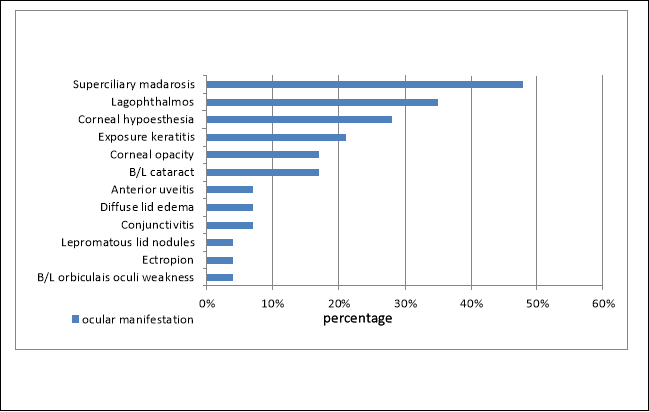
Out of 50 cases of Leprosy, 58% had ocular involvement and majority were of the age group 21-40years. Ocular involvement was predominantly seen in Lepromatous type with 35% having ocular lesions. The most common ocular manifestation observed was superciliary madarosis(48%). Potentially sight threatening lesions accounted for 72.4% of which lagophthalmos was common. No cases of blindness seen.

Conclusion:

Visual impairment is preventable in Leprosy if detected early. The risk of ocular complications increases with the duration of the disease, despite being treated with systemic anti-leprosy drugs.


Keywords:

Leprosy (Hansen’s disease), lepromatous, tuberculoid, slit skin smear, ocular involvement


INTRODUCTION

Leprosy or Hansen’s disease is a chronic infectious disease caused by an intracellular rod shaped acid fast bacilli Mycobacterium leprae which affects the skin, nasal mucosa, peripheral nerves and the anterior segment of the eye.

1

Mycobacterium laprae was discovered by a Norwegian physician G.Armauer Hansen in the year 1874.

1

The most ancient writings of ‘’SUSHRUTA SAMHITA’’ compiled in 600BC refers to leprosy as Vat Rakta or Vat Shonita and Kushtha

2,3

. Leprosy occurs in all ages and both sexes. Male: Female ratio is 2:1

4

. Leprosy bacilli has a predilection for neural tissue and their target is Schwann cell. The fate and type of leprosy depends on the resistance and immunity of the affected individual

5

( Jopling, Mc Douglass 1996). There are 11million cases throughout the world and about 1/3

rd

have ocular manifestations.

6

Prevalence of blindness due to leprosy is 4.7% of the population in India.

7,8

Various studies shows ocular involvement in Leprosy patients. The frequency and types of involvement depends on the duration and form of the disease.

2,9

Ocular lesions are common in lepromatous type of leprosy and presents with lepromatous nodules, conjunctivitis, keratitis, pannus, scleritis and uveitis. Lesions are rare in Tuberculoid type of leprosy and are secondary to the involvement of branches of facial nerve which presents with paralytic lagophthalmos, exposure keratitis and neurotrophic keratitis. Acute iridocyclitis and scleritis are seen in type 2 lepra reaction occurring in lepromatous leprosy.

6

Blindness has been reported in 7% of patients secondary to lagophthalmos, uveitis, exposure keratitis and cataract

8

. Proper attention and early detection can prevent potentially sight threatening lesions.


MATERIALS AND METHOD

The present study was carried out in the out patient Department. of Ophthalmology and In patient department of Dermatology at Meenakshi Medical College and Hospital, Kanchipuram from March 2012-May 2014. In this study a total of 50 patients were taken, 38 males and 12 females of the age group 20years and above . Prior to the study an informed consent form from the patients and ethical clearance was obtained from the Institutional Ethics Committee.

Inclusion Criteria:

All diagnosed cases of leprosy. Old and new cases, both genders and age group of 20 years and above.

Exclusion Criteria:

Non compliant patients, Patients with pre existing ocular disorders due to other causes than leprosy.


Type of study

: A cross sectional descriptive study for a period of 14 months.

P

rocedure

: Relevant details of both ocular and systemic history, including details of lepra reaction and clinical examination of patients was recorded on a proforma. A detailed slit lamp examination of the anterior segment of eye was done. Visual Acuity recorded with help of Snellen’s chart

10

. Corneal sensation was checked with a wisp of cotton. IOP was recorded with help of Schiotz tonometer

10

. Fundus examination with 78D and IDO done. Lab investigations like haemogram, ESR, Urine routine and RBS done. Slit skin smear and skin biopsy from the ear lobe was performed by the Dermatologist and report obtained as positive for M.leprae (Ziehl Neelsen technique)

11

. Patients were started on systemic anti leprosy drugs(multi drug therapy) and treatment for lepra reactions. Patients with ocular manifestations were treated accordingly to their need of Lubricant eye drops, topical antibiotic with steroid drops, eye ointments, frequent blinking exercises, physiotherapy, lid taping at night time and spectacle correction.


RESULTS:

In this study of 50 patients with leprosy, majority belonged to the age group of 21-40years (46%). 76% were males and 24% were females. Out of 50 cases, 30% were tuberculoid type, 22% lepromatous type and 48% borderline type. Out of 50 cases 58% had ocular involvement in which 45% were within the age group 21-40years. Out of the 29 cases with ocular involvement 72% were males. 35%with ocular manifestations were of lepromatous type of leprosy. 41.4% gave a positive history of lepra reaction. The ocular involvement was directly proportional to the duration of leprosy. 55% had leprosy more than 5 years. Superciliary madarosis (48%) was the most common ocular manifestation. The potentially sight threatening lesions were Lagophthalmos(35%), seen more in lepromatous type(14%). 28% had corneal hypoesthesia, 21% with exposure keratitis, 17% had corneal opacity, anterior uveitis and conjunctivitis each accounted for 7%. It was interesting to note that 60% of patients with lagophthalmos had exposure keratitis.


DISCUSSION:

The involvement of eyes in leprosy is due to infiltration of the tissues by the bacilli and damage to the nerves

12

. In this study 58% of the patients had ocular involvement. This can be compared to other studies of Wani.S.et al 2005 which showed 69% of ocular involvement, Gnanadoss A S et al 1986 showed 59.2%

13

. Studies conducted by Shields shows 33% of potentially sight threatening lesions which included keratitis, iritis, lagophthalmos and secondary glaucoma

14

. In our study the potentially sight threatening lesions were lagophthalmos, exposure keratitis, uveitis, corneal hypoesthesia and corneal opacity which accounted nearly for 72.4%. Majority of the patients in our study were of the age group 21-40 years and male predominance was seen in both for, affected eyes with leprosy(76%) and ocular involvement (72%). This can be compared with the study by Wani.S et al (82.6%)

12

which also showed predominance for men. This study further shows that ocular manifestation were seen more in lepromatous leprosy (75.36%) followed by borderline(14.49%) and tuberculoid leprosy(10.14%)

12

. In our study conducted, ocular involvement was 35% in lepramotous, 31% in borderline and 17% in tuberculoid type. The reason being that M.leprea has a favourable environment in the anterior segment of the eye and the bacilli is found more in lepromatous type of leprosy. Madarosis was the commonest ocular manifestation in our study which was about 48% when compared with Shield’s 1974(54%)

14

and Acharaya B P (59.2%)

15

and Wani.S. et al (72.46%)

12

. Lagophthalmos accounts for 35% in our study when compared to Wani.S et al (28.98%)

12

, Acharaya B P (34.3%)

15

, Lamba et al 1983 (13%)

16

, Shields 1974 (29%)

14

and Weerekon 1972 (27%)

17

. Lagophthalmos is commonly associated with lepra reaction in the face and damage to the facial nerve and also depends in patients with lepromatous leprosy(14%) which is similar to the observation by Wani.S et al (18.84%)

12

. In this study corneal involvement was seen in 66% of the patients, corneal hypoesthesia 28%, exposure keratitis 21% and corneal opacity in 17%. In the study conducted by Wani.S et al corneal involvement (36.23%)

12

. Radhakrishnan N et al observed that the major cause of blindness in leprosy was exposure keratitis due to lagophthalmos(23%) and leucoma (25%)

18

. Cataractous changes in lens was seen in 17% of the patients, but it was not a complication due to leprosy or MDT but merely due to senile lens changes in the older age group of the patients in our study. This is also supported by the study from Gnanadoss A S et al

13

. Iris pearls seen in anterior uveitis are said to be the pathognomic of leprosy

19,20

. But in our study uveitis was observed only in 7% of the patients when compared to Wani S et al

12

which showed 31.88%. This probably is due to the small sample size of our study and also the duration of leprosy not being more than 10 years for all patients ,because uveitis is seen mostly in chronic cases of leprosy. This is supported by various studies like Lamba 1983

16

(14%), Hornblass 1973

21

(16%) and Gnanadoss A S et al 1986

13

(5.6%). In this study all patients with ocular manifestations were either treated formerly(58.6%) or presently (41.4%) with systemic anti leprosy drugs. Courtright et al suggested that ocular pathology will still occur in MDT treated leprosy patients

22

. Thus treatment does not prevent the occurrence of ocular lesions

12

. Moreover once the patient is on treatment the ocular reaction is seen more in the first 6-12 months due to reactions

23

. The progressive leprosy related lesions are the result of chronic nerve damage.


CONCLUSION:

The risk of ocular lesions increases with the duration of disease, lepra reaction and facial patches in this reaction. Screening of all patients affected with leprosy can help in identifying the potentially sight threatening lesions which can be treated earlier. Visual impairment if detected early is preventable. The Multi Drug therapy for leprosy has improved the outcome of the affected with leprosy but does not retard the development of ocular complication.


LIMITATIONS:

Owing to the small sample size in this study many other ocular manifestations could not be assessed. A relationship between uveitis, Complicated cataract and leprosy can be suggested if the patients presents with a longer duration of leprosy more than 10 years, as in this study we had only 4 patients in that category.


ACKNOWLEDGEMENT

It is with the sense of accomplishment and deep gratitude that we dedicate the work to all those who have been instrumental in its completion.

We are greatly thankful to the RMO, Meenakshi Medical College Hospital and Research Institute, Kanchipuram. To our Associate Professors, Assistant Professors, Colleagues and Staffs of the Department of Ophthalmology and Dermatology for their timely help, support and constant guidance in our work.


REFERENCE

1.Lewallen, Paul Courtright. An overwiew of ocular leprosy after two decades of multidrug therapy. International Ophthalmology Clinics – world blindness. Sept2004, vol47(3):87-99.

2. Dharmendra. History of spread and decline of leprosy. Leprosy.Vol I, Bombay: Kothari Medical Publishing House,197;7-21.

3. Rastogi N, Rastogi RC. Leprosy in ancient India. Int J Lepr 1984;52:541-3.

4. Park K. Epidemiology of Communicable Diseases. Park’s Textbook of Preventive and Social Medicine. 17

th

edn., Jabalapur: M/S Banarsidas Bhanot Publishers, 2002; 242-253.

5. The disease In: Handbook of Leprosy, 5

th

edn., Delhi CBS Publishers and distribution; 1996;10-53.

6. Sihota. Tandon disease of uveal tract. Chapter 17.Parsons’ Diseases of the Eye,20

th

Edition. New Delhi. Elsivier 2007;239-72.

7. Thompson Allardice et al, Patterns of ocular morbidity and blindness in leprosy: Leprosy review vol 77(2) June 2006.

8. Ffytche TJ. Residual sight threatening lesions in leprosy patient completing Multidrug therapy and Sulphone monotherapy, Lepr. Rev, 1991;62: 35-43.

9. Mark J. Mannis Mascai, Arthur. Leprosy, chapter 62. Eye and skin disease, Lippincott- Raven publishers, 1996;543-50.

10. “Orthoptists and Prescribing in NSW, VIC and SA”. The Royal Australian and New Zealand College of Ophthalmologists. Retrieved 29 July 2010.

11. PVS Prasad. Microbiology. In: all about leprosy. 1

st

edn. Jaypee brothers publishers,2005.pg 4-11.

12. Junaid S. Wani, Saiba Rashid M.S. Ocular manifestations in leprosy- A clinical study; JK- Practitioner 2005; 12(1): 14-17.

13. Gnanadoss AS, Rajendran N. Ocular lesions in Hansen’s (leprosy). IJO 1986;34:19-23.

14.Jerry A Shields; George O; Waring; AJO,1974,77;880-890.

15. Acharaya B P. Ocular involvement in Leprosy- A study in mining areas of India. IJO 1978; 26:21-4.

16. Lamba PA; Arthanariswaran: Leprosy India 1983,55;490.

17. Lloyd Weerekon: BJO. 1972,56;106.

18. Radhakrishnan N, Albert S. Blindness due to leprosy. IJO 1980;28:19-21.

19. Ffytche. T.J., 1981, Trans. Ophthal. Soc. U.K. 101:325.

20. Hogeweg, M. & Leiker, 1983, Brit J Dermat.109:477.

21. Albert Hornblass: AJO.1973,75;478.

22. Courtright. P., Lu Fang Hu. Multi drug therapy and eye diseases in leprosy. A cross sectional study in People’s Republic of China. Int . J. Epidemiol. 1994;23(4):835-42.

23. Dr. Margreet Hogeweg, Prevention of Blindness due to Leprosy. ICEH,

http://www.iceh.org.uk

.

Why is there a divergence in medical education between allopathic and osteopathic medicine?

Why is there a divergence in medical education between allopathic and osteopathic medicine?

• You should be asking a very specific research question related to one of the health care service delivery systems we discuss in the course. Your project will

endeavor to answer. (Example: Why is there a divergence in medical education between allopathic and osteopathic medicine? Or: What are primary care physicians doing to

actively address the epidemic of Type 2 diabetes in the US?) These are just examples. You should develop your own question.
• You need to develop a fully articulated outline describing your project, turn it in to Dr. Conrad for comment (ungraded). It will then act as a template for your

project.
• You should take full advantage of research resources such as library publications, internet sources, and databases of literature.
• Please do not use sources more than five (5) years old and stick to books or journals that are either peer reviewed or technical with editorial oversight.
• Your final paper for the project should be approximately 15 pages long, exclusive of the bibliography, exhibits or appendices. It should be fully cited (rule of

thumb: when you use more than 7 words of someone else’s writing in the same context, you must cite it, otherwise it is plagiarism.) Please use a standard footnoting

style and be consistent throughout the paper.
• All papers should be typed, double-spaced, in no smaller than a 12 point font win one inch margins. Please number all pages. Any graphs or tables should be included

in the text of the paper at the appropriate places.
• Check all grammar and spelling before submitting the paper. A spell/grammar checker in a word processing program should catch any problems. You must correct all

problems. Be especially watchful of using passive voice. This is not a good practice in writing and should be avoided. Please refer to the Strunk and White book for

clarification of passive voice and how to avoid it.

Two books to assist in conceptualizing and formatting your paper:

A Manual for Writers of Term Papers, Theses, and Dissertations, Kate L. Turabian, Revised by John Grossman, University of Chicago Press, February 1996 or newer.

(older, inexpensive copies should be available on Ebay or other resellers sources, or in a library.)

Elements of Style, Stunk and White, Longman; 4th edition (August 2, 1999) or newer.

Both are extremely helpful in giving direction of how to conceptualize and write a term paper. In addition, the “Turabian” gives methods of citation, using methods in

the text, footnotes, or endnotes. Both books have been around for quite some time and may be available in the library.

OUTLINE FOR THE PROJECT
(Note: although I am giving you a basic outline for the project, that you should follow for the structure of the final paper, you must write the final paper using

paragraphs and full sentences. No papers using bullet points and incomplete sentences will be acceptable and will go back to the student, ungraded. If you are confused

about what a research paper should look like in a graduate class, please go to the Center for Learning Resources, on the UNH campus, to receive tutoring in this

practice.)

I. Introduction
a. State why the question you have chosen is important
b. State why the reader should be interested in your question and topic.
c. Finish the section by stating what you intend to find and what the goal of answering your research question should be.
II. Literature Review
a. You should read as many articles as possible, from scholarly journals exclusively, that are no longer than five years old, and write a few pages discussing what the

authors say and how their viewpoints may vary.
i. If you cite something from the article that is seven words or more of someone else’s writing, even if it isn’t a direct quote, you must give a citation. This can be

either in a footnote, endnote, or in the text. Styles of citations are presented in the Turabian book and in several online sites.
ii. You must be consistent in your citation style.
b. Books are also good sources of information, but should not be older than five years, and should be cited in the same way as scholarly articles.
c. DO NOT use popular publications or websites that are not submitted for peer review scrutiny. They are not trustworthy. A reference librarian in the library can help

you with this matter, if you are unclear.
III. Analysis and Consideration
a. You should consider the literature and the various points of view and discuss them in this section.
b. You should factor in any factual knowledge you may also have, such as disease rates, population numbers, expenditure amounts, etc. (again if you present such

information, you must give a citation of a source.)
c. Discuss what you think the correct point of view may be and why, based on the material you have already presented.
IV. Conclusion
a. Given your review, consideration, and analysis of the material you have researched, what is your conclusion and therefore the answer to your original research

question? Present that in this section with evidence from your research as to why you have made this conclusion.
b. Based on what you have found out, what new avenues of research should follow? Discuss where future researchers should place their efforts in this area, in our

opinion.

The Role Of Theory And Practice Facilitated By Reflection Nursing Essay

Question

“Dewey (1938) stated that all genuine education comes through experience. Certainly, in practice-based professions such as the health care professions, clinical experience should be the basis for learning. To extract learning from experience, we need to create meaning from our experiences as we interact with and react to, them. We cannot allow any experience to be taken for granted; once we do so, actions become routine and habitual, we stop noticing and enter into a rut” (Stuart 2007).

Critically discuss this quotation by focusing on the complexity of learning in practice, the complexity of supervisory process and the end goal of creating a competent practitioner.

Table of Contents

Introduction

It is in the interest of both the university and the clinical areas to ensure that newly qualified nurses are perfectly competent to take on the responsibilities of their new jobs. The big question is; which area should play the best part in ensuring that this feat is accomplished? Conversely, could it be a perfect balance between the two domains? Considering the changing face of nursing education to keep up with modern times, it is also useful to contemplate the challenges that students and educators, both academic and clinical are faced with. In order to establish if the goal of producing a competent practitioner is reached, it is important to determine what exactly constitutes a competent practitioner. As a final thought the concept of competency shall be pondered to see if it is sufficient to produce competent professionals when today’s employers demand high standards and excellency of care.

The changing nature of nursing

Countless times nursing has been referred to as both an art and a science. Clearly, this is to delineate that it is a combination of both academical knowledge and practice skill. Through the years nursing education has shifted from hospital training (skills) to higher education (academic) namely university baccalaureates, masters and also doctorates (Wilson, 2008). Jarvis (2005) explains that this change is occurring because nursing is undergoing a process of professionalization (professionalism). Another important change is that, whereas the student nurses before were all young recruits nowadays the classroom is a mixture of ages either due to mature students entering nursing or due to continuing education (Jarvis, 2005). These adult learners may thus have different learning needs. The fact that nursing has distanced itself from the medical model, in favour of a holistic, patient centered approach, it has also inevitably changed the way nurse education is planned and delivered nowadays. Alongside the study of anatomy and physiology, nurse educators had to include the nursing process and humanistic subjects like the concept of care, psychology, sociology and ethics.

Meurier, Vincent & Parmar (1997) maintain that this process was necessary for nursing to become an autonomous profession that has research underpinning its practice. Evidence based practice became a means of gaining credibility with both clients and other professions. Greater autonomy has been given to nurses locally by the issuing of the nursing warrant. However, autonomy also translates into increased accountability. Patients abroad are now personally suing individual nurses when they are thought to be personally responsible for errors. Never before has it been more important to produce competent, efficient and effective nurses in order to avoid costly litigations and avoidable patient suffering and harm. The emphasis is now on which type of learning is best at producing competent nurses, theoretical, academic or possibly a mixture of both.

The great debate

One of the main objectives of this assignment is to critically discuss the quote provided. In this quote Dewey is said to put great emphasis on the role that experiences plays in providing a genuine education. Experience is defined in the Longman (2010) dictionary as “knowledge or skill that you gain from doing a job or activity”. Experience is an important component of practice development (Lyneham, Parkinson & Denholm, 2009). However, nursing is not only about doing but also about thinking.

In the quote provided, Dewey’s seems to be subjective when he omits to recognize the role that theory plays in the learning process. However Dewey, in his own book states that “the belief that all genuine education comes about through experience does not mean that all experiences are genuinely or equally educative” (Dewey, 1998, p. 13). Knowles, Holton III, & Swanson, (2005) believed that many Dewey’s ideas were misinterpreted through the years and emphasised the importance of direct quoting. Hence, to evaluate properly Dewey’s quote, one must assess it in the whole context not just a short quote. Peplau (1988, p. 13) asserts that the art and science aspects of nursing should always be kept “interconnected if not inseparable”. This statement suggests that experience and academical knowledge, should complement each other in order to achieve optimal learning. The clinical environment is a rich learning ground full of learning opportunities. On the other hand, this knowledge can be in a tacit form and hard to translate into words. Eraut (2004) maintains that when these situations arise, the practitioner needs to find alternate ways of unlocking and sharing this knowledge. Reflection, which is widely taught in nursing curriculae nowadays may be a means of articulating knowledge that is embedded in practice (McBrien, 2006). Thus, this is an example of theory complimenting experiential learning. Furthermore, without nursing developing its own theoretical body of knowledge the quest for professionalization would have been unreachable. In order to advance the nursing profession and provide the tools to increase the body of knowledge, critical thinking and research modules have been added to the nursing curriculae. This enabled nursing to move away from the dominancy of other professions and empowered nurses to be able to make their own competent decisions based on well researched evidence.

Clinical experience includes also the practicing of skills, which are primarily learnt through role modelling strategies and perfected through repetition thus increasing competence. Consequently, habitualisation runs the danger of becoming a ritualistic practice when it is taken for granted and done without thought (Stuart, 2007). Heath and Freshwater (2000) regard proficiency in skill, achieved through repetitive practice as positive. They explain that nurses will require less thought whilst performing procedures and their attention may be dedicated to answering the patient’s questions or observing his behaviour. However, practice without reflection truly risks becoming a rigid, habitualised and ritualistic vicious circle.

Experience is not just about performing skills well and in good timing. It is also an opportunity to be faced with different clinical situations and challenges that equip the nurse with the necessary knowledge to deal with similar situations in the future. A report compiled by the Department of Health (1999) entitled Making a difference outlined that many newly qualified nurses lacked the necessary skills to function as confident and competent practitioners in their new professional roles. Therefore, although nurses might possess the academical knowledge to pass their final exams, they lacked the experience to operate confidently on the wards. Another shortfall was that newly qualified nurses were observed to lack the critical thinking skills necessary to function in the increasingly complex clinical environment (Aronson, Rosa, Anfinson & Light, 1997). Many argue that this is the result of the shift from hospital based training to university centered education, creating the theory practice gap phenomenon (Evans, 2009). In the following paragraphs, the theory practice gap and means of reducing it shall be discussed.

Theory- Practice Gap

In the past, nurses had more clinical hours than study hours as part of their nurse education. Furthermore, the students of the past were counted as part of the nursing compliment. This may explain why they found the transition from a student to qualified nurse less problematic. However, this kind of training sucked the students into a circle of ritualistic practice concentrating on efficiency rather than effectiveness. In contrast today’s student is provided with all the theoretical knowledge to ensure that practice is guided by evidence thus shifting the balance onto effectiveness. Wilson (2008) explains that teaching should not just be the imparting of facts but that students must learn how to adapt this information to each unique clinical setting. Therefore, it is empirical to bridge the gap between what is known and what is practiced.

The gap between theory and practice is not something of the present and will persist through the ages. Haigh (2009) considers this gap to be important as it portrays nursing as a “vibrant and dynamic profession” (p. 1). Notwithstanding this, the theory practice gap has inspired theorists to introduce learning models in the clinical environment and mostly included the participation of a clinical supervisor (Beinart, 2004 and Lynch, Hancox, Happell, & Parker, 2008). Furthermore, no model has managed to eradicate the theory practice gap (Baxter, 2007). Whichever model may be used, the importance of having a clinical supervisor with exceptional qualities must not be overlooked.

An advantage of the local nursing scene is that although the Institute of Nursing has now become a faculty, its basis is still within the general hospital. The significance of this is not only that the two domains are not physically separated, but that also academical staff and other resources such as the library are easily accessible. However other measures are also necessary in order to amalgamate theory and practice. The areas of reflection and clinical supervision as a means of reducing the gap shall be discussed in the following paragraphs.

Reflection and learning

Schön (1983) in his book regarding the reflective practitioner states that reflective practice enables a person to learn from both his actions and experiences. Jarvis (2005) maintains that the role of a teacher may include facilitating reflective practice for practitioners in order to “crystallize” the ideas generated in practice. Moreover, Schön established that nurses reflect upon their actions and through this, knowledge about practice is generated as opposed to just the application of knowledge to practice. Rolfe (1997) supports this statement by asserting that reflective practice is a systematic and thoughtful process that allows nurses going about their daily work to make sense of their practices. Reflection is a means of identifying areas that need improvement. However, reflection should also take place in instances that went well to identify the key principles that contributed to success. Surgerman, Doherty, Garvey and Gass (2000) point out that if reflection is taken away from practice, the practitioner might not be able to learn from these experiences.

Unfortunately staff shortages and the overcrowding of wards often leave little time for nurses to think (Weaver, Warren & Delaney, 2005). However, this should not be an excuse not to engage reflective practice. Reflection on action may be more suitable and should be greatly encouraged amongst supervisees as a means of making sense of practices being undertaken. This form of reflection was also used by Florence Nightingale as a means of generating knowledge from practice and the start of evidence based practice (McDonald, 2001). Another way would be to organise group reflections. The group may include a mixture of supervisors and supervisees in order to facilitate discussion and the sharing of knowledge (Lee, 2009). The process of reflection is also very useful in helping students and qualified staff alike to develop critical thinking skills. Further on, a problem solving attitude may be instilled, which is a valuable tool for the nurses in their career (Jarvis, 2005) thus leading to the development of a competent practitioner. The generation of ideas from reflection is not sufficient. The greatest challenge is to put these ideas into practice. Clinical supervisors can be an asset in helping students to engage reflective practice whilst helping them articulating and implementing the ideas generated.

Clinical supervision

Wong and Lee (2000) define the roles of clinical supervision as to help students develop their clinical skills, help to bridge theory and practice and assist students with their socialisation into nursing. McBrien (2006) states that clinical supervision acts as an extension of classroom teaching. In other words, the clinical supervisor works alongside the university to maximize the educational activity gained from the ward experience. In the wards, the supervisor, helps to safely monitor students, whilst they practice what they have learned in the classroom thus bridging the afore mentioned gap. Supervisors may teach supervisees by being good role models, and help novice students acquire knowledge through emulating their behaviour. As supervisees progress the supervisor must then give greater freedom to the student whilst challenging their practices in order to develop their reflective and critical thinking skills. Supervisors must be well prepared and supported (Lynch, Hancox, Happell, & Parker, 2008). Furthermore, their practices have to be grounded in evidence as supervisees at this stage will healthily challenge what the supervisor is imparting.

Supervision takes up different forms in different hands “depending on the intent and emphasis of the supervisor” (Johns 1996, p.1142). Staff shortages, overcrowding and high patient turnover may result in ward nurses looking at students in an inappropriate manner, especially if supervision was forced on them. Consequently, they may look at students as a burden, an extra duty or a waste of their free time. Moreover, they may view them as an extra pair of hands which can be easily manipulated to do their every bidding. McBrien (2006) warns that faced with such negative attitude student nurses may be inclined to abandon their learning objectives in order to fit in. Furthermore, nurses may be hostile and uncooperative towards their colleagues who are trained clinical supervisors who take on students for supervision in their wards.

The clinical supervisor thus has an important role in creating an environment conducive to learning on the wards. This should include measures to make students feel welcome and accepted by the rest of the ward staff in order to safeguard the student’s self esteem and potential for learning (Franke, Garssen, & Huijer Abu-Saad, 1995). Moreover, good relationship is of utmost importance in obtaining the desired goals in the supervisory process. The relationship between the supervisor and the supervisee is the key for successful clinical supervision (Lynch, Hancox, Happell, & Parker, 2008 and Sloan, 1999).

The above points strongly indicate that clinical supervisors have to be willing and dedicated to undertake the teaching role in the ward. Supervisors must undergo specialised training. However, in order to move a further step, full collaboration with the academic body has to be in place. Sloan (1999) stated that on-going training for supervisors helps them to construct their own supervision models, to develop interpersonal skills and facilitate supervisory support besides others. One training module is not enough to last a life-time, hence update courses and meetings should be held yearly. By this means not only knowledge is updated but also an opportunity for the sharing of ideas is provided. Introducing regular meetings with the academic supervisor ensures not only a bridging of the theory practice gap but also that the desired student goals are made clear and achievable.

Unfortunately, the number of nursing students by far outnumbers the amount of clinical supervisors who have been formally trained. This lack of supervisors may be the result of the absence of a good reward system such as monetary or professional. Alternatively, the quality of supervision might deteriorate with its introduction. This can be due to applicants applying for the rewards, rather than a keen interest in supervision. In this event, a rigid vetting process and performance appraisal should be introduced. The concept of collaborative learning has been explored by Jeffries (2005) as a means of compensating for the lack of supervisors. The main advantages were an increased sense of teamwork, student bonding and richer discussions. However, Evans (2009) points out those students who are less eager to participate may hide within these groups thus limiting the development of their potential. Moreover, large groups may contribute to certain students getting away with not performing duties that they might consider not to their liking (Evans, 2009).

An important role that the clinical supervisor must play, which is sometimes overlooked is the development of self awareness. Heath and Freshwater (2000) maintain that the supervisor must help the student to develop an awareness of self, and an acceptance of responsibility for one’s own actions. Thus the supervisor must instil the concept of accountability, which greatly contributes to the development of a competent practitioner. Todd & Freshwater (1999) assert that through this process the supervisee becomes less dependent on the clinical practitioner because an internal supervisor is developed. Hence, the supervisee develops a professional conscience whilst becoming more capable to assume more responsibility for one’s own learning. When this is achieved, the seed of life-long learning is planted ensuring that the supervisee will continue to self direct learning even after graduation. Jarvis (2005) states that if this had to be universal for all students, continuing education programmes could be drastically reduced.

Competent practitioners

Weaver, Warren and Delaney (2005) explain that nursing care affects a range of health care outcomes namely; mortality, morbidity and costs. For this reason, an emphasis is now being placed on high quality care, avoidance of errors, cost effectiveness and elimination of wastages. A competent practitioner is someone who is able to conduct tasks safely on their own. Moreover, competency is defined by the Nursing Council of New Zealand, (2008, p.12) as, “the combination of skills, knowledge, attitudes, values and abilities that underpin effective performance as a nurse”. Conversely, Lofmark, Smide, & Wikblad, (2006) state that competency must be achieved in all areas and not just in clinical and technical skills. Furthermore, it is difficult to find a person who is competent in all areas. Having stated all this, a doubt arises, whether being a competent practitioner is enough to meet these growing healthcare demands.

Nurses are faced daily with items that are out of stock, staff shortages and unexpected and unplanned occurrences. In these situations, knowledge and standard practice are not sufficient to meet healthcare demands. Heath and Freshwater (2000) explain that a nurse that goes beyond the competent phase not only can demonstrate greater technical proficiency but is also able to correct and adapt her actions according to the unfolding situations. Benner (1984) asserts that for competent practice to become proficient, a qualitative change must occur. Benner, Tanner, & Chesla, (2009) believe that some nurses may never develop beyond the competent stage. Given the complex clinical situations that every single nurse is faced daily on the wards, this transition should be avidly cultivated. Improvisations and solutions must be effected in order to ensure that patients still receive good quality care. Drawing up on past experiences, knowledge new or old and utilizing reflection and problem solving skills are a means of coming up with new solutions. The clinical supervisor is an invaluable asset in helping the supervisee to make this transition. This can be done by being a role model, providing meaningful experiences that can be utilized in future practice as well as supporting the supervisees in developing their own problem solving skills.

A universal responsibility

Although an emphasis has been made that the clinical supervisors should be formally trained, every single nurse in the clinical setting should take an interest in the education of student nurses. These same students will in the future become nursing colleagues and further on nursing administrators and lecturers. Making sure that they receive the best possible education is a means of safeguarding the future of nursing. On a more egoistical note, these same students will be the nurses in the wards taking care of us and our loved ones. Therefore, ensuring that they develop their full potential is a guarantee of receiving excellent quality care to the highest standards.

Conclusion

It has been established that experience and theoretical knowledge both play a pivotal role in the formation of competent practitioners. The phenomenon of the theory practice divide occurs, when academical knowledge is not successfully adapted into the working environment to achieve meaningful practice. In order to bridge these gaps important assets were identified namely clinical supervision, experience and the use of reflection. Clinical supervision is a challenging area of nursing that should involve specific training and utmost dedication. Collaboration with the academical supervisors ensures that the goal of achieving competent practitioners is achieved. However, exceptional practice should be the ultimate goal that should be shared by all clinical practitioners in order to safeguard the future of nursing.

“Do we have everything we need on sales and costs?”

“Do we have everything we need on sales and costs?”

“Do we have everything we need on sales and costs?” you ask. ”It must be time to compute the net present value (NPV) and internal rate of return (IRR) of the Apix expansion project.”
“We have the data from James and Luke regarding projected sales and costs, respectively, for the food packaging project,” says Mary. “It is feasible to project that we will receive a tax break from this implementation. I have information from our audit firm that indicates that future depreciation methods for taxes will be straight-line; however, the corporate rates will be reduced to 35% as we assumed in our weighted average cost of capital (WACC) calculation.”

People Who Undergo Amputation Experience Many Emotions Nursing Essay

People who undergo amputation experience many emotions. In Graces case, she may experience anxiety with emotional outburst not only due to the pain and physical loss of a limb, but also what effects the amputation will have on her in terms of career, family life and socialization. Some possible reactions Grace may experience include sadness, anger, grief, anxiety and depression.

Following an amputation, the patient may experience post-surgical pain, swelling or an infection which could be one of the reasons why Grace is anxious. Physically, an amputation may change her ability to carry out the tasks that she was previously capable of doing. Changes in her ability to walk and mobilize may also mean that it is more difficult for her to get out to socialize with others in her community or ability to work and maintain a career. This can cause considerable frustration and sadness as there will be a loss in independence and her ability to perform activities of daily living may be reduced.

Grace may also experience a distortion of body image which can affect her image within her community. The appearance of the residual limb may make Grace self-conscious, embarrassed and concerned with her sexuality because of her appearance. Certain cultures and religious beliefs may view individuals with amputations as being of a lower status (Paul H. Lento Md, n.d.). It’s possible that Grace might also face isolation due to her cultural background and how her family and community respond to amputation.

After an amputation, Grace will probably go through several psychological stages. It is essential that she goes through the grieving process and that you acknowledge and understand the process as she is going through each stage (Morris, 2008).

Describe the needs Grace may experience

Physical

During this early stage of recovery, Grace may experience difficulty with her mobility and may require basic but important needs like getting positioned in the bed; transferring from bed to chair and back; balancing when standing; and using crutches, a wheelchair, or wearing a prosthetic.

During rehabilitation Grace may begin an exercise program and moving around without prosthesis. She may have a prosthetic limb fitted if she wishes. This artificial device can be very beneficial to someone like Grace who has lost a significant body part, the leg. It can physically provide greater and more efficient mobility.

Pain control is another important area. Grace will need assistance from a physical therapist and a prosthetist (is she’s a prosthetic user) to teach her how to care for the residual limb to promote healing, how to wrap it to reduce swelling and how to clean it to avoid infection.

Psychological

Psychological counselling and therapy may be needed to help Grace adjust emotionally. It may also be helpful for her to discuss many of the challenges of having an amputation, both physical and emotional, with a person who has already had an amputation. This may provide a sense of hope and acceptance as well as allow her to ask questions about what it is like to live as an amputee, while also learning tips on how to function in society.

Local support groups may be helpful for Grace to meet others who may be going through similar experiences. Individuals in these groups may not only assist with tips on how to adapt to an amputation but may also serve as a peer for others with this new disability.

Social

Changes in Graces ability to walk and mobilize may mean that it is more difficult for her maintain a social life. Some areas concerns include: socializing with family and friends, return to or maintaining employment, social acceptance in her community, and sexual adjustment.

Hence, Grace will need both physical and emotional support from family, friends and other amputees who have experienced these difficulties in the past who will be able to offer encouragement for you to try and return to the community. She may also require help from social services to assist her back into the community.

Cultural

Grace’s cultural background may influence how others such as the health care team and family and friends respond to her amputation. Therefore it’s important that the health care team members acknowledge and understand the cultural significance of her amputation. This will enable them to be more sensitive to her specific needs. For example, Grace may need an interpreter or a social worker of aboriginal background to help her communicate.

Communicating with Indigenous People

Use clear, uncomplicated language. Do not use jargon.

Employ bicultural workers or interpreters

Respect, acknowledge, actively listen and respond to the needs of Aboriginal people in a culturally appropriate manner. Acknowledge their beliefs and practices. Avoid stereotypes. Be honest.

Be aware and respectful of relevant extended family and kinship structures when working with Aboriginal people. Ensure that extended family is included in important meetings and in making important decisions.

Display Aboriginal visual and written material where possible.

Don’t mimic Aboriginal speech patterns or attempt to speak Aboriginal English as a way of encouraging an Aboriginal person to be more open.

Respect the use of silence and don’t mistake it for misunderstanding a topic or issue.

Always wait your turn to speak.

Always consult with Aboriginal staff/people if unsure.

Be aware that words might have different meanings in different communities.

(NSW Department of Community Service, 2009)

Learning program to assist mobility – “getting dressed”

Self Care Deficit: Dressing

Related to immobility as evidenced by impaired ability to put on or take off clothing.

Goals:

Demonstrate increased ability to dress/groom self.

Demonstrate ability to cope with the necessity of having someone else assist him/her in performing the task.

Demonstrate ability to learn how to use adaptive devices to facilitate optimal independence in the task of dressing/grooming.

Identify skills and abilities to be developed:

Patience

Walking

Strength and flexibility

Learn new ways to get dressed

Have good balance – As a new amputee, Grace has lost a percentage of your body weight during your amputation and you will need to learn how to redistribute your weight accordingly.

Learning how to fall and get up – Since falling is something she probably will encounter, learning the proper techniques that minimize injury to your body and to the artificial limb is important.

Determine the most effective teaching strategies:

Actively listening to the client.

Allowing sufficient time for dressing and undressing, since the task may be tiring, painful, and difficult.

Providing privacy during dressing.

Assisting patient in removing or replacing necessary clothing

Choosing clothing that is loose fitting, with wide sleeves and pant legs, and front fasteners.

Encourage participation in program.

Promote independence in dressing through continual and unaided practice.

Demonstrating new ways of getting dressed

Gait walking exercise

Determine most effective interventions to meet social, educational and other needs:

Interventions for Educational:

Consult/refer to physical therapist or prosthetist for teaching application of prosthetics.

Plan for patient to learn and demonstrate one part of an activity before progressing further.

Maintain aseptic technique when changing dressing/caring for wound.

Instruct in dressing/wound care, skin massage and appropriate wrapping of the stump

Teach the importance of antibiotics in preventing and treating infection.

Intervention for social:

Encourage/provide for visit by another amputee, especially one who is successfully rehabilitating

Arrange social services/social worker to assist in performing ADLs.

Encourage family to participate in care.

Assess degree of support available to patient.

Demonstrate/assist with transfer techniques and use of mobility aids, e.g., trapeze, crutches, or walker.

Interventions for other needs:

Provide care preoperatively by initiating exercise to strengthen muscles of extremities in preparation for crutch walking.

Support the client through fitting, application, and utilization of prosthesis.

Allow the client to express emotional concerns.

Services available in the Community

Ambulatory rehabilitation (Victoria Government Health Information, n.d).

Consultative Medical Service

Nursing: health advice, education, counselling and monitoring

Physiotherapy: group and individual treatments aimed at restoring and maintaining the client’s maximum movement potential

Occupational Therapy: group and individual treatments, activities of daily living and home assessment

Social Work: to assist clients and their carers with the management of problems related to family, finances, accommodation or socialisation

Podiatry: diagnosis and treatment of foot and lower limb disorders

Amputee support groups

Limbs 4 Life

The Amputee Association Peer Support Program

Specialized health care services

Prosthetist – provide care for anyone requiring an artificial limb

Barriers in the community

Discrimination – The vast majority of Aboriginals with disabilities do not identify as a people with disability thus there’s significant social stigma associated with being labelled as disabled.

Issues such as being lost of mobility and independence may prevent her from participating in the wider community – E.g. Participating in employment, catching public transport or just feeling comfortable visiting the local supermarket or post-office.

Isolation due to shame and embarrassment of the way she looks. Also isolation due to her cultural background and how her family and community respond to amputation.

Issues affecting the access of Indigenous people with a disability to support services. Some of these issues relate to specific environments – such as urban, rural and remote locations

Language barriers – different understanding of the same word, the use of jargon by service providers, and different life conceptions may lead to misunderstanding and ineffective service provision

Compliance of Nurses with personal protective equipment

Introduction

The identification of clients with infectious diseases through the clinical and laboratory assessment is Possible, but not always be effective. Because the most of infectious diseases such as AIDS, hepatitis and other, the Microorganisms needs to the incubation period before appearance the signs and symptoms of disease on the clients, however, the probability of transmission of infection are possible in these is period. Therefore, any patient should be regarded as a potential source of infection (Hinkin and Gammon, 2008). Use of personal protective equipment is very important to prevent infectious pathogens transmitted from patient to nurse and the versa is true. Furthermore, correctly select and use of personal protective equipment is very effective to prevent transmission of infection, in addition to reduce the risks of exposure for infectious agents (Hon et al 2008). However, the health environment filled with hazards and pathogens because of that nurses should be use effective barrier equipment to break down any probability to contamination by infectious agent (Hinkin and Gammon, 2008).

The personal protective equipments in all contents aprons, gloves, gowns, eye protection (goggles, glasses), caps, laboratory coats, resuscitation bags and face shields/mask all of this and other, are use frequently in general care settings as very important part of standard precaution (Clark et al 2002; Pratt et al 2007).

The standard precautions developed gradually from the universal precautions (Hinkin and Gammon, 2008), which began as prevention agent to prevent transmission of blood borne pathogens to healthcare workers (Wilson 2001). Standard precautions are evidence-based guidance designed to reduce incidence of healthcare associated infection and transmission of infections in healthcare environment (Pellow et al. 2004). Also all intervention and precautions must be applied by all healthcare workers to provide professional care and safety to all health worker and patients in health environment (Pratt et al. 2007).

The Standard precautions it aim to prevent transmission of infection or at least reduce probability of transmission any infected pathogens to the lowest level between nurses and patients , also to protect the patients and healthcare workers at the same time by use standardized precautions such as personal protective equipments (Cullen et al, 2006). Damani (2003) did clarify the standard infection precautions guideline, health worker education are playing effective role to minimize major problems in the UK such as the antibiotic resistant and health care associated infections.

Furthermore, the personal protective equipments as the important part of standard precautions and playing very effective role to prevent incident of healthcare associated infections, it was identified as one of the most common complications in the health care environment, recently which affects on approximately 10% of clients admitted to hospitals worldwide (Filetoth 2003), around 4-10% between hospitals in the developed countries (Nazarko 2008). Also the rate varies from 5-15% in the developing countries (Jarvis 2007). Globally, healthcare associated infections infect a patient every two minutes and the world loses one patient every two hours because of healthcare associated infections leading to non-compliance the healthcare workers with personal protective equipments use and anther standard precautions (Chief Medical Officer’s Report 2006).

For instance, harbarth et al (2001) cleared the rate of hand hygiene compliance among healthcare workers nearly 34%, and Golan et al (2006) cleared the compliance for hand hygiene before provide care nearly 10% and 36% after provide care. Therefore, some studies suggest that the use of MMS, images, videos and online education is very effective to education the health care workers and increased level of compliance and application of personal protective equipments during practice (Pullen 2006), such as Hon et al (2008) reported the rate of hand hygiene compliance among healthcare workers post provide course when wear the personal protective equipment nearly 87% and 68% when taking off the personal protective equipments.

The main infectious occupational risks in the healthcare environment such as hepatitis B virus (HBV), hepatitis C virus (HCV) and human immunodeficiency virus (HIV). Also There are some nurses more risk to transmit or received infection for or from patient such as staff nurses in surgical or operations department, because of he or she have high chances to direct contact with blood of patient and make many of specific procedures(Ganczak and Szych, 2007).

Doebbeling et al (2003) did clarify the occupational blood exposure occurred frequently among the healthcare workers , also as stated in his study one-fourth to one-third of the respondents had injured by percutaneous blood exposure in the previous three months. Specifically, more than one-third of nursing had exposure more than one time to mucocutaneous blood in the previous three months. Also the exposure and injury rates to infection in health environment is vary differ according to the occupation, which depending on several factors such as the average of time spent in provide care for patient or treated of specimens, use of standard precautions during provide care, frequency use of certain devices and mostly never recapping needles.

Gershon et al (1995) clarify the compliance rates among healthcare workers related for the eleven items of personal protective equipments, 97% compliance rate for gloves ; 95% for disposal of sharps; and also the compliance rate is low for others items such as 62% for wearing protective outer clothing and 63% for wearing eye protection. Therefore, Gershon et al find strongly relationship between the compliances of healthcare workers and several key factors such as perception of risk; and training on use the standard precautions as the personal protective equipments.

Research questions and aims:

What is the level of compliance of nursing with Personal protective equipments use? The aim for this question is to evaluate the level of compliance with Personal protective equipments use among Jordanian nurses during provides care for patients. Also to identify the level of compliance for each tool of personal protective equipments.

What are the significant factors that lead to non-compliance with personal protection equipments use among Jordanian nurses during provides care? The aim for this question is to identify the significant factors that lead to non-compliance with personal protective equipments use during provides nursing care for patients.

Almost all nursing interventions need to use personal protective equipment frequently during provide care for patients and especially when applying sterilizes nursing procedures for patients, Because of that this study aims to:

1-to identify mainly significant factors that led to non-compliance with personal protection equipment among Jordanian nurses during provides care.

2- To evaluate the level of compliance with Personal protective equipments use among Jordanian nurses during provides care for patients.

3- To enhance the safety for patients and caregivers in hospital in the same time.

4- To explore the gaps between knowledge and practice relater to personal protective equipments among Jordanian nursing.

5- To enhance apply the standard precautions guideline for personal protective equipments among nursing.

6- To prevent transmission of infection between the nurses and patients, also to minimise incident some of major problem in healthcare environments such as health care associated infection and antibiotic resistant.

7- To provide appropriate solutions and suggestions for these is factors.

Rational of the methodology:

This study was proposed to evaluate the level of compliance with Personal protective equipments use and identify the level of compliance for each tool among Jordanian nurses during provides care for patients. Also to explore the significant factors that leads to non-compliance with personal protection equipments use. However, for the above proposed research quantitative design shall be used.

Quantitative researchers do not look to confirm a hypothesis, but looking forward to reject the hypothesis through the analysis of data and therefore development of statements through clarify of causal relationships (Phillips and Burbules, 2000). Moreover quantitative researches often start with a hypothesis related to phenomena to be tested and after the data are collected and analyses, support this is hypothesis or refute by clarify the relationship between the variables (Holt 2009). Furthermore, quantitative research is often used as a method trying to display causal relationships under controlled or standardized condition (Casebeer and Verhoef, 1997).

Quantitative research is described as the numerical representation and processing of observations and data for the purpose of describing and explain phenomena and facts that those observations reflect. On the other hand the qualitative research is defined as the non-numerical representation and analysis of observations and data; for the purpose of determining underlying meanings and discovering the patterns of relationships (Babbie 1992). As a result the quantitative research is apply deductive approach (where data are especially collected for the purpose of hypotheses, analysis and testing ideas) rather than the qualitative research is apply inductive approach (develop the generalizations and ideas Through the data ) (Meadows 2003).

Quantitative research is identified the science as objective fact or truth, different from quantitative research is identified the science depending on previous experience and thus subjectivity determined. Furthermore, quantitative research method is use numerical estimates and statistical analysis from a generalization sample related to a larger number of populations “true” (Casebeer and Verhoef, 1997). And thus the quantitative research involves experiments and surveys, where statistics and data are collected by using standardized methods such as structured interviews and questionnaires (Meadows 2003). On the other hand the qualitative research method is use narrative description and continual comparisons, are more often use to understand the specific sample or situations being studied (Casebeer and Verhoef, 1997).

Quantitative research is an effective and necessary part of healthcare services researches; the most example of this is the controlled randomized experiment research, with its importance on experimentation and large size of sample. However, quantitative researches cover a wide broader spectrum of activity, which can contain some of small-scale descriptive studies, through to more specialization and complication studies by detect and explore the relationships between variables (Meadows 2003).

Quantitative research used many of research designs for example experiments or surveys and correlational studies (Holt 2009). Also Robson (2002) classified the quantitative research to several types under the headings experimental design, quasi-experimental design and non-experimental design; however these designs sometimes are similar in several respects such as patterns of group behaviour, properties and tendencies. But meadows in (2003) classified the quantitative research strategies to two designs experimental and non-experimental designs. Also the experimental designs are characterized by the introduction or management of some variable for example randomized control trials (RCT) (Lanoe 2007). But in the non experimental designs the data are get from existing groups, for example (relational design) to consider at the relationship between a number of variables such as the scores on a pain or depression scale and age; (descriptive design) to identify the frequency and type of problem in a specific group; (analytical design) to determination why a specific group is affected although the another is not (Meadows 2003).

The qualitative studies are more complicated for generalization than the quantitative studies and more controversial. Therefore, Researchers in quantitative research rarely worry for generalizability issue. Also the goal of most qualitative studies is to present a rich of study, contextualized and considerate of human experience through the concentrated study of particular cases (Polit and Beck, 2010).

Related to my aim from this is study the quantitative design is more appropriate than qualitative design. However, the designs of quantitative research are serves the proposed aims for these is study. In addition this study when looking forward to identify the relationship between the nursing compliance and personal protective equipments, identify frequency of non-compliance of nursing for the personal protective equipments and to determine which personal protective equipments more compliance and another are less compliance. And also after analyse the data will be able to identify the significant factors that lead to non-compliance with personal protective equipments use among the nursing.

it was consider that the literature review could put in the picture the select of methodology and method for this study and also according to the objectives and aims of this study; in addition, this study looking forward to analysis of collected data from a largest size of sample from nurses through survey design. Thus quantitative design approach would be the most excellent approach to achieve my aims and objectives.

Research methodologies:

Qualitative methods

The most three data collection methods common in qualitative research are interview participant observation and focus group discussions.

Firstly, participant observation method the data collection in this method when the researcher watching interactions and acts of participants in a natural situation. Also perhaps the researcher has a role or task in the observation site in addition for his observation role (Greenhalgh and Taylor, 1997). Thus involve on the researcher use some of data collection techniques for example observation, interviewing and self-analysis and reflection. In addition the participant observation is aim to create a completely and specifically description of social interaction in a natural situation (Astin and Long, 2009). Also the researcher has more control on the participants especially about credibility issue and more aware about the less tangible aspects for example apathy and good will. But the participant observation the researcher might have complexity to making observe if involved in the location and recording data especially if working in busy situation such as hospital, the researcher lost the accuracy of observation if the participants might see the researcher make spying or threat (Lanoe 2007). In addition the participant observation techniques put the researcher under some particular pressure and ethical challenges (Astin and Long, 2009).

Secondly, interview method is defined as the interaction and effective conversation between the researcher and participant and usually is in the form face-to-face in a natural location such as participant’s home or workplace (Astin and Long, 2009). Moreover the interview can give the interviewee and researcher more flexibility to express opinions, views and make dissection. But the researchers need to have communication skills of interview; Long time to collect data; difficulty in recording, analysing and coding the information; and the interviews non-confidential are not anonymous (Lanoe 2007).

Quantitative methods:

The most common methods to collect data in quantitative researches is the survey, which approximately always uses questionnaires, structured interviews (face-to-face or telephone), or tests and scales (Meadows 2003).

Firstly, structured interview method the researcher an interviewer poses his questions exactly the same question in the same way and order on the respondent and also gives the opportunity for the researcher to filling out the answers of questionnaire (Holt 2009). But the researcher will be exposed to the same problems that face in any interview such as need to have communication skills of interview, long time to collect data and analysis, in addition difficulty to find appropriate place and time of interview especially with nurses are working in hospital (Lanoe 2007).

Secondly, it was consider that the literature review could put in the picture the select of method for this study. Also and according to the objectives and aims of this study, questionnaires method approach would be the best approach to achieve the objectives and aims of this study.

Questionnaires are a most method of data collection in quantitative design, also characterized mostly as relatively inexpensive; can be cover large numbers of sample by given to several participant at the same time; allow the participant a degree of privacy and answered anonymously, Therefore the participants might be more truthful. However, some famous questionnaires don’t require users to get a licence from the author for use (Holt 2009). Also the questionnaires method characterized by more easier to analyse and code of data and. In addition more effectively for time to respondents’ and researcher’s especially if the respondent as the nurses working in busy area (Lanoe 2007). Nieswiadomy (2008) summarized the importance of questionnaire method by ability to provide good accurate data on population, using relatively small size of samples. In addition the advantage of questionnaire researcher can obtained large amount of data, quickly and less cost.

Although, the questionnaires method needs effort to preparation and perhaps time to test validity and reliability, also some persons do not like forms. Moreover, the most limitation of questionnaire is the type of information obtained (Nieswiadomy 2008), because of some respondents might be answer casually “do not bothering about their answers” or trying to provide the correct answer, although the researcher cannot ask the respondent to clarification their answers (Lanoe 2007).

Literature review:

The purpose of the literature review is to explore and clarify the recently study, knowledge, standardise precautions guideline and theory on the compliance of nurses with personal protective equipments use, in other hand to clarify the significant factors that lead to non-compliance for it among nurses. Moreover it was considered that the literature review would inform the select of most appropriate research design and method for this study.

The literature search for this study which will be using computerized databases by Athens log-in: Medline, CINAHL, Ovid, SAGE, Cochrane Database and the Evidence-Based Medicine. In addition, specific online journals as in Science Direct journal, Medscape Nurses, Medpulse Journal, BioMed central articles, Journal of advanced Nursing, BMJ Journals. Furthermore, have been limited set for each data base: date range between1996-2010, related for nursing, full text articles and journals. To provide the recently studies, information and researchers on the compliances of nurses with personal protective equipments ; and to grow deeper in topic of this study more analytically and Informatics, in addition to devise the best methods used for the same of this study; read and analyse some of the used questionnaires, and perhaps use one of their.

Additional reviewing included the WHO, NHS, Jordanian Ministry of Health, and Jordanian Nursing and Midwife Council. A manual search also undertaken by examining the reference list at the end of the articles found and those that were relevant were followed through. So as to get at the latest statistics and numerical and ratio analysis to benefit of their in this study, accordingly, building of some comparative studies and explore some of the causal relations between the personal protective equipment tools and the compliances of nursing and in addition to clarify the significant factors that led to non-compliances with personal protective equipments and support that by statistically rates.

Also and one of literature review strategy is critically read and analyse for text books references about nursing research, standard precaution, personal protective equipment and nursing guideline.

The key words used were “Nursing Personal protective equipment”, “Standard precaution”, “Nursing safety”, “Qualitative and quantitative research”, “qualitative research”, “quantitative research”, “Nursing compliance”, “guideline”, “Jordanian nursing”, “Knowledge”, “practice”, “attitude”

According to the topic, formulated questions, objectives and aims of this study the literature review clarify the picture about select of methodology and method for this study and also after the literature review has been seen on some of the questionnaires used in the same study and how collected and what the questions that used in the questionnaires. In addition, identify the most significant factors effect on the compliances of healthcare workers with personal protective equipments use.

Project Human Resources And Communications Management Assignment


Construct a 1,000-1,250-word response that addresses the following:

  1. Read the “Franklin Equipment, Ltd.” case study 11.3 in chapter 11 of the textbook. Respond to Questions 1 through 4 of the case.
  2. Discuss strategies for conflict resolution for stakeholders that you believe would be applicable for this case.
  3. Finally, discuss how the key challenges raised on the case could be framed within a Christian perspective. In other words, how could the key challenges in the case be addressed using Christian principles? (CWV/IFLW)

Be sure to cite three to five relevant scholarly sources in support of your content. Use only sources found at the GCU Library or those provided in Topic Materials.

Prepare this assignment according to the guidelines found in the APA Style Guide, located in the Student Success Center. An abstract is not required.

This assignment uses a rubric. Please review the rubric prior to beginning the assignment to become familiar with the expectations for successful completion.

You are required to submit this assignment to LopesWrite.

A discussion on the link between HRIS and Strategic management.

A discussion on the link between HRIS and Strategic management.

Task – Conduct a research on the topic of ‘Human resource Information Systems( HRIS) using secondary data sources and write an essay (approx. 1000 words) on ‘the impact of Human resource Information Systems on strategic Management’. The essay should include

-An introduction to Human Resource Information systems(HRIS)

-A discussion on the link between HRIS and Strategic management.

– A conclusion based on the factors influencing the use of HRIS in an organization.

– A bibliography/references