Pain Management in Nursing

ABSTRACT

General researches that address pain management after cardiac surgery have been conducted. However, few studies that focus on the nurses working in cardiac setting have been carried out. Therefore, this study will target nurses working in Cardiac Critical Care Unit. It will mainly explore nurses’ knowledge of pain management and identify factors that may impede and facilitate effective post operative pain management following a CABG survey. In order to do this, Data will be collected through semi-structured interview by employing convenience sampling where by a sample of 10 nurses will be considered. In addition to this, to obtain optimum data, the Nurses’ Knowledge and Attitude Survey (NKAS) tool will be applied. In terms of issues of reliability and validity, after conducting extensive literature review, the content of the interview will be reviewed by a group of experienced researchers. The research will also address the issue of ethics in the entire research process.

BACK GROUND TO THE STUDY

About 75% of surgical patients have experienced moderate to severe pain post operation. Tsui et al. (1995), (Apfelbaum, Chen, Mehta, Gan, 2003). Despite advanced and growing research in pain, treatment options, educational development, and technological development, patients experience poorly controlled pain after surgery. Watt-Watson, Stevens, Garfinkel, Streiner, & Gallop (2001), Nash et al. (1999). Pain management is an important aspect of nursing care and nurses play the greatest role in relieving the pain experienced by the patients. Effective pain management is greatly associated with adequate knowledge of the nurse. Awareness of the perceived barriers has also a great contribution to effective management of the pain. Lack of adequate knowledge of pain management and barriers can greatly compromise patients’ well being after the surgery. Research on nurses’ knowledge and perceived barriers and facilitators to management of pain in general, and local research on post op pain management of patients perception after cardiac surgery has been conducted (Saliba, 2003), but, till up to date few research has been conducted specifically on nurses working in cardiac setting, and none of this studies were carried out in Malta.

LITERATURE REVIEW

INTRODUCTION

The purpose of this study will be to explore nurses’ knowledge of pain management and to identify factors that may impede or facilitate effective post operative pain management following a CABG surgery. To prepare this Literature review, various database searches were carried out using Cumulative Index of Nursing and Allied Health Literature (C.I.N.A.H.L.), Medline, and E.B.S.C.O. A manual search was also carried out at the UOM Faculty of Health Care and the Medical School Library. The key search words and phrases used for this study include “pain management” and “knowledge”, “barriers” and ”pain management”, ”post operative” and ”pain”, ”facilitators” and ”pain”, ”pain knowledge” and ”nurse,” and “CABG” and “pain”. The literature search for this study has been carried out with in the time frame of 1994 and 2010.

1.1 BARRIERS TO PAIN MANAGEMENT

A non experimental exploratory pilot study was done by puls-McColl, Holden & Buschmann (2001), a likert scale consisted twelve questions was provided to the nurses to identify perceived barriers to adequate treatment of pain. The highest rated barrier stated was nurses’ care responsibility towards other acutely ill patients. The subsequent rated barriers were: inadequate assessment, nurses’ lack of time to adequately assess and control pain, and patients’ reluctance to report pain respectively. However, since barriers were pre-determined in the questions asked by the researchers, it is possible that other barriers could have been left unmentioned by the respondents that they could state if they had been asked to mention themselves.

This study has limitation in that it is limited to small self selected convenience sample which leads to potential unrecognized bias. The researcher highlights that though the validity of the tool was examined and approved for the study, the reliability of the tool is somewhat in doubt as examining the reliability by Kuder Richardson (KR-20) was 0.5.

However, according to LoBiondo-Wood & Haber (2006) the Kuder Richardson reliability for the entire scale was calculated at 0.75, which is acceptable, however below 0.7, the magnitude of the correlation is not robust.

Rejeh, Ahmadi, Mohammadi & Anoosheh (2009) conducted a qualitative study where 26 Iranian nurses from three general hospitals participated in sharing their experience and perception of influencing barriers to post op pain management. The design used for this study was exploratory in nature, allowing the respondents to explain their experiences by their own words rather than answering predetermined questionnaires. This allowed the researcher to get an in-depth understanding and richer information of the phenomena. In this study, it was found out that lack of nurses’ educational preparation, their limited authority, limited nurse-patient relationship, and disturbance in pain intervention were identified as the common barriers to post op pain management. Participants explained that the nursing educational system did not perform well and that they weren’t provided adequate pain management lectures during their course. Further, they described that the content of the course they obtained during the course mostly included pharmacological interventions. The respondents also described that nurses’ limited latitude for intervention for relief of pain often restricted the management of pain effectively. Nurse-patient relationships were an important barrier to post operative pain management which was pointed out by nineteen respondents. This possibly could be as a result of an increase in non- nursing duties, heavy workloads, and unbalanced nurse-patient ratio which influence adequately assessing and managing the patients’ pain. Rejeh et al (2009).

The limitation to this study is that the sample size is small comparing to the country Iran, and thus the findings in this study cannot generalize the country. (Polit &Beck, 2004).

Fox, Solomon, Raiina, & Jadad (2004) conducted a study based on focus group methodology in Hamilton Ontario in four long term institutions. The participants were 6 physicians, 19 registered nurses, 8 registered practical nurses, 13 health care aides, and 8 occupational therapists or physiotherapists. They were asked to identify barriers to the management of pain in long-term care institutions. The barriers which were identified were categorized in to 3 types- Caregiver-Related Barriers (caregiver insensitivity to patients’ pain and caregiver beliefs and knowledge about pain management), Patient-Related Barriers (cognitive impairment in patients which were identified by all the participants, patients’ reluctance to report pain and difficulty administering medications to patients, which were identified solely by nursing staff, and system-related barriers (which includes frustration that was experienced by the registered practical nurses and Health care assistant, lack of communication, documentation and insufficient time for nursing staff). However, since this study was conducted in four long term institutions which provide rehabilitation service for cognitively impaired people, it made the findings more related to medical rather than surgical. It has been suggested in a variety of clinical setting that barrier to optimal pain management is vast. This includes: fear to addiction and beliefs about pain by patients, nurses’ communication difficulties with patients, their attitude towards pain, lack of nurses’ consultation with peers, difficulty of communicating with physicians, lack of in depth pain assessment at baseline and limited access to clinical pharmacist ,and lack of standardized approaches. Fox et al., (2004); Hadjistavropoulos, Herr, Turk, Fine, Dworkin, Helme, & Williams, (2007); Martin, Williams, Hadjistavropoulos, Hadjistavropoulos , & MacLean, (2005); Tarzian, & Hoffman, (2004); and Titler, Herr, Schilling, Marsh, Xie, & Ardery et al (2003).

1.2 FACILITATORS TO PAIN MANAGEMENT

Rejeh et al (2008) conducted a qualitative approach on 26 Iranian nurses working in general surgical wards in three educational hospitals in Tehran. Data were collected through semi-structured interview and analyzed using content analysis method at the same time each interview was conducted. According to the participants, one of the factors that facilitate pain management was nurse-patient relationship. They explained that establishing an appropriate relationship with the patient was necessary to provide effective pain management. Participants believed that a good relationship with a patient enabled them to find out the ‘truth’ about the patients’ pain. They also pointed out that nurses’ responsibility and accountability has an effect on pain management. Further, they expressed their belief that commitment to professional code of ethics, respect of the patients’ right and a nurses’ conscience could facilitate to effective pain management. The subsequent themes emerged from this study also revealed that ‘knowledge and skills’ of the nurses and considering ‘physician as a colleague’ were identified as a facilitator to post operative pain management. Knowledge and skills were described an important factor that help the nurses to provide effective pain management. Although concurrent analysis of the data with the interview and subsequent interview schedule was conducted, the study has a limitation in that the limited number of participants it considers cannot provide generalization to the large population of nurses.

1.3 NURSES’ PAIN MANAGEMENT KNOWLEDGE

A non experimental exploratory pilot study was done by puls-McColl, Holden & Buschmann (2001) using a standardized instrument to describe the sampled nurse knowledge of pain management. Convenience samples of 25 registered orthopedics/surgical nurses were taken to take part in the study. The instrument for the pain knowledge was sub-divided in 6 domains (pain assessment, barriers to treatment use of terminology, medications, actions and side effects, treatment interventions, and pain management role). The results were calculated by percentage and shown 100%, 88%, 63%, 60%, 84%, and 81% respectively on the given domains. However, on particular questions about pharmacological and re-medication time for a patient, the participants’ answer was too low.

In a study by Rejeh et al (2009), when the participants were interviewed about barriers to post operative pain management, they identified lack of pain management as one of the barriers. They described that their pain management knowledge was not sufficient in general. They further explained that this was due to lack of educational preparation during their nursing course. They added that most of the content of the courses delivered to them focused on pharmacological interventions and not on issues related to pain management.

The above study was not intended to explore the nurses’ pain management knowledge. The researchers only investigated the barriers to pain management and not the nurses’ knowledge level towards pain management.

A recent study by Hsiang-Ling, & Yun-Fang (2010) was carried out in Taiwan. A cross-sectional design was used to survey the knowledge of pain management. Nurses (n=370) were recruited by stratified sampling from 16 hospitals working in an ICU across Taipei country in Taiwan. Nurses’ knowledge of pain management was measured using the Nurses’ knowledge and attitude survey-Taiwan version. (NKAS-T). (Lai et al, 2003, as cited in Hsiang-Ling & Yun-Fang 2010). The total result showed that 53.4% correct answer was rated which indicated poor pain management knowledge by the nurses. Of the total 37 questions asked to the nurses, 10 questions had correct answer of lower than 30% and eight of these were related to knowledge of medication, indicating nurses’ poor knowledge of analgesics.

A study of knowledge of pain after surgery was done by Coulling (2005) in UK. An instrument developed by McCaffery and Ferrell’s called knowledge and attitude survey regarding pain instrument was used as a tool. Questionnaires were sent to 101 doctors and nurses. (n=101) of those nurses (n=49) were working in three acute hospitals, three orthopedics and two surgical wards with a response rate of 81%. The result indicated that nurses’ average result was 71% which was higher than the counterpart junior doctors. They were more knowledgeable in assessment and analgesic delivery system while less knowledgeable in pharmacology. In this study, the non-UK nurses had shown poorer results. This could be attributed to educational back grounds or cultural backgrounds with different beliefs about the meaning of pain.

METHODOLOGY

3.1 INTRODUCTION

This chapter will present an overview picture of how this study will be planned, designed, and accomplished. It will discuss the aim and objectives of this study, operational definition of terms used in this study in accordance with the research setting and target population. Finally, it will discuss data analysis method and ethical issues that will be considered.

3.2 AIMS AND OBJECTIVES

The overall aim of this study is to explore cardiac nurses’ knowledge, attitude, and practice of pain management following a CABG surgery.

To meet the goal/aim, the following objectives will be addressed:

To explore the cardiac nurses’ knowledge and attitude of pain management post CABG surgery.

To identify any influencing barriers to effective pain management following a CABG surgery.

To identify factors that may facilitate effective management of pain in post CABG surgery.

OPERATIONAL DEFINITIONS

According to Polit and Beck (2004) operational definition defined as; a variable defined and specified for the purpose of a particular study and should correspond to its conceptual definition. For the purpose of this study; the following terms are defined as follows.

CABG: (Coronary Artery Bypass Graft) is a commonly performed procedure which involves restoring flow around narrowed segments of coronary artery by using a bypass graft. (Henry & Thompson, 2005).

Cardiac Nurses: Staff nurses (SN), nursing officers (NO) and deputy nursing officers (DNO), working in cardiac setting.

Pain management: The assessment of pain and intervention to relief the pain by pharmacological and non pharmacological methods.

Knowledge: Awareness, consciousness or familiarity gained by experience or learning. (Collins English Dictionary, 1991)

Attitude: The way a person views something or tends to behave towards it, often in an evaluative way. (Collins English Dictionary, 1991)

Practice: The condition of having mastery of a skill or activity through repetition. (Collins English Dictionary, 1991)

THE RESEARCH DESIGN

The aim of the study is to explore cardiac nurses’ knowledge and attitude of pain management and to identify factors that may facilitate or impede to effective pain management. Since the researcher will try to provide a picture of a specific situation, a descriptive non-experimental design will be appropriate. According to LoBiondo-Wood & Haber (2006), descriptive non-experimental design is used to describe a picture of a phenomenon, explore events; people; or situations as they naturally occur; or test relationship and differences among variables. (p.239). The majority of nursing researches are non-experimental in nature as the research involves human subjects. (Polit & Hungler, 2004).

To reach the aim of this study, both quantitative and qualitative approach will be adopted. Qualitative (semi-structured interviews) and quantitative (survey) approach will be implemented. Morse (1994) states that conducting a qualitative study allows the researcher to obtain deep knowledge of issue being investigated (barriers and facilitators to pain management) rather than generalizing. In a quantitative (survey), a standard instrument will be adopted to explore the nurses’ knowledge of pain management.

TARGET POPULAION: INCLUSION AND EXCLUSION CRITERIA.

Target population of this study will be nurses working in CICU (Cardiac Critical Care Unit). The reason why these nurses are selected is because they are responsible of patients after CABG surgery. The inclusion criteria for this study will be nurses working in CICU. Exclusion criteria, people who will not take part in this study, will be caregivers/helpers.

Data collection for this study will be carried out in CICU (Cardiac Intensive Care Unit), in a private room. The NO will be contacted and permission will be sought for the arrangements.

SAMPLE SIZE.

Participant’s sample will be selected from CICU, through convenience sampling. According to LoBiondo-Wood & Haber (2006) convenience sampling is defined as sampling strategy that uses the most readily accessible subject to be studied in a study. A sample of 10 nurses will participate (n=10).

RESEARCH TOOLS

In order to reach the aim and objectives, the researcher will use a semi-structured interview, in which the questions will be developed and formulated after an extensive literature review is done. This interview method will allow the researcher to understand in-depth situation of the nurses’ barriers and facilitators to pain management by their own words rather than predetermined questions.

The NKAS (Nurses’ knowledge and Attitude survey) tool will also be applied in this study. The NKAS is widely used around the world and the developer of this tool will be contacted via email in order to get permission as well as to modify some of the questions which can be more related to this study subject.

DATA COLLECTION AND PILOT STUDY

A pilot study will be done prior to the actual data collection. Polit & Beck (2006) defined pilot study as a small study conducted in preparation for the major study. Polit and Hungler (1999) further stated that pilot testing is a vehicle which helps the researcher in assessing feasibility and function of the data.

An interview will be scheduled with the participants and at the same time the NKAS tool will also be provided to the nurses to answer the questions. Verbal and written instruction will be given prior to the data collection.

DATA ANALYSIS

The data which will be recorded on tape will be transcribed verbatim and content analysis will follow. According to (Hutchinson and Wilson, 1992), since concurrent transcription of data after the initial of interview minimizes the possibility of bias and inaccurate analysis, data should be transcribed immediately following the interview or the day after. Permission will be sought from the nurses to record the interview data on a tape.

3.10 RELIABILITY AND VALIDITY

Reliability is the degree of consistency or dependability with which an instrument measures the attribute it is designed to measure. (Polit & Beck 2006). Whereas, Validity is the degree to which an instrument measures what it intends to measure. (Polit &Beck, 2006). The NKAS tool has been developed over several years and widely used around the world. The content Validity has been established by review of expert pain. (McCaffery & Ferrell, 2008). Test-retest reliability was also established (r>.80) and internal consistency reliability was established (alpha r>.70). However, some questions will be modified in relation to the study subject, and research experts will be consulted.

The interview will be structured and formulated to its final stage after extensive literature review is carried out. The interview content will be reviewed by a group of experienced researchers and pain management experts.

ETHICAL ISSUES

Ethical approval will be sought from the Ethics board of committee and the University research ethics committee (UREC).

According to Polit & Beck (2006), when caring out a research, participants have the right to expect that any data they provide will be kept in strictest confidence.

The researcher will explain the nature of the study to the participants along with an information letter. Participants will be informed that participation on this study is on a voluntary basis and that at any time of the interview, they can withdraw without providing any reason. An informed consent will be obtained from each participant. Participants will be assured that their confidentiality will be maintained, but anonymity will be lost as the researcher will interact with them. However, they will be informed that all data would be destroyed after the successful completion of the study.

APPENDIX

TIME SCALE

An important and poplar time scale tool which is widely used is a Gantt chart. A Gantt chart is an excellent tool that helps manage the time and it also allows other areas of life can also be included. Tarling & Crofts (2002).

BUDGET AND RESOURCES

Purchasing Articles: App. Euro 200

Printing and Binding: App. Euro 100

Unexpected expenses: App. Euro 50.

Telefone: App. 20 Euro

Transportation: App. 20 Euro

Total Euro 390

Essence Of Informed Consent Nursing Essay

The relationship between a doctor and a patient today is based on the principle of freedom of choice (of doctor, treatment type) which is characteristic of informational relationship model. A new concept has replaced the previously prevailing in medical practice paternalism, when doctor individually, not considering patient’s opinion, made the decision on the examination and treatment.

In the modern system of doctor-patient relationship, a patient’s right to voluntary informed consent plays an important role. Informed consent, which is a prerequisite for any medical intervention, is a patient’s voluntary acceptance of treatment after being sufficiently informed by the doctor.

The process of obtaining informed consent can be divided into two stages: 1) providing patient with information on the basis of voluntariness and competence and 2) the getting and proper registration of the patient’s consent (Cohn & Larson, 2007).

Under the current law a patient has the right to be fully informed (Hoeyer, 2009):

about his or her health status (including medical indicators of that state);

about the doctor’s assumed actions, potential risks and benefits of each procedure;

about alternatives to the proposed treatment;

about the diagnosis, prognosis and course of treatment.

When informing a patient, particular attention should be given to the possible risks associated with the course of the recommended treatment.

In addition, to make conscious decisions about medical intervention the patient has the right to consult with a disinterested person and get an additional independent opinion on the state of his or her health. The patient also has the right to obtain information about the professional qualities of the person providing medical aid or special care, about the rules that the patient must follow when undergoing treatment and immediately after. The data provided to the patient by the doctor should contain all the necessary information (Schenker, 2011; Sugarman, 2005).

Taking into account the principle of voluntariness of obtaining information, the patient has the right to refuse from receiving information about his or her health status or indicate a person who should be informed instead (Felt, 2009).

When informing, an important issue is the patient’s competence and ability to understand the received special medical information. Obviously, information should be communicated to patient in a way consistent with his or her ability to comprehend. It should be differentiated depending on patient’s individualities and specific circumstances (general health state, educational level, etc.). Explaining the nature of the forthcoming treatment to the patient, it is desirable to use a minimum of medical or technical terms. If necessary, an interpreter should be provided for adequate communication and perception of information about treatment by the patient (Cohn & Larson, 2007).

At the time of receiving the information the patient should be able to perceive it in order to make conscious decisions about voluntary consent to medical intervention. Informed consent means that the decision should be made on patient’s own free will without such external factors as coercion; deception; threat; career, financial or other dependency (Cohn & Larson, 2007; Sugarman, 2005).

The obtained patient’s consent to medical intervention should be properly recorded. The current law on health care does not provide as a norm a written form of consent, but since getting informed consent is regarded as the right of the patient and therefore implies corresponding obligations of the doctor, the written form of consent is advisable as evidence of doctor’s execution of his duties. In case of a court issue or a conflict between patient and doctor, the written informed consent of the patient will guarantee objective consideration of the dispute.

Literature review

In medical literature, an opinion is expressed that informed consent is a doctor’s means of legal protection, greatly weakening patient’s legal position and not representing his or her interests fully.

Any treatment carried out without patient’s informed consent is considered illegal, and if it causes harm, the question of obtaining a refund is solved uniquely. The situation changes when a damage occurs after fulfilling the obligation of providing the necessary information to the patient and obtaining the consent. In this situation the plaintiff-patient has to prove the relationship between treatment and harm beyond the limits of informed consent, or disclose the poor quality, insufficiency, or incompleteness of information, only in this case his or her verbal or written consent loses its meaning (Cockcroft, 2009; Felt, 2009; Sugarman, 2005). The current court practice of the dispute between patients and hospitals fully confirms this thesis.

The problem can be solved by developing a certain standard of informing a patient about each type of medical intervention taking into account the existing medical standards for the provision of various forms of aid (Cockcroft, 2009). Standard of informing and the unified form of the document for this type of medical intervention can help to prevent or significantly reduce the number of legal disputes over the insufficiency and incompleteness of information provided to the patient. The lack of standard of informing the patient and the unified mechanism of regulation of issues related to its obtaining and registration prevents both the full implementation of the respective rights of a citizen and the protection of medical employees in case of conflict situations (Hoeyer, 2009).

Moreover, in recent years a lot of information has appeared that team paternalistic attitude to the patient reduces the effect of therapeutic measures, that openness and collaboration between doctor and patient in making treatment decisions increase patient’s chances to survive even with the direst diagnoses, including cancer (Cohn & Larson, 2007; Schenker, 2011). There is an article (Cunningham & Watson, 2004) about the married couple of Simontons, the administrators of Dallas Cancer Center, who have achieved obvious success in treating malignant tumors by developing in patients the attitudes and belief in the possibility of nonspecific treatment of physiotherapy and occupational therapy. Practicing since 1971, the authors of the method managed in 63 out of 159 people condemned by the official medicine to maximum of one year of dying to completely remove the cancer stress (still alive), and help others to at least double their life span making it 24.4 months against 12 in the control group of patients treated by standard methods. That is a polar case of a high efficiency of cooperation of doctors and patients (Cunningham & Watson, 2004).

Due to the increasing number of lawsuits related to poor-quality medical care, unfavorable outcome of medical intervention, many hospitals are developing their own form of the document that displays the patient’s consent to medical intervention. Practice shows that the most commonly proof of voluntary consent of the patient to medical intervention is registered in case of delivery paid medical services or performing complex interventions, as well as in outpatient clinics that provide dental care. Lately, the principle of informed consent has been actively used in carrying out such interventions as preventive vaccinations.

Further, we’ll analyze the concept of informed consent, figuring out its main elements and effects, as well as discuss the implication of the concept in nursing practice.

Antecedents, attributes, and consequences of the concept of informed consent

The concept of informed consent was born in the fight against paternalism in the relationship between doctor and patient when it was believed that the doctor was all-knowing, wise, stern father, and the patient was an innocent child, who should unquestioningly obey the opinion of elders. Its appearance is associated with two global processes: the development of universal human rights, when with increasing educational and cultural level of the population each individual as a personality has become aware of his uniqueness and value, and the dissemination of market relations in the sphere of medical care, when a doctor gets into the position of the person who sells medical service, and the patient – the person buying it (Sugarman, 2005).

The bargaining parties are legally equal. In these circumstances, the seller (doctor) should prove himself that the choice made for the patient is the best available and be able to convince the buyer (patient), conveying his own logic of decision in a way that the latter would understand and believe that doctor’s actions are intended to cure, rather than just pulling the money. Thus, the risk is shared between the parties: the doctor puts his reputation and professional responsibility at risk, and patients put their health and sometimes their life.

In general, the concept of informed consent derives from the general concept of individual rights, formulated at the beginning of the century. In particular, it refers to the right of a free citizen (the first and superior to other rights) to the inviolability of his personality, the right to himself implicitly recognized by all the rest (Steinberg, 2009). This law prohibits a doctor to break out his patient’s bodily integrity without having the permission. By this we mean that the patient is a person who will continue to live after medical penetration with all the consequences produced by it. And there is no legal obligation to the patient to accept the proposed treatment; in addition, laws do not mention that the patient can be subjected to any curative effects without his informed consent.

The rights of doctors also do not include mandate to treat someone who is in need of treatment just in the opinion of doctor. The work of a doctor is certainly complicated by the conditions of the legal protection of personality, but the lack of such protection is not good too. For example, a Muslim fundamentalist will die of the idea that he was poured another person’s blood when he was in a severe coma, and his relatives will regard it as lethal sacrilege.

Thus, the doctrine of informed consent lies in the fact that before the doctor asks the patient to give consent on implementing an individual course of treatment or procedures that are risky, but have alternative options, especially where the chances of success are low, the patient must be provided with the following information (Cohn & Larson, 2007; Hoeyer, 2009):

– what the proposed procedures are, and what they involve;

– what the risks and benefits of recommended measures are, specifically emphasizing the danger level of the most adverse outcomes (death or severe disability);

– what alternative ways of treatment and their risks are;

– what will happen if a patient do not start or delay treatment;

– which the probability of success is and what kind of success is expected by the doctor;

– what possible difficulties and duration of rehabilitation are;

– what other related information can be provided (answers to patient’s questions, posing similar cases from doctor’s experience, etc.)

The patients are to be informed about the serious risks that increase their liability in the choice of consent to treatment or alternative treatment or in the direction of the full withdrawal from it. For example, the probability of death 1:10 000 should be mentioned, and the probability of postoperative non-threatening complications may not be mentioned.

From a legal point of view, the doctrine increases patient’s self-involvement and self-determination in decision making and thus, increases its validity. The market “buyer-seller” relations are supplemented by the specific component of personal trust of the patient towards the doctor. The patient believes that the doctor gives him the full amount of information needed for the success of treatment. Thus, the relationship may assume the character of paternalism: the patient entrusts his fate to doctor at a level children entrust themselves to the care of parents. But this is no longer the same command paternalism that was specific for the past soulless administrative management systems.

Still, a lot of discussions are focused around the question on how often patients need to be asked for permission. Courts consider that patients are to be asked in all cases fraught with any serious complications, infection, changes in appearance, etc. For example, a pregnant woman was treated by a dermatologist on a case of spots on her face. The doctor applied the traditional methods, without considering pregnancy, and the spots became more vivid on therapy. The court found the doctor guilty, as he did not see a serious reason for treatment and exposed a pregnant woman to unnecessary risk. First of all, courts ask their experts how necessary the treatment was and whether it did not involve additional risks which could be more significant than the expected success (Walker, 2008).

Lawyers also in all cases try to find out whether the patient’s consent was competent, voluntary, and based on clear information.

The problem the competence of concerns both parties. The doctor should not go beyond his competence in explanations. For example, the risk for complex anesthesia should be explained by an anesthesiologist. At the same time, every adult patient should a priori be considered legally competent listener, if he has no restrictions on capacity and is not under the acute influence of alcohol, drugs, etc. The question of the competence of the decision often arises in cases of deliberate incompetence of patients (children, persons found legally incapable because of mental disorders, moronity, senile dementia, etc.). Here, a decision is made by the same schemes with the participation of parents or guardians. For example, regarding homelessness people, the decisions are made by specially authorized social workers. If the family or of the guardianship have no consensus, the question of a single custodian is decided by court (Steinberg, 2009).

Voluntariness lies in the fact that when making decisions, especially when signing a written consent or refusal, the patient was not subject to any external pressure (threats, bribery, onerous financial terms). Understanding of the provided information can be difficult to prove, which in judicial practice is known as an example of denial of earlier given evidence. Often the patient finally remembers that the choice was made by him voluntarily (Felt, 2009). But if the doctor initially failed to reconcile the expectations of the patient from treatment with the possibilities of modern therapy, it becomes difficult to resolve such conflicts.

There are 4 main cases when the doctrine of informed consent may not be applied:

1. In case of emergency care, where any delay threatens the life or preservation of the health of the patient;

2. If the risks are negligibly low and are well known to all the citizens (e.g., risks of blood test);

3. If the patient knowingly refuses to listen to information about the likelihood of death or severe disability (such a refusal is preferably set down).

4. If the doctor believes that the patient cannot psychologically bear the informational trauma from the message on the discovered disease or health state. In this case, the doctor should ask the patient to whom he entrusts the discussion of health problems and future treatment. In modern terms, this occasion is resorted rarely.

It would also be wrong to introduce the patient to treatment, allowing him to read professional literature (Schenker, 2011). Such reading could cause “the effect of Mark Twain”, who, reading the Encyclopaedia Britannica, discovered he had all the diseases, except for puerperal fever. Besides, the language of medical literature is complicated for an average patient. It can only complexity the understanding of what the patient has to move through and what results he has to wait for and when.

However, hospitals and clinics have an internal profilization, and for each doctor, there is a small collection of some standardized technologies and procedures, the description of which is easy in the framework of adopted treatment schemes and within the language understandable to an average literate competent patient. In these booklets of internal use, a patient can find the information on risks, alternatives, and consequences of refusing from treatment. Literate patients are provided with booklets and others come through interviews with nurses (Cohn & Larson, 2007; Schenker, 2011).

Conclusion. Implications for nursing

Nursing personnel makes up the largest category of health workers, and the effectiveness of health care institutions largely depends on their professional knowledge and skills.

Important functions of the nursing staff are informing patients about their rights and responsibilities when receiving medical aid, about medical interventions conducted by nursing staff including information about the associated risks, options for medical intervention, their consequences and outcomes of treatment (Higgins & Daly, 2002).

Discussing situation with the patient and possible ways of its improvement, the nurse should consider the significant point that the patient has the right to accept or reject the suggested treatment and care after receiving the necessary information. Therefore, he should be informed about everything that happened to him, everything that will be done, that he himself or his relatives will have to do, and give the consent. Further, the plan can only include the problems, goals and interventions agreed by the patient. It is desirable that the informed consent of the patient was recorded in nursing documentation. In our case the patient cannot speak, but he understands everything and can by any gesture confirm his consent. The nurse must not only respect the rights of the patient but also tell him about his rights (Higgins & Daly, 2002; Informed consent for research in critical care: implications for nursing, 2006).

The nurse should write down all nursing interventions, actions on addressing the problem, into a report (usually on the reverse side of the page with the plan). This helps to monitor the activities of nurses and to provide continuity, so that the next shift nurse knew what has been done and what needs to be done. The plan of nursing interventions is made by the nurse, who was on the shift when the patient arrived, but during a shift of some other nurse some additional problems may occur. Then the nurse formulates goals and nursing interventions, and inserts an extra sheet into the folder kept for each patient. If the problem is solved, the corresponding sheet is replaced to the bottom of the folder (Ulrich, 2010).

It is recognized around the world that the quality of health care depends not only on doctors, but also on the professional nursing care. Therefore after discharging a patient, all the documentation on the nursing process is stored in the archive together with patient record. It is desirable that a patient had a copy of the plan of nursing interventions, so that he could estimate progress on the way to recovery. In any case, the nurse should discuss the situation with the patient and his relatives, show positive changes, etc. (Higgins & Daly, 2002; Ulrich, 2010)

In any case, nursing interventions can be very diverse, but one of the major responsibilities of nurses is to clarify the patient’s understanding of purpose and progress of the upcoming treatment and his consent to the procedure.

In general, the doctrine of informed consent is the most modern form of the union of medicine with the people, the reflection of the most humane inclusion of medicine for the benefit of living, constantly renewing humanity. Only the further development of the principle of voluntary informed consent to medical intervention, its wide application in medical institutions can help to protect the legal rights and interests of both patients and medical professionals.

Comparison of Lifestyle and Infectious Disease on Impacts to Human Health

Rationale

In Australia, increasing living standards have led to a significant reduction in the rates of infectious diseases. The benefits of abundant resources have also led to a high prevalence of preventable diseases arising from lifestyle patterns. Because of these trends, lifestyle dependent diseases will likely be a greater threat to Australian public health than infectious diseases in the future. This report will investigate AIDS (Acquired Immune Deficiency Syndrome) and CVD (cardiovascular disease) to compare the threats posed by infectious and lifestyle dependent diseases. Recent advances in medicine have made AIDS a treatable condition, lowering the mortality rate substantially. To the contrary, the Australian lifestyle is conducive to CVD, because of lifestyle factors, like diet and exercise. The following information to highlight HIV and CVD effect Australian mortality.

HIV (Human Immunodeficiency Virus) has always been a matter of global concern. When highly active antiretroviral therapy has not been developed, patients who suffered from HIV always infected tumor problem and opportunistic infection, including cardiovascular effect. Since the advent of antiretroviral drugs in the mid-1990s, AIDS cases in Australia have decreased dramatically, HIV patients can take medicine to control the condition. Advances in medicine have made AIDS a treatable situation, medicine can be taken to prevent HIV to worsen and reduce the risk .

In CVD, global CVD kills about 17.5 million people each year, WHO estimated that by 2030, the death toll will be increased to about 24 million. (REF. WHI) Due to the Australian lifestyle is conducive development of CVD which affects one in six Australians. Also, CVD was the main cause of more than 575,800 hospitalisations in 2016/17. (REF. HEART FOUNDATION)

Therefore, this report proposes the following research question:


Will cardiovascular disease affect the mortality in Australia more than AIDS in 2030?’

Background

AIDS is a set of symptoms caused by HIV. When HIV gets inside a person’s body, it attacks the human immune system. HIV attacks CD4 cells of immune system cell in the body. (REF. HEALTHLINE) Most commonly, people get or transmit HIV through sexual behaviours and needle use. Also, HIV may be spread from mother to child during pregnancy, birth, or breastfeeding. (REF. UNAIDS) Gay men and other men who have sex with men are more easily to receive AIDS than the ordinary person. The importance reasons to HIV among this group is that unprotected anal sex. Anal sex is higher risk to transmission AIDS than vaginal sex. In Australia, men who have sex with men is most risk, overall men who have sex with men comprise around two-third of new HIV diagnoses. (REF. MSM)

CVD (Cardiovascular diseases) is the number 1 cause of death globally, was the underlying cause of death in 45,400 deaths in 2015 (29% of all deaths) according to the AIHW National Mortality Database. (REF. AIHW) CVDs are a group of disorders of the heart and blood vessels and they include coronary heart disease, cerebrovascular disease, peripheral arterial disease, rheumatic heart disease. As a result of Australian abundant sources, many people overtake the unhealthy diet and obesity increase the incidence of heart disease. Also, fast food is easy to be purchased at the street. Saturated fat such as meat, butter and fried food will block the artery of heart. Smoking, overweighting and lack of exercises will also be led to CVD. Australian may have a wrong concept that drug abuse and heavy drinking can relieve their stress in life. However, these behaviours will actually cause CVD. Furthermore, low-density lipoprotein (LDL) and high blood pressure to raise your risk for heart disease and stroke. LDL is something called “bad” cholesterol, can build up on the walls of your blood vessels. As of build up over time, the insides of the vessels narrow. This narrowing block blood flow to and from your heart and other organs, it can cause strokes and heart attacks. (REF. CDC)

Evidence

Figure 2: People living with HIV (all ages)

As evident from the data in Figure 1 which shows trends in CVD hospitalisation rates in 2005-06 to 2015-16. Obviously, males have CVD is more than females that shown in figure 1.  Between 2005-06 to 2015-16, males and females have been a slight increase in the hospitalisation rate.

As evident from the data Figure 2 which shows trends from 1990 to 2018. Between 1990 and 1996 have remained constant. Between 1998 to 2918 have increased sharply. Compare to Figure 1 and Figure 2, trends in HIV are increased noticeably.

Figure 3: Trends in CVD deaths, by sex, 1985-2015

As evident from the data in Figure 3 which shows trends in CVD death, by sex from 1985 to 2015. In 1985, CVD death in males is around 610 (per 100,000 population); in 2015, CVD death in males is around 180 (per 100,000 population), there has been a sharp decrease between 1985 to 2015.

In 1985, CVD death in females is around 410 (per 100,000 population); in 2015, CVD death in females is around 140 (per 100,000 population), there has been a sharp decrease between 1985 to 2015.

Nowaday, medical advances can decrease the trends in CVD deaths. On the contrary, medical advances is not developed in 1985.

As evident from the data in table 4 which shows AIDS relater deaths in Australia in1990 to 2018. Between 1990 and 1995, AIDS-related mortality rate has increased sharply. In 1996 and 1997 AID-related mortality rate plummeted. Between 1998 and 2018, have remained constant. It can show AIDS relater deaths in Australian has been a slight decrease. As medicine has made AIDS a treatable condition, lowering the mortality rate substantially. Between 1985 and 1987, FDA (Food and Drug Administration) approved first ELISA ( Enzyme Linked Immunodeficiency Assay) test kit to screen for antibodies to HIV and become the first drug approved for the treatment of AIDS. (REF. FDA) therefore, morality plummets more than 500 people.

Compare to Figure 3 and Figure 4, it can show the medicine have made both of the disease a treatable condition. By contrast, AIDS-related mortality rate is decreased by 2030.

Evaluation

There are issue associates with the evidence presented however. The Australian mortality rate in CVD death is higher than AIDS-related. It could be Australian to have a high quality of life, and having an unhealthy diet increase the incidence of heart disease. CVD is a global concern and the age of patients are gradually became younger. Due to the increased rate of obesity and decreased exercise levels, cardiovascular disease is one of Australia’s largest health problems. It could be assumed that Australian disregard obesity and exercise, the mortality rate in CVD continuously rising. By contrast, AIDS can control by the drugs, expected can ending AIDS by 2030.

Conclusion

In conclusion, cardiovascular disease affects the Australian mortality is more than AIDS in 2030. In various results, the trend of CVD development is high than AIDS. Due to Australia is a development country, abundant resources can lead to increased risk of CVD. Also,  advances in medicine have made AIDS a treatable condition, can decrease mortality of AIDS and become a treatable, chronic disease. As a result, the mortality of CVD will continue to rise until 2030.


Reference List

•     AM, M. (1988). The pathology of AIDS. – PubMed – NCBI. Retrieved 25 August 2019, from https://www.ncbi.nlm.nih.gov/pubmed/2836878

•     Australia. (2019). Retrieved 25 August 2019, from https://www.unaids.org/en/regionscountries/countries/australia

•     Cardiovascular disease snapshot, Formats – Australian Institute of Health and Welfare. (2018). Retrieved 25 August 2019, from https://www.aihw.gov.au/reports/heart-stroke-vascular-disease/cardiovascular-health-compendium/formats

•     Department of Health | Human Immunodeficiency virus (HIV). (2014). Retrieved 25 August 2019, from https://www1.health.gov.au/internet/main/publishing.nsf/Content/cdna-song-HIV.htm

•     Foundation, T. (2019). Heart disease in Australia. Retrieved 25 August 2019, from https://www.heartfoundation.org.au/about-us/what-we-do/heart-disease-in-australia

•     Global Hearts Initiative. (2019). Retrieved 25 August 2019, from https://www.who.int/news-room/detail/15-09-2016-global-hearts-initiative

•     High blood pressure (hypertension) – Symptoms and causes. (2018). Retrieved 25 August 2019, from https://www.mayoclinic.org/diseases-conditions/high-blood-pressure/symptoms-causes/syc-20373410

•     HIV and AIDS: Causes, Symptoms, Treatments, and More. (2018). Retrieved 25 August 2019, from https://www.healthline.com/health/hiv-aids#hiv-statistics

•     HIV Transmission | HIV Basics | HIV/AIDS | CDC. (2019). Retrieved 25 August 2019, from https://www.cdc.gov/hiv/basics/transmission.html

•     HuffPost is now a part of Oath. (2017). Retrieved 25 August 2019, from https://www.huffpost.com/entry/how-does-the-immune-system-really-work_b_5a2315cfe4b05072e8b569ca?guccounter=1&guce_referrer=aHR0cHM6Ly93d3cuZ29vZ2xlLmNvbS8&guce_referrer_sig=AQAAAGVPjPIfm_3eAyToiWc5q3sUK8uM9oQm5d5YQsRwp39LV61UTfIuxgDQKyX7RHgk_Wgqi0fBlV6CiX9JCtzro_RcR_iv2eYFlx8Lx4T41mlEf5GCgaXXYbRmFJP3IpEtafeh3AnLjpmDC7_oU479yQnrrqN0Fr6qRONqyRr9KdE2

•     Introduction to the Cardiovascular System | SEER Training. (2019). Retrieved 25 August 2019, from https://training.seer.cancer.gov/anatomy/cardiovascular/

•     LDL and HDL Cholesterol: “Bad” and “Good” Cholesterol. (2017). Retrieved 25 August 2019, from

https://www.cdc.gov/cholesterol/ldl_hdl.htm

•     Men who have sex with men (MSM), HIV and AIDS. (2019). Retrieved 29 August 2019, from https://www.avert.org/professionals/hiv-social-issues/key-affected-populations/men-sex-men

•     The Effects of HIV on Your Body. (2017). Retrieved 25 August 2019, from https://www.healthline.com/health/hiv-aids/effects-on-body#2

•     What Are HIV & AIDS?. (2018). Retrieved 25 August 2019, from https://www.thewellproject.org/hiv-information/what-are-hiv-aids?gclid=CjwKCAjw1_PqBRBIEiwA71rmtSFKocaU7COQVPv78Nf5g8HDcF_gtMEEd0RjA2NzHw3_zoOSmPGsDBoCb8oQAvD_BwE

•     What are HIV and AIDS?. (2018). Retrieved 25 August 2019, from

https://www.avert.org/about-hiv-aids/what-hiv-aids

•     SMART StudyStrategies for Management of Antiretroviral Therapy Study. (2006). Retrieved 26 August 2019, from

http://www.natap.org/2006/CROI/CROI_21.htm

Men who have sex with men (MSM), HIV and AIDS. (2019). Retrieved 29 August 2019, from https://www.avert.org/professionals/hiv-social-issues/key-affected-populations/men-sex-men

Treatment of Alzheimers Disease Essay


ACE Alzheimer’s: An adjuvant strategy of treating Alzheimer’s disease with Vitamin A, C & E (ACE)


ABSTRACT

Alzheimer’s disease (AD) is a chronic and slowly progressing neurodegenerative disorder which has become a major concern with regards to health, worldwide. This disorder is characterised by progressive dementia and cognitive decline. Pathologically, AD is characterised by the presence of Aβ plaques and tau neurofibrils. However, literature has shown that oxidative stress is one of the most important risk factor behind the cause of AD. Oxidative stress often leads to production of Reactive Oxygen Species (ROS), which further increases structural and functional abnormalities in neurons of the brain, which subsequently, presents as dementia and cognitive decline.

In order, to curb the oxidative stress, antioxidants can be of great help. There have been many evidences that supports the use of antioxidants in the treatment for AD. Vitamins A, C and E are an example of antioxidants that can be used as adjuvants in the treatment of AD. This article will focus on current literature and will present forward the evidence based advantages of using Vitamin A, C and E as an adjuvant treatment for AD.


Keywords:

Antioxidants, ACE, Adjuvant therapy.


INTRODUCTION

A clinical psychiatrist and neuroanatomist, Alois Alzheimer, reported “A peculiar severe disease process of the cerebral cortex” to the 37th Meeting of South-West German Psychiatrists in Tubingen, thus marking the discovery of one of the most interesting pathologies in medicine – Alzheimer’s disease. His invention was based on the observations in one his patient named Auguste D, suffering from profound memory loss, unfounded suspicions about her family, and additional worsening psychological changes. Her post mortem findings further revealed dramatic shrinkage of the brain and abnormal deposits in and encircling the nerve cells

[1].

AD has proven to be a significant public health issue, as it consumes a major amount of heath budget in developed as well as developing countries. AD has become one of the leading causes of dementia in patients less than 65 years, other causes being Lewy body dementia (LBD), frontotemporal dementia (FTD), vascular dementia (VaD) and alcohol associated dementia [

2

].

United States alone has documented a $200 billion annual expenditure on patients affected by AD. Moreover, one person develops Alzheimer’s dementia every 68 seconds emphasizing the incidence of the disease [

3

]. Dementia can be defined as a chronic progressive disorder marked by memory deficits, personality changes, and impaired reasoning.

Results from population-based studies have shown a significant relationship between the certain risk factors and development of AD. Increased risk was shown with an increase in age, fewer years of education, and head trauma. Genetic factors do contribute to the early development of AD – increased risk with mutations on chromosome 21 (cases of down’s syndrome) as it carries the amyloid precursor protein, the presence of apolipoprotein E epsilon 4 allele and the presenilin 1 and 2 genes. The strongest factor identified till date are the apolipoprotein E genes located on chromosome 19 which exists in three forms – ε2, ε3, and ε4. ε2 has been found to reduce the risk, ε3 is found to be neutral whereas ε4 has been associated with a tremendous increase in risk as well as early development of symptoms (Figure 1) [

4

].


Chromosome

Genes

21
AMYLOID PRECURSOR PROTEIN

19
APOLIPOPROTEIN E

14
PRESENILIN 1

1
PRESENILIN 2


Figure 1.

Genetic factors causing a risk to develop Alzheimer’s

Ad is difficult to differentiate from other causes of dementia like LBD, FTD and Vad [

5

]. It may present with dysfunction of various fields such as vision, touch – voluntary movements, personality deficits and judgemental disorders depending upon the area of the brain affected [

6

].The National Institute of Neurological and Communicative Disorders and Stroke and the Alzheimer’s disease and Related Disorders Association (NINCDS/ADRDA) has proposed a diagnostic criteria for differentiating between AD and other known causes of dementia. In compliance with NINCDS/ADRDA , AD is diagnosed if: (I) Cognitive functions decline progressively over a period of time including/ not including memory impairment or (Ia) Inability to understand language and verbal commands (aphasia); (Ib) Loss of ability to accomplish tasks due to incoordination of muscles (apraxia); (Ic) Failure to recognise previously known objects and loss of ability to use them(agnosia); (Id) Unable to plan, organise and execute daily chores; (II) All above mentioned under ‘I’ do get progressively deteriorated with time; (III) Other known causes of dementia as well as cognitive deterioration must be eliminated [

6,7

].

Neurofibrillatory tangles and extracellular amyloid plaques have been the initial histopathological findings associated with AD. Recently several other features have been recognised which include degeneration of neuronal synapses, aneuploidy and loss of neurons in the hippocampus. Despite the recent inventions, presence of extracellular amyloid plaques and intracellular NFT have been taken into account as the main histopathological criteria for establishment of AD [

8

]. Among all the different hypothesis, Aβ cascade has been the most accepted. Previously, a mutation in beta-Amyloid Precursor Protein (APP), which contributes to the normal function of neurons and cerebral development, was thought to be the sole culprit since the accumulation of Aβ proteins had lead to the pathogenesis of AD [

9

]. Eventually, mutated presenilin genes (both 1 and 2) have been discovered to play a role in the formation of Aβ pools [

10

]. But the exact mechanism underlying how Aβ aggregation contributes to the pathophysiology of AD largely remains unclear. Formerly, toxicity of neurons was believed to be caused by intracellular plaques. But recent data has suggested the role of intracellular Aβ proteins, which do not become sequestered into the extracellular plaques, as the toxic triggers stimulating the progression of AD [

11

]. Recently, it has also been shown that intracellular accumulation of Aβ proteins precedes the formation of extracellular Aβ protein plaques and NFT formation [

12

]. The role of intracellular Aβ protein in the progression of AD has also been demonstrated in recent experiments on transgenic mice. Results of these experiments indicate that increased deposits of Aβ proteins within the cells are associated with accelerated cell death [

13

].

Other important causative factors in the development of AD include oxidative stress and Reactive Oxygen Species (ROS) [

14

]. Susceptibility to oxidative damage is due to several factors which include relatively lower levels of antioxidants, significantly higher levels of polyunsaturated fatty acids, (these fatty acids rapidly fall prey to ROS), the presence of metallic ions and high oxygen utilisation [

15

]. Oxidation have been prove to be fatal for several constituents of the cells including carbohydrates, lipids, proteins, RNA and DNA [

16

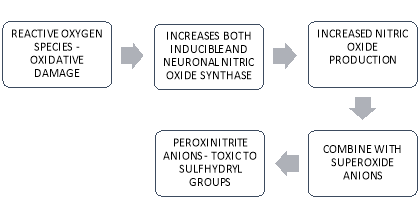
]. Indirect mechanisms do play a vital role in the damaging process. Oxidation has been proven to accelerate the expression of inducible nitric oxide (iNOS) and accentuate the activity of neuronal NOS (nNOS). This leads to increased production of nitric oxide (NO). NO is known to interact with super oxide anions thus forming a highly reactive peroxynitrite anion. These transient molecules exerts their effects mainly on sulfhydryl groups of cells. [

17

]. The entire process has been depicted in figure 2.


Figure 2

. Nitric Oxide Pathogenesis

In addition to the indirect mechanisms, oxidative stress alters the protein structure. Impaired proteins are known to accelerate oxidative damage, thus proven to be interrelated. ROS causes the protein to be oxidised leading to a modified structure and causing them to be dimerized and aggregated [

18

]. Thus the oxidised protein which is both structurally and functionally abnormal gather as inclusions within the cytoplasm of the neurons, seen in the form of NFT (tau aggregates) and Aβ plaques [

19

]. Alternatively, Aβ plaques can also lead to the increased production of ROS. The entire process has been depicted in figure 3.


OXIDATION


ALTERED PROTEIN STRUCTURE


CYTOPLASMIC INCLUSIONS DIMERISATION & AGGREGATION


Figure 3.

Displaying Correlation between Oxidation and Protein Dimerization, thus forming a Vicious Cycle

Aβ (1-42) is an abundant species of Aβ proteins seen in AD [

20

]. Aβ (1-42) peptides is known for its toxicity which can be attributed to a residue of methionine at position 35 [

21

]. Oxidation of methionine contributes to the formation of methionine sulfoxide, which generally leads to irreversible oxidation and subsequently, forming methionine sulfone [

22

]. Methionine sulfoxide reductase (MSR) can even help the reduction of methionine sulfoxide into methionine [

23

]. However, the activity of MSR is also observed to be impaired in AD [

24

]. Methionine peroxide plays an important role in oxidative stress and toxicity caused by Aβ (1-42) peptides. The lone-pair of electrons present on the S atom of methionine undergoes oxidation of one atom and as a result, sulfuranyl radicals (MetS.+) are generated [

21

,

25

]. Sulfuranyl radicals are known to trigger the generation of other ROS like sulfoxides and superoxides by interacting with molecular oxygen [

26

].

The reason behind this intense oxidative damage could be attributed to the relative absence or decreased function of different antioxidant mechanisms of the body. Glutathione is one of the major antioxidant which can protect the brain tissues by causing detoxification of damaging ROS [

27

]. One of the main reasons of increase in oxidative stress in AD is the decreased glutathione levels in the brain [

28

]. The other members of the cellular antioxidant mechanism which plays a pivotal role includes Superoxide Dismutase (SOD) and Catalase (CAT). SOD is an antioxidant which is responsible for converting toxic superoxide ions into far less toxic hydrogen peroxide [

29

]. CAT evolves this reaction in to one step further and turns hydrogen peroxide into water [

30

].

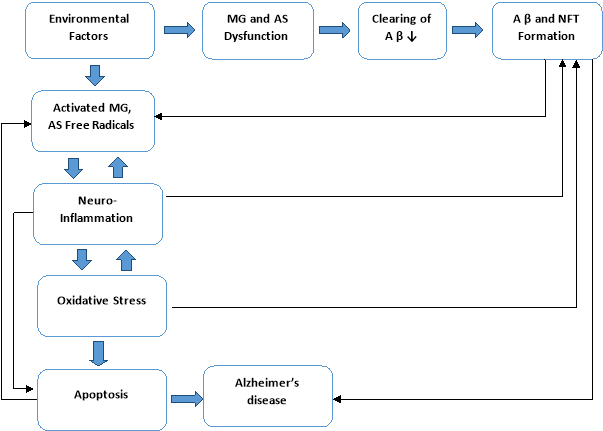
Investigations have revealed that the levels of SOD and CAT decline in patients with AD [31]. Glutathione reductase (GR) and Glutathione peroxidase (GPx) represent the other crucial parts of the cellular defence mechanism which acts against oxidative stress. GPx is responsible for the metabolism of hydrogen peroxide and lipid hydroperoxides [32] and GR accelerates the reaction which helps in the regeneration of Glutathione (GSH) [33]. In total, the combination of an oxidative stress with above mentioned cellular defence mechanism against ROS, leads to the pathogenesis of AD. The pathogenesis of Alzheimer’s disease is mentioned in

Figure 4

.


Figure 4

. Pathogenesis of Alzheimer’s disease (MG : Microglia ; AS: Astrocyte; AP: Amyloid protein beta; NFT: Neurofibrillary tangles)


ACE ALZEIHMERS: VITAMIN A, C & E (ACE) THERAPY


ROLE OF VITAMIN A

Vitamin A and beta carotene have been shown to have multiple benefits for people suffering from AD. Various studies have found that patients suffering from AD have significantly lower levels of Vitamin A level and beta carotene in their CSF as well as blood [

34

]. The development of neurodegenerative disorders has shown to be influenced by Vitamin A and beta-carotene. Vitamin A plays an active role in neuronal development both in early life and in the adult nervous system. It protects and assists in the regeneration of neurons during recovery from neurodegeneration [

35

].

Inhibition of formation and destabilization of Aβ fibrils is an additional effect of Vitamin A and beta-carotene [

35

]. Since oligomerization of Aβ fibrils is an important mechanism contributing to neuronal toxicity in AD, Vitamin A supplementation has been shown to decrease the aggregation and oligomerization of Aβ40 and Aβ42 fibrils [

36

]. It has also been shown that Vitamin A and beta carotene decrease the decline of cognitive function in AD. Moreover, higher levels of these vitamins have been associated with better memory performance and spatial learning in these patients [

34


36

].


ROLE OF VITAMIN C

Various studies both in vivo and in vitro have shown to have significant effect in the brain due to decreased levels of vitamin C. Decreased plasma levels despite adequate intake in patients further confirmed the belief of protective effects of vitamin C in the spectrum of neurodegenerative diseases [

37

]. Hence, it can be proved that oxidative stress induces damage in AD and protection against this stress is offered to a certain degree by antioxidant vitamins. The progression of AD is altered by Vitamin C by interfering with various different aspects of pathology.

Numerous studies, both in-vivo and in vitro, have shown that Vitamin C can decrease oxidative stress. The structural progression of AD is prevented by Vitamin C by hindering the oligomerization of Aβ peptides [

38

]. Brain injury induces oxidative stress and reduces the level of antioxidants like vitamin C and SOD. Vitamin C supplementation improves the level of SOD, which consecutively helps to decrease oxidative stress and subsequent brain injury [

39

].

It has been suggested that even without additional supplementation, a normal intake of Vitamin C can have a neuroprotective effect in patients with AD. Cognitive decline in AD patients has shown to decrease is patients taking adequate Vitamin C [

40

]. In addition, results from a prospective observational study (n=4740) over a period of 3 years have shown that additional supplementation with antioxidant vitamins like vitamin C and E may be associated with both decreased incidence and prevalence of AD [

41

].


ROLE OF VITAMIN E

Vitamin E represents a cluster of 8 antioxidants composed of 4 tocotrienols and 4 tocopherols. It has been reported that there is a greater risk of neurodegenerative disorders like AD and Mild Cognitive Impairment (MCI) with lower plasma levels of vitamin E. Additionally, the level of vitamin E metabolic products (5-nitro-γ-tocopherol etc.) is shown to increase significantly in AD and MCI [

42

].

Deficiency of Vitamin E can lead to the damage and destruction of neurons and has been implicated in cases of cerebellar atrophy [

43

]. Vitamin E is a potent antioxidant which can delay the progression of AD at several levels. Increased oxidative stress induced by Aβ plaques is known to be a risk factor for neuronal death and ensuing brain injury in AD. Vitamin E behaves like a scavenger for these free radicals and therefore, is neuroprotective. [

44

].

Vitamin E also provides protection against AD via various other methods. For example, the 12-lipoxygenase pathway leads to glutamate-induced neuronal cell death by inflammation. Vitamin E can reduce this inflammation induced neuronal death [

45

]. Furthermore, consumption of vitamin E has been linked with the regeneration of SOD, levels of which are shown to decline in AD [39]. Among the different forms of vitamin E, the greatest degree of protection against AD is provided by α-tocopherols and γ-tocopherols [

46

].

A population-based cohort study of 5395 individuals was conducted to evaluate the efficacy of dietary supplementation of antioxidants to provide protection against AD. Among all the antioxidants used, results showed that the most significant degree of protection (p=0.02) against dementia and AD was provided by Vitamin E [

47

]. Moreover, supplementation of 30 International Units of alpha-tocopherols can act as a valuable adjuvant in the treatment of various neurodegenerative diseases, including AD

[48].


Conclusion

Alzheimer’s disease represents one of the most significant age-related neurodegenerative disorders. Oxidative stress is one of the most important mechanisms involved in the development and progression of this condition. In order, to curb the oxidative stress, antioxidants can be of great help. The use of antioxidant vitamins A, C and E as adjuvant therapy for AD has always been given consideration. Thus, further clinical research is necessary to study the potential of these vitamins such that it can be integrated into clinical treatment to accelerate the recovery of patients afflicted by this disorder.


REFERENCES

  1. Alzheimer A, Uber eine eigenartige Erkrankung der Hirnrinde

    Allgemeine Zeits Psychiat Psychisch Gerichtlich Med

    1907 64:146-48.
  2. Harvey RJ, Skelton-Robinson M, Rossor MN, The prevalence and causes of dementia in people under the age of 65 years

    J Neurol Neurosurg Psychiatry

    2003 74:1206-09.
  3. Alzheimer’s Association2012 Alzheimer’s disease facts and figures

    Alzheimers Dement

    2012 8:131-68.
  4. Lindsay J, Laurin D, Verreault R, Hébert R, Helliwell B, Hill GB, Risk factors for Alzheimer’s disease: a prospective analysis from the Canadian study of health and aging

    Am J Epidemiol

    2002 156:445-53.
  5. Karantzoulis S, Galvin JE, Distinguishing Alzheimer’s disease from other major forms of dementia

    Expert Rev Neurother

    2011 11:1579-91.
  6. Castellani RJ, Rolston RK, Smith MA, Alzheimer Disease

    Dis Mon

    2010 56:484-546.
  7. McKhann GM, Knopman DS, Chertkow H, Hyman BT, Jack CR, Kawas CH, The diagnosis of dementia due to Alzheimer’s disease: Recommendations from the National Institute on Aging-Alzheimer’s Association workgroups on diagnostic guidelines for Alzheimer’s disease

    Alzheimers Dement

    2011 7:263-69.
  8. Swerdlow RH, Pathogenesis of Alzheimer’s disease

    Clin Interv Aging

    2007 2:347-59.
  9. Zheng H, Jiang M, Trumbauer ME, Sirinathsinghji DJ, Hopkins R, Smith DW, Beta-amyloid precursor protein-deficient mice show reactive gliosis and decreased locomotor activity

    Cell

    1995 81:525-31.
  10. Levy-Lahad E, Wasco W, Poorkaj P, Romano DM, Oshima J, Pettingell WH, Candidate gene for the chromosome 1 familial Alzheimer’s disease locus

    Science

    1995 269:973-77.
  11. Lesne S, Kotilinek L, Amyloid plaques and amyloid-beta oligomers: An ongoing debate

    J Neurosci

    2005 25:9319-20.
  12. Gouras GK, Tsai J, Naslund J, Vincent B, Vincent B, Edgar M, Intraneuronal Abeta42 accumulation in human brain

    Am J Pathol

    2000 156:15-20.
  13. Bayer TA, Wirths O, Intracelluar accumulation of amylois beta- A predictor for synaptic dysfunction and neuron loss in Alzheimer’s disease

    Front Aging Neurosci

    2010 2:8
  14. Butterfield DA, Amyloid beta-peptide (1-42)-induced oxidative stress and neurotoxicity: implications for neurodegeneration in Alzheimer’s disease brain. A review

    Free Radic Res

    2002 36:1307-13.
  15. Butterfield DA, Castegna A, Lauderback CM, Drake J, Evidence that amyloid beta-peptide-induced lipid peroxidation and its sequelae in Alzheimer’s disease brain contribute to neuronal death

    Neurobiol Aging

    2002 23:655-64.
  16. Butterfield DA, Reed T, Newman SF, Sultana R, Roles of amyloid β-peptide-associated oxidative stress and brain protein modifications in the pathogenesis of Alzheimer’s disease and mild cognitive impairment

    Free Radic Biol Med

    2007 43:658-77.
  17. Koppenol WH, Moreno JJ, Pryor WA, Ischiropoulos H, Beckman JS, Peroxynitrite, a cloaked oxidant formed by nitric oxide and superoxide

    Chem Res Toxicol

    1992 5:834-42.
  18. Hensley K, Hall N, Subramaniam R, Cole P, Harris M, Aksenov M, Brain regional correspondence between Alzheimer’s disease histopathology and biomarkers of protein oxidation

    J Neurochem

    1995 65:2146-56.
  19. Butterfield DA, Kanski J, Brain protein oxidation in age-related neurodegenerative disorders that are associated with aggregated proteins

    Mech Ageing Dev

    2001 122:945-62.
  20. Selkoe DJ, Alzheimer’s disease: genes, proteins, and therapy

    Physiol Rev

    2001 81:741-66.
  21. Butterfield DA, Boyd-Kimball D, The critical role of methionine 35 in Alzheimer’s amyloid beta-peptide (1-42)-induced oxidative stress and neurotoxicity

    Biochim Biophys Acta

    2005 1703:149-56.
  22. Moskovitz J, Berlett BS, Poston JM, Stadtman ER, Methionine sulfoxidereductase in antioxidant defence

    Methods Enzymol

    1999 300:239-44.
  23. Maher P, Redox control of neural function: background, mechanisms, and significance

    Antioxid Redox Signal

    2006 8:1941-70.
  24. Gabbita SP, Aksenov MY, Lovell MA, Markesbery WR, Decrease in peptide methionine sulfoxidereductase in Alzheimer’s disease brain

    J Neurochem

    1999 73:1660-66.
  25. Pogocki D, Schoneich C, Redox properties of Met(35) in neurotoxic beta-amyloid peptide. A molecular modeling study

    Chem Res Toxicol

    2002 15:408-18.
  26. Milller B, Williams T, Schoneich C, Mechanism of sulfoxide formation through reaction of sulfur radical cation complexes with superoxide of hydroxide ion in oxygenated aqueous solution

    J Am Chem Soc

    1996 118:11014-25.
  27. Dringen R, Gutterer JM, Hirrlinger J, Glutathione metabolism in brain: metabolic interaction between astrocytes and neurons in the defence against reactive oxygen species

    Eur J Biochem

    2000 267:4912-16.
  28. Saharan S, Mandal PK, The emerging role of glutathione in Alzheimer’s disease

    J Alzheimers Dis

    2014 40:519-29.
  29. Zelko IN, Mariani TJ, Folz RJ, Superoxide dismutase multigene family: a comparison of the CuZn-SOD (SOD1), Mn-SOD (SOD2), and EC-SOD (SOD3) gene structures, evolution, and expression

    Free Radical Biol and Medi

    2002 33:337-49.
  30. Chelikani P, Fita I, Loewen PC, Diversity of structures and properties among catalases

    Cell Mol Life Sci

    2004 61:192-208.
  31. Marcus DL, Thomas C, Rodriguez C, Simberkoff K, Tsai JS, Strafaci JA, Increased peroxidation and reduced antioxidant enzyme activity in Alzheimer’s disease

    Exp Neurol

    1998 150:40-44.
  32. Arthur JR, The glutathione peroxidases

    Cell Mol Life Sci

    2000 57:1825-35.
  33. Shigeoka S, Onishi T, Nakano Y, Kitaoka S, Characterisation and physiological function of glutathione reductase in Euglena gracilis z

    Biochem J

    1987 242:511-15.
  34. Bourdel-Marchasson I, Delmas-Beauviex M-C, Peuchant E, Richard-Harston S, Decamps A, Reignier B, Antioxidant defences and oxidative stress markers in erythrocytes and plasma from normally nourished elderly Alzheimer patients

    Age and Ageing

    2001 30:235-41.
  35. Ono K, Yamada M, Vitamin A and Alzheimer’s disease

    Geriatrics Gerontol Intl

    2012 12:180-88.
  36. Takasaki J, Ono K, Yoshiike Y, Ikeda T, Morinaga A, Takashima A, Vitamin A has anti-oligomerization effects on amyloid-β in vitro

    J Alzheimer’s Dis

    2011 27:271-80.
  37. Rivière S, Birlouez-Aragon I, Nourhashémi F, Vellas B, Low plasma vitamin C in Alzheimer patients despite an adequate diet

    Int J Geriatr Psychiatry

    1998 13:749-54.
  38. Montilla-López P, Muoz-Águeda MC, FeijóoLópez M, Muñoz-Castañeda JR, Bujalance-Arenas I, Túnez-Fiñana I, Comparison of melatonin versus vitamin C on oxidative stress and antioxidant enzyme activity in Alzheimer’s disease induced by okadaic acid in neuroblastoma cells

    Eur J of Pharmacol

    2002 451:237-43.
  39. Ishaq GM, Saidu Y, Bilbis LS, Muhammad SA, Jinjir N, Shehu BB, Effects of α-tocopherol and ascorbic acid in the severity and management of traumatic brain injury in albino rats

    J Neurosci Rural Pract

    2013 4:292-97.
  40. Harrison FH, A critical review of Vitamin C for the prevention of age-related cognitive decline and Alzheimer’s disease

    J Alzheimers Dis

    2012 29:711-26.
  41. Zandi PP, Anthony JC, Khachaturian AS, Stone SV, Gustafson D, Tschanz JT, Reduced risk of Alzheimer disease in users of antioxidant vitamin supplements: the Cache County Study

    Arch Neurol

    2004 61:82-88.
  42. Mangialasche F, Xu W, Kivipelto M, Costanzi E, Ercolani S, Pigliautile M, Tocopherols and tocotrienols plasma levels are associated with cognitive impairment

    Neurobiol Aging

    2012 33:2282-90.
  43. Aoki K, Washimi Y, Fujimori N, Maruyama K, Maruyama K, Yanagisawa N, Familial idiopathic vitamin E deficiency associated with cerebellar atrophy

    Rinsho Shinkeigaku

    1990 30:966-71.
  44. Yatin SM, Varadarajan S, Butterfield DA, Vitamin E prevents Alzheimer’s amyloid β-peptide (1-42)-induced neuronal protein oxidation and reactive oxygen species production

    J Alzheimer’s Dis

    2000 2:123-31.
  45. Khanna S, Parinandi NL, Kotha SR, Roy S, Rick C, Bibus D, Nanomolar vitamin E α-tocotrienol inhibits glutamate-induced activation of phospholipase A2 and causes neuroprotection

    J Neurochem

    2010 112:1249-60.
  46. Morris MC, Evans DA, Tangney CC, Bienias JL, Wilson RS, Aggarwal NT, Relation of the tocopherol forms to incident Alzheimer disease and to cognitive change

    Am J Clin Nutr

    2005 81:508-14.
  47. Devore EE, Grodstein F, van Rooij FJ, Hofman A, Stampfer MJ, Witteman JC, Dietary antioxidants and long-term risk of dementia

    Arch Neurol

    2010 67:819-25.
  48. Pham DQ, Plakogiannis R, Vitamin E supplementation in Alzheimer’s disease, Parkinson’s disease, tardive dyskinesia, and cataract: Part 2

    Ann Pharmaco ther

    2005 39:2065-72.


Teaching database basics presentation | Information Systems homework help

Put yourself in the position of a clinician coming to an information technology session. You are asked to present information about the basics of relational database design. Specifically, you are asked to communicate the similarities and differences between the terms entity, table, field, and record as they relate to DBMS systems.

Your audience is clinicians who do not necessarily understand these four fundamental database concepts. Using examples from the health field, create a PowerPoint presentation explaining each of these four concepts for a non-technical audience. Also, explain how these detailed concepts relate to the value of a business intelligence applications such as a data warehouse in a health care setting.

Detailed speaker notes should be used to explain each textual and graphic slide in detail.

In your presentation,

· Articulate the meaning of the term entity relating examples to the types of entities that we might see in a health-related database.

· Discuss the difference between a field and a record in a relational database.

· Articulate the purpose of data tables in relational database design.

· Compose examples of how these concepts might relate to developing a comprehensive data warehouse in a health setting.

The Teaching Database Basics presentation

· Must be six to eight slides in length (not including title and references slides) and formatted according to APA Style

· Must include a separate title slide with the following:

o Title of presentation

o Student’s name

o Course name and number

o Instructor’s name

o Date submitted

2 scholarly references must be included

Knowledge and Perception of Parents with Children Living with Autism


Introduction.

[1]

This study takes an aim at analysing the family knowledge and perception with children living with Autism. It further takes more interesting aspect on how various members within the family contribute in caring for these children. The study will also examine how parents living with children with Autism are treated in the society. In addition, it will also try to apply the researched areas to the social care sectors within the National Health Services (NHS). In conclusion, the study will be exploring the differences between girls and boys with Autism. The method undertaken for this study will be a comprehensive evaluation of ten (10) researched articles on the subject of family knowledge and perception with children living with Autism.


Research Questions

  1. What are parents’ experiences when living with an autism child?
  2. The risks involvements in living with autism children?
  3. How are autism children treated in society?


Rational/Added Value.

Current researched studies and knowledge have revealed that, families with children living this type of lifelong neurological disorder sometimes have little or lack knowledge about the condition and hence makes it very frustrating to cater for these children (Mukaddes , 2012). The National Health Service (NHS) and other reputable stakeholders in health like The World Health Organization (WHO), in support of this,  are putting up procedures to support health carers and families with the essential support to cater for these children (NHS Choice, 2016; WHO,2017). Report by the Centre for Disease Control and Prevention (2014) indicates that 1 out of 100 of the world population is suffering from this condition. Likewise, National Health Services (NHS, 2018) points out that 1 out of every 58 children born in the united-kingdom suffer from autism.

About 80% of people living in England, according to the NHS Choice (2018) supports that, children living with autism should be given the necessary backing needed. The results from this survey clearly indicates that, there are still about 20% of people in England who need to be enlighten on this condition and hence led to this study.

The originality of this study lies in the fact that, articles and evidences use in the study were appraised

with the help of a CAPS TOOL. Aveyard (2014) supported that, it is very essential to critically appraise articles and evidence as it helps the researcher and other reader in making a good discernment of the information that is used. This study is a competitive advantage in giving its readers a better understanding of the topic chosen. To conclude, the study is also essential for an award of a degree for Bachelor of Science in the University of Bedfordshire.


Theory’s

  • Erikson’s psychological stages of developments.
  • Labelling theory.
  • Behavioural theory


Aim and Objectives.

  1. To explore the cultural and social factors that affect the parents   living with children with autism.
  2. Understanding the autistic parent’s perspective on the condition and their coping ability.

3.   To explain the psychological, financial and emotional burden that is faced by the autistic parent and its impact on employment.

4.   To identify the impact of these perceptions on the development of the Autistic child.

5. The support mechanism available to families.

A qualitative study conducted by Huws and Jones (2009) using a semi structured interview to explore the lay perception of Autism. The study aims was to provide an in-depth analysis and generalisations of the perceptions and understanding of the particular group of subjects rather than the general population, the sample size was 10 which is far below any sample size which is generalisability according to Parahoo,( 2014). Findings from these studies indicated that participants, during the interview had no knowledge on Autism and none of them tried to ask the interviewer what autism meant. From the analysis four outcomes were generated. These are autism as a transgressing normative expectancy; functional ability discourse and dependency; the discourse of mental status and autism; explanatory discourses and autism. Entirely, it was evident from the findings of the study that people drew their perceptions and understanding of a normal childhood development and had little understanding of the autistic child. It is very relevant as per the studies to encourage the exposure of children with this condition to the society so as to increase awareness and further promote knowledge.

Wade (2008); and Schreck and Mulick (2000) in their studies showed evidence of some sort in terms of the awareness and a degree of perception of parents of the autistic child. Huws and Jones contradict from their evidence on perception indicates no level of perception by participants in the study. It is very keen there should by mass media and public education to promote the awareness of the condition and parents with autistic children sharing their experience. The role of parents and support are more evident in mothers with autistic children than those without. Tunali and Power (2008) also suggested that both mothers of children with and without autism focus on their parental roles. However, Culler and Kozloff (1987) opines that it is hard for mothers with children living with autism to pursue higher jobs and careers because of increase demand of care by these children.


Methodology

As part of health professionals’ responsibility in meeting a component of clinical governance, health professionals are therefore encouraged to support their practice with current evidence-based knowledge. In view of this, there are countless research works published every year and it is the responsibility of health professionals to carry out literature search technique in order to get relevant research knowledge related to their clinical area of practice. One of the key responsibilities of nurses and social workers is searching for relevant evidence and informing them in daily practice.(NMC 2013). Similarly, Gerard(2013) supported that literature form an important part of a proposal since it helps the researcher to analysis various literatures.

The search of literature begins by identifying academic databases from the university of Bedfordshire electronic library databases such as discover, digital library catalogue and health and social science databases as this gives reliable and evidence-based data which is relevant to the research topic (Green, 2000). Academic database was preferred due to how comprehensive and organised the information there is organised for the study (Bell, 2010). Again, Polit and Beck, (2014) suggest that the use of databases as source of research information has been proven as gold standard in getting literature review.  Furthermore, the choice of words selected for the search would be done by giving much attention to details which lead to the preferred evidence expected for the study.

In searching for relevant evidence, the writer will use keywords such as Autism, attitudes of autistic parent, perception of autistic parent, psychological and social impact on autism and knowledge of parents on autism. According to Polit and Beck (2014); Ritchie (2003) using keywords in searching for information is very vital in arriving at relevant evidence in answering the research question the writer then did a more precise and focused search to trim down to the field of social sciences, psychological and health research using the recommended research database. Cumulative index to nursing and allied health (CINAHL), Medline, psycINFO, PubMed, SocINDEX with full text, ASSIA (Applied social studies index& abstract and psycARTICLES. Effective and comprehensive literature searching must be done using several databases since this helps to widen the scope and aid easy understanding of the concepts from a diverse perspective. The Boolean operator would also inculcate to ease the search process NOT, OR, AND thereby narrowing down the search items. The Boolean operator helpes to arrive at numerous useful literatures which were scrutinized to arrive at preferable results of articles that answer the research question. In all after the use of these strategies and processes there would be a lot of articles and these would be relevant to answer the research question selected.  The writer will utilize these resources with the help of the university Liberian to arrive at evidence for the purpose of this study.


ETHICAL AND FEASIBILITY ISSUES.

Ethical issues are keen to every research work involving human subjects; all research work must be approved before its commencement (Gerrish and Lacey, 2010). Ethical considerations in conducting a research study serves as a moral guide for the researcher and helps to direct the agenda of the study, also the ethical committee looks into the effects the said study has on its participant and ensure there is no harm on researched subjects (Harcort and Sargent, 2012). Parahoo (2014) opines that individual stages of the research work have their own ethical implications and associated direction of the work. All research projects must ensure proper ethical approval as well-informed consent from its participant to enhance the genuity of the work and to protect the interest of its subjects before it commences.  In conclusion the writer in this context will hence apply all available ethical considerations and all background studies to ensure that a complete work is done.


Research Plan.

McKenzie’s (2018) research cycle will be used to analysis research plan.

Date Action
November Proposal planning
December Researching information {speak to supervisor}.
January Organising and arranging information.
February Blending the work together {speak to supervisor}
March Evaluating the work.
April Reporting and review.


Reference list.


  • Aveyard. H (2014) Doing a literature review in health and social care:

    A practical guide

    . (3rd. edn). GB: Open University Press.

  • Baker & McKenzie (2018) SWOT Analysis

    , pp. 1–7. Available at: http://0-search.ebscohost.com.brum.beds.ac.uk/login.aspx?direct=true&db=buh&AN=129722490&authtype=shib&site=eds-live&scope=site (Accessed: 8 November 2018).
  • Bell, J. (2010) Doing Your Research Project: A guide for first time researchers in education, health and social sciences. Berkshire: OUP.
  • Booth, A. Rees. A, and Beecroft, C. (2015) ‘Systematic reviews and Evidence Syntheses’, in Gerrish, K. and Lathlean, J. (eds.) The Research Process in Nursing. 7thedn. India: John Wiley & Sons, Ltd. pp. 333-351
  • Clark, A. (2014).

    Understanding research with children and young people

    .
  • De Montfort University (2013).

    Literature searching process

    . Available at:


    http://www.library.dmu.ac.uk/Images/Howto/LiteratureSearch.pdf


    . (Accessed 01 November 2018).
  • E. Gray, D. (1993).

    Perceptions of stigma: the parents of autistic children

    . [online] onlinelibrary.wiley. Available at: https://onlinelibrary.wiley.com/doi/abs/10.1111/1467-9566.ep11343802 [Accessed 4 Nov. 2018].
  • Gerard, G. (2013).

    Basic research methods: an entry to social science research

    . London: SAGE PUBLICATIONS, pp.3,25,38.
  • Gerrish, k., Lacey, A (2010).

    The research process in nursing

    . 6

    th

    edn. West Sussex; Blackwell / publishing Ltd.
  • Gerrish, K., Lacey, A. (2010).

    The research Process in Nursing

    .  6

    th

    edn. West Sussex: Blackwell Publishing Ltd.
  • Green, S. (2000)

    Research Methods in Health

    , Social and Early Years. London: Heinemann.
  • Harcourt, D. and Sargeant, J. (2012)

    Doing ethical research with children

    . McGrawHill Education (UK).
  • Jaci C. Huws & Robert S. P. Jones (2009) Diagnosis, disclosure, and having autism: An interpretative phenomenological analysis of the perceptions of young people with autism, Journal of Intellectual & Developmental Disability, 33:2, 99-107.
  • LoBiondo-Wood, G. and Haber, J.  (2014) Methods and critical Appraisal for Evidence-based practice. 8th edn, China: Elsevier Mosby.
  • Moule, P. Aveyard, H. and Goodman, M. (2017)

    Nursing Research: An Introduction.

    3rd edn. London: sage publication Ltd.
  • Mukherji, P and Albion, D. (2009)

    Research methods in Early Childhood

    . London: Sage
  • Mukuddes,N.M. (2012),

    Gender Identity Problem In Autistic Children

    . John Wiley & Sons, {Online}, Available at


    https://onlinelibrary.wiley.com


    . (Accessed on 1

    st

    Nov. 2018).
  • NHS CHOICES (2018),

    Autism spectrum disorder (ASD

    ). {Online}, Available at;


    https://www.nhs.uk/conditions/autism/


    . (Accessed on 1

    st

    Nov. 2018).
  • NMC. (2013). The code for nurses and midwives (0nline). Available at

    http://www.nmc.org.uk/standed/code

    (Accessed on 3rd November 2018).
  • Parahoo, K. (2014)

    Nursing research: Principles, Process and issues

    . 3

    rd

    edn. Basingstoke: Palgrave Macmillan.
  • Parahoo, K. (2014) Nursing research:

    principles, process, and issues.

    2nd edn. Hampshire: Palgrave Macmillan
  • Ritchie. (2003) Qualitative research practice. London, sage publication.
  • Volkmar, F. (2009).

    A practical guide to autism: what every parent, family member, and teacher needs to know

    . [online] Available at: https://www.vlebooks.com/vleweb/Product/Index/6690 [Accessed 4 Nov. 2018].

Promoting Mental Health and Wellbeing among Older People

PROMOTING MENTAL HEALTH AND WELLBEING AMONG OLDER PEOPLE WITH LONG TERM HEALTH CONDITIONS

TABLE OF CONTENTS

Contents


INTRODUCTION:


BACKGROUND


BASELINE STATISTICS:


KEY RISKS FACTORS:


HEALTH AND WELLBEING


HEALTH PROMOTION:


INTERVENTIONS:


Five ways to wellbeing framework:


Community level intervention:


Evaluation


THE IMPACT AND WHAT HAS CHANGED


CONCLUSION:


REFERENCES:


INTRODUCTION:

This essay will discuss promoting mental health and encouraging wellbeing, the focus group is the older people with age 60 and above, we will talk about what is mental health and wellbeing, the impact on the group selected, and how to implement using different interventions, using primary and secondary impacts. We will discuss the five ways of wellbeing framework, what it meant and how we can apply it to the intervention. This will take us through what is health inequalities and equity issues.

This research will see us discuss how public health professional could evaluate interventions and it can be evaluated to the mental health and wellbeing. And it will be wrapped up with our findings and our thoughts on the conclusion.


BACKGROUND

:


Adults between the ages of 60 or more make huge commitments to society as relatives, volunteers and dynamic supporters of society (Who.int, 2019). Albeit some still have great psychological wellness, many are in danger of creating mental health, neurological disarranges or substance use difficulties, just as other medical issues, for example, diabetes, hearing misfortune and osteoarthritis (Aseniorconnection.com, 2019). As people age, they are bound to encounter various conditions at the same time. (Who.int, 2019).

BASELINE STATISTICS:

In the world today, people are ageing fast and the percentage of the world’s older adults is estimated to almost twice that by 12 to 22 per cent between 2015 and 2050(Aseniorconnection.com, 2019). It is expected to grow from 900 to 2 billion people in absolute terms over 60 years of age (Marak, 2019). Elderly people are facing special, recognizable physical and mental health challenges (Who.int,2019).


Rationally and neurologically disarranges (RNDs), which speak to 17.4 per cent of years with disabilities (YLDs) represent more than 20 per cent of 60 years old and more seasoned grown-ups and 6.6 per cent of all incapacities among individuals over 60 years old (Marak, 2019). Dementia and discouragement are the most well-known sickness in this focus gathering, influencing 5 to 7 per cent of the world’s more established populace, with 3.8% being influenced by tension and 1 per cent of the issue of medication use, which is occasionally ignored or misdiagnosed (Who.int,2019).

KEY RISKS FACTORS:

There are numerous hazard factors for emotional wellness problems every day. More experienced people can encounter life stressors that are common to everyone and in later life this progressive misfortune in limits and a reduction in utilitarian capacity (The World Health Organisation, 2019). For example, more seasoned adults may experience reduced portability, Chronic pain, fragility or other health problems for which long-term care is required. They may also experience events such as deprivation or a decline in socioeconomic status or retirement.

All these stressors can lead to loneliness and psychological distress which will require a long- term care for this focus group (who.int,2019). E.g. Older adults living with physical conditions such as heart disease are more likely to develop depression than those with good health. (

Mentalhealth-uk.org, 2019

). Elderly adults are also vulnerable in terms of abuse of their dignity and respect, including verbal, physical, financial, psychological and sexual abuse. Five topics that elderly people say are important for their mental health and well-being were identified in the British Later Life Mental Health and Wellness Survey (Mentalhealth-uk.org, 2019)The types of discrimination they experience are:-

  • Participation in cultural and political life
  • Relationship – friends and family, they want to feel part of the community
  • Health – physical and mentally sound, and access to care
  • Income – fear of not having enough income


HEALTH AND WELLBEING

:

The WHO defines health as “state of complete physical, mental, and social well- being and not merely the absence of disease”(WHO, 2010). whereas Wellbeing is tied in with feeling better and working great and includes a person’s understanding of their life; and a correlation of life conditions with social standards and qualities. (The University of Edinburgh, 2019).

There is a two-way relationship between wellbeing and health: Health influences wellbeing and wellbeing itself, health is one of the most important things that people say about well- being. Physical and psychological wellness influence wellbeing, however, mental health and wellbeing are independent proportions, mental health is not just the opposite of mental disease. (GOV.UK, 2019).

Wellbeing exists in two dimensions:

  • Subjective wellbeing (or personal wellbeing) directly asks people how they think and feel about their own well- being and includes aspects such as life satisfaction (evaluation), positive emotions(hedonic) and the purpose of life ( eudemonic)(Rees, 2019).
  • Objective wellbeing is based on basic human rights and needs, including food, physical health, education, safety and so on. A goal well- being can be measured through self-reporting (e.g. Ask people if they have a specific condition of health or more objective measures (e.g. Life expectancy and mortality rates) (Rees, 2019).

The World Health Organization (WHO) understands the meaning of well- being as “physical, mental, and social prosperity” of these components, mental prosperity has been verifiably misjudged and often overlooked. Over the last five years, the WHO has effectively reached the boundaries that anticipate access to emotional well- being and the combination of psychological well- being in public health around the world (Who.int, 2018).

Health care is the maintenance or improvement of well-being through the prevention, determination and treatment of disease, illness, injury and other physical and mental impairments in individuals (Ons.gov.uk, 2019). Healthcare is delivered by well-being experts (suppliers or specialists) in united fields of well-being. Doctors and specialist partners are a part of these well-being experts. E.g. Dentistry, midwifery, nursing, medications, optometry, audiology, pharmacy, brain science, word-related treatment, active recovery and other welfare professions are all part of the human services. It includes work done in primary care, secondary care and tertiary care, as well as in public health.

Key policies to reduce Health care management: (

Ons.gov.uk, 2019)

Fig.1. Source: (Ons.gov.uk, 2019)


HEALTH PROMOTION:

Many within and outside the field of mental health and health promotion recognise the need to assemble, review and generate evidence about the tangible benefits of mental health promotion, this includes the relationship between social and cultural factors and the mental health of individuals and communities. (Mentalhealth-uk.org, 2019).

The mental health of older people can be improved by promoting a healthy lifestyle, Active and Healthy Ageing (Adaa.org, 2019). Mental health promotion for older adults involves creating living conditions and environment that supports wellbeing and allows people to lead a healthy life. (Hubley, Woodall and Copeman, 2018)

Promoting mental health depends largely on strategies to ensure that older people have the necessary resources to meet their needs (GOV.UK, 2019), such as providing securities and freedom, adequate housing support, social support, health and social programmes targeted at vulnerable groups, e.g. people living alone, rural area, those who have chronic, mental or physical illness. This promotion emerged as evidence for the effectiveness of interventions and the public health policy and practice implications (GOV.UK, 2019).

They create programmes to prevent and deal with older people abuse and community development programmes. From the above description, we can identify and differentiate mentally healthy and mentally unhealthy.

MENTALLY HEALTHY

MENTALLY UNHEALTHY

  • They show respect to others and are aware of themselves.
  • Understands their limitation and can tolerate others
  • They understand that all behaviour is casual and motivate positive behaviour
  • Not aware of their own self
  • Do not understand their own limitations, hence they can’t understand others.
  • They can’t understand the cause of their behaviour, and cant motivate anything positive


INTERVENTIONS:

What is an intervention?

Interventions in public health are designed to improve health for people or at risk subgroups. Problems such as diet and smoke are complicated multifactorial aetiology (Craig et al., 2008). Early intervention means that psychological instability is discovered and treated in the early stages. The ability to treat psychosis early incredibly increases the chances of the individual being able to appreciate a healthy and productive future.

There is no currently available medication to cure Dementia, but much can be done to support and improve the lives of the people with dementia and their carers and families (Nolan et al., 2011). This can be implemented through early diagnosis, which will promote early optimal management. Identifying and treating accompanying physical illness, and by detecting and managing challenging behaviour and providing information and long-term support to the carers (Nolan et al., 2011).

Prompt recognition and treatment of mental, neurological and substance use disorder in older adults is essential, both psychosocial interventions and medicines are recommended.


Five ways to wellbeing framework:

The Five Ways of Wellness is a simple and accessible way of demonstrating activities that can improve and maintain mental health and well- being. They were created by NEF (the new economics foundation) for Foresight, the UK government’s future thinks tank, as part of the Mental Capital and Wellbeing foresight project. (GOV.UK, 2019). This framework is meant to be positive and engaging, exemplary and non- prescriptive, but based on the wide-ranging scientific evidence gathered by the project. They are

  • Connect – E.g. Building social relationships, spend time with family and friends.
  • Be active- E.g. Regular physical activity.
  • Take notice-Mentally “present,” focus on awareness and appreciation.
  • Keep learning-Be curious about the world, try new stuff.
  • Give- Make a positive contribution to the lives of other people.

The Five Wellness Clubs have been incorporated into their work by groups as varied as GPs and other healthcare professionals, mental health commissioners, artists, religious groups, community and volunteer agencies and local authorities. (Aked and Thompson, 2019) .The range of uses was striking, far beyond the idea of “Five Wellbeing Ways “as a set of messages for the promotion of health. The Five Ways to Wellbeing are based on scientific evidence of the behaviour of individuals. If people incorporate more Five Ways activities into their daily lives, this evidence suggests that their well- being will improve (Aked and Thompson, 2019).


Community level intervention:

The term “community ” often refers to the community as an intervention setting. As an environment, the community is primarily defined geographically and the location where interventions are carried out. Such interventions may take place throughout the city, using mass media or other methods, or in community institutions such as neighbourhoods, schools, churches, places of work, voluntary agencies or other organisations. (Kenneth R. McLeroy, 2019). There are two types of intervention, primary and secondary interventions.

Prevention includes a wide range of activities known as Interventions, which is aimed at reducing risks or threats to health(iwh.on.ca). Although there are three categories: primary, secondary and tertiary, we will be looking at primary and secondary intervention.

The primary intervention aims to prevent diseases or injury before it occurs, this is done by preventing exposures to hazards that causes this by altering unhealthy and unsafe behaviours that can lead to this disease or injury and increase awareness to preserve this disease or injury from occurring (iwh.on.ca). In the case of my focus group (older people) this group are prone to accidents, due to their fragile posture and their mental state of mind. A safety check should be carried out regular within their home, if under the community or social care .E.g.

  • To mandate safe and healthy practices by banning and controlling the use of hazardous products (asbestos).
  • Introducing healthy eating through eating well and exercising, and avoid things like smoking, and
  • To encourage early immunisation against infectious diseases.

The secondary intervention refers to interventions that have been undertaking to reduce injury or disease, that is, all specific treatment-related strategies, and the tertiary prevention would include treatments that will reduce disabilities and all forms of rehabilitation, to avoid a relapse of this illness. (Health.mo.gov. (2019). This preventive strategy needs to be implemented at a specific period before the onset of the mental disorder or issues, in order for the effect applied to be effective there (www.euro.who.int)

  • Should be regular exams and screening test to detect diseases in early stages, e.g. mammograms to detect breast cancer.
  • Usage of medication prescribed e.g. aspirin to prevent further occurrence of heart attack or stroke.
  • Working environment should be supervised and modified to limit injuries sustained at work, e.g. installation of lift instead of manual handling.

WHO,(Nytimes.com, 2019), also has played an important role in prevention and promotion in mental health since in the ’50s, Over the years there have been several resolutions passed  by World health organisation and World health assemblies, urging his members to undertake steps towards prevention and promotion in mental health.(who.int).

To understand this we need to understand why the intervention of services to this focus group, we channel it to Inequity in health and health care, this is referred to the inequalities that are judged to be unjust or unfair from derived results from the social processes (Russo and Russo, 2012). Equity in care requires active engagement in planning, implementation and regulation of health systems to make an unbiased accountable person to arrange and address the needs of all members of the society (Theobald and Cooper, 2012). This information can be identified, through information about death, illness and health services, this can be indicated through the use of demographic or socioeconomic groups(ons.org).

Currently, in England, is been researched that people living in the least deprived areas live 20 years longer in good health than people in the deprived areas(publichealthmatters.gov.uk).


Evaluation

:

The primary reason for evaluation is to gain insight into existing or prior initiative (Gargani and Donaldson, 2011) therefore, evaluation is the social and technical practice of gathering and using empirical data to make judgements of quality about the entity of being evaluated (Green and South, 2006). The social practice- involves relationships and interaction with ‘stakeholders’, which are individuals or group who has a ’stake’ in the programme been evaluated. The technical practice side relies on other methodologies of social science (gathering data and reports). And the valuing practice yields judgements on the quality of a particular intervention.

To improve and account for public health, an effective programme called evaluation has to take place among public health professionals, by involving procedures that are useful, feasible, ethical and accurate (healthknowledge.org.uk). This evaluation framework will help health professionals to plan a program, it is a practical and non-prescriptive tool(cdc.gov). There are steps and standard to be followed in this framework which will help to understand the program and how it is evaluated. The programme is used to apply different elements for planning effective health strategies, and improve the existing programs (Porter, 2016).

The framework is composed of several steps that must be considered to evaluation to take place (Porter, 2016).

  • The Users: is the user that the evaluation is created for. This involvement is required for clarifying the intended purposes, questions and purposes, and preventing the evaluation from being misguided.
  • Questionnaire: this is a way information is generated from the evaluation, by creating evaluation questions with the stakeholders.
  • Methods: this evaluation is derived from feedbacks on research options particularly in the area of social, behavioural, and focus group.
  • Gathering evidence:  An evaluation cannot be completed without credible information about the primary users. e.g. evidence should be perceived by stakeholders as relevant and believable.


THE IMPACT AND WHAT HAS CHANGED

Four UK mental health organizations are working together to enhance people’s lives (Mentalhealth-uk.org, 2019).

The only UK- wide advice services to support 4 millions of UK citizens with financial and mental health issues have been launched by Mental Health & Money Advice. 70,000 people have been visited on our website since our launch last November, 83 per cent of whom found the information useful(Mentalhealth-uk.org, 2019).

  • In Wales, Hafal has supported over 70 + services year- round directly to 5,000 people with mental illness and 1,000 caregivers. Hafal’s partner with local services such as Cyfle Cymru has been able to help over 3,000 people out of work suffering from mental health or drug abuse to get a job.
  • In Northern Ireland, Mind Wise bolstered 6000 grown-ups living with a psychological instability including 3,500 through the criminal equity frameworks, 125 connected in the venture for youngsters and 1370 through support services.
  • In Scotland, Mind Scotland support provided more than 50,000 hours of support to people and provided 17 services to support 1,300 mentally ill people.
  • Rethink Mental Illness is the largest provider of voluntary mental health services in England, with more than 200 services and 150 support groups. From psychological therapies, crisis and recovery centre to peer support groups and housing services, Rethink Mental Illness helps thousands of people throughout England directly every year.


CONCLUSION:

Health is a massive and complicated issue to deal with, different theories and meaning, and it all seems like a never-ending story. There are more groups in the society that need more help than the other due to either social factor, demographical or lifestyle situation. The main focus of this research is to see how this has applied to my focus group (Older people), in terms of interventions and need assessments.

My focus group was on the older people, who are the most vulnerable in the group from the background research in promoting mental health and wellbeing. A lot of plans has been put in place in terms of health care services, and the NHS long term plan(LTP) on prevention to save 500,000 of lives over the next 10 years, which the Chief Executive Duncan Selbie says ‘it will mark a turning point on how we provide healthcare across England ‘.


REFERENCES:

  • Adaa.org. (2019).

    Older Adults | Anxiety and Depression Association of America, ADAA

    . [online] Available at: https://adaa.org/finding-help/helping-others/older-adults [Accessed 10 Jan. 2019].
  • Aked, J. and Thompson, S. (2019).

    Five ways to mental wellbeing

    . [online] GOV.UK. Available at: https://www.gov.uk/government/publications/five-ways-to-mental-wellbeing [Accessed 4 Jan. 2019].
  • Aseniorconnection.com. (2019).

    Mental Health and Older Adults

    . [online] Available at https://www.aseniorconnection.com/blog/mental-health-and-older-adults [Accessed 9 Jan. 2019].
  • Carersuk.org. (2019).

    Needs assessment – Carers UK

    . [online] Available at: https://www.carersuk.org/help-and-advice/practical-support/getting-care-and-support/needs-assessment [Accessed 5 Jan. 2019].
  • Craig, P., Dieppe, P., Macintyre, S., Michie, S., Nazareth, I. and Petticrew, M. (2008). Developing and evaluating complex interventions: the new Medical Research Council guidance.

    BMJ

    , p.a1655.
  • Dual Diagnosis. (2019).

    Evidence-Based Treatment Practices | Dual Diagnosis

    . [online] Available at: https://www.dualdiagnosis.org/treatment-therapies-for-dual-diagnosis-patients/evidence-based-treatment-practices/ [Accessed 5 Jan. 2019].
  • Gargani, J. and Donaldson, S. (2011). What works for whom, where, why, for what, and when? Using evaluation evidence to take action in local contexts.

    New Directions for Evaluation

    , 2011(130), pp.17-30.
  • Green, J. and South, J. (2006).

    Evaluation

    . Maidenhead, Berkshire: Open University Press.
  • GOV.UK. (2019).

    Public Health England

    . [online] Available at: https://www.gov.uk/government/organisations/public-health-england [Accessed 3 Jan. 2019].
  • Haryanahealth.nic.in. (2019). [online] Available at: http://haryanahealth.nic.in/userfiles/file/pdf/Mental%20Health/2017/WHO_Resources/WHO%20Fact%20sheet%20Mental%20health%20and%20older%20adults.pdf [Accessed 6 Jan. 2019].

  • Health.mo.gov. (2019).


    Home

    . [online] Available at: https://health.mo.gov/data/InterventionMICA/ColorectalCancer/schoolbased.html [Accessed 5 Jan. 2019].
  • Hubley, J., Woodall, J. and Copeman, J. (2018).

    Practical health promotion

    . 1st ed. Cambridge, UK: Polity Press.
  • ISO. (2019).

    About us

    . [online] Available at: https://www.iso.org/about-us.html [Accessed 18 Jan. 2019].
  • Kenneth R. McLeroy, C. (2019).

    Community-Based Interventions

    . [online] PubMed Central (PMC). Available at: https://www.ncbi.nlm.nih.gov/pmc/articles/PMC1447783/ [Accessed 4 Jan. 2019].
  • Marak, C. (2019).

    Carol Marak invites you to opt-in to her weekly newsletter, Age with Purpose – Urbana Daily Citizen

    . [online] Urbana Daily Citizen. Available at: https://www.urbanacitizen.com/opinion/columns/65662/carol-marak-invites-you-to-opt-in-to-her-weekly-newsletter-age-with-purpose-30 [Accessed 6 Jan. 2019].
  • Mentalhealth-uk.org. (2019).

    Mental Health UK


    – Working together for everyone’s mental health

    . [online] Available at: https://www.mentalhealth-uk.org/ [Accessed 8 Jan. 2019].
  • Mentalhealth-uk.org. (2019).

    Mental Health UK


    our impact

    . [online] Available at: https://www.mentalhealth-uk.org/our-impact/ [Accessed 4 Jan. 2019].
  • Ons.gov.uk. (2019).

    Home – Office for National Statistics

    . [online] Available at: https://www.ons.gov.uk/ [Accessed 2 Jan. 2019].
  • Nolan, Y., Burgess, C., Shaw, C. and Railton, D. (2011).

    Health & Social Care (Adults)

    . London: Pearson.
  • Nytimes.com. (2019).

    World Health Organization

    . [online] Available at: https://www.nytimes.com/topic/organization/world-health-organization [Accessed 7 Jan. 2019].
  • Porter, S. (2016). A framework for improving the responsiveness of policy through development evaluation.

    Evaluation

    , 22(2), pp.245-258.
  • Rees, E. (2019).

    Personal well-being in the UK – Office for National Statistics

    . [online] Ons.gov.uk. Available at: https://www.ons.gov.uk/peoplepopulationandcommunity/wellbeing/bulletins/measuringnationalwellbeing/oct2015tosept2016 [Accessed 4 Jan. 2019].
  • Russo, R. and Russo, K. (2012).

    Intervention

    . [Camden], Me.: Down East.
  • The Chicago School of Professional Psychology. (2019).

    Ageing alone

    . [online] Available at: https://www.thechicagoschool.edu/insight/aging-single-senior-citizens/ [Accessed 7 Jan. 2019].
  • Theobald, T. and Cooper, C. (2012).

    Doing the right thing

    . Basingstoke: Palgrave Macmillan.
  • The University of Edinburgh. (2019).

    what are health and wellbeing?

    [online] Available at: https://www.ed.ac.uk/sport-exercise/healthy-university/about-health/what-is-health-and-wellbeing [Accessed 3 Jan. 2019].
  • Wearmouth, J. (2016).

    Special educational needs and disability

    . London: Routledge Taylor & Francis Group.
  • Who.int. (2019).

    Home

    . [online] Available at: https://www.who.int/ [Accessed 4 Jan. 2019].
  • Who.int. (2019).

    Mental health of older adults

    . [online] Available at: https://www.who.int/news-room/fact-sheets/detail/mental-health-of-older-adults [Accessed 11 Jan. 2019].
  • World Health Organization. (2019).

    Ageing and Life Course

    . [online] Available at: https://www.who.int/ageing/en/ [Accessed 3 Jan. 2019].
  • World Health Organization. (2019).

    Mental health of older adults

    . [online] Available at: http://origin.who.int/mediacentre/factsheets/fs381/en/ [Accessed 8 Jan. 2019].

Global Health Issue Analysis: HIV/AIDS

GLOBAL HEALTH ISSUES

Global issue is a broad description that is often used to explain matters of great social concern that affect human populations locally and that are shared among diverse human societies within our global community. Global issues koncern us all and one at the heart of many valuable learning experiences. Issues such as environment al sustainability, health, peace building and human rights focus students attention and contemporary events and how they affect our lives at a local and global level. Many people argue that globalization has Server to bring the world closer together creating a more cooperative environment. The impact of new information and communication Technologies has changed the way people learn, work and live. From the suffering of the Second World War emerged a new international organization- the United Nations.

The United Nations founding, In 1945, enabled its Member States and their peoples to work together to promote peace and cooperation, economic and social development, and a clear Visio codified by international law.

In 1981, one of the leading causes of death in our time broke upon the world scene. The new ailment was named acquired immune deficiency syndrome(AIDS) and also Human immunodeficiency virus(HIV).

HIV means that you have tested positive for the virus and it does not become AIDS usually for ten years or until immune system problems appear.

HIV/AIDS causes immense suffering to millions of people. UNAIDS (the joint United Nations programme on HIV/AIDS showed that HIV/AIDS has bee diagnosted in every continent on the globe, yeti t is distribution is far from even.

One of the many consequences of the pandemic is that it has a major impact of life expentancy among the worlds poorer countries. The impact of AIDS on life expectancy is also felt beyond Africa, albeit somewhat less dramatically. Haiti’s life expectancy is currently almost six years less than it world heve been without AIDS, in Combodia it is currently four years lower. South Africa has also been affected, in Guana, for example, the probability of becoming HIV- positive between the ages of 15 and 50 is 19% or nearly 1 in 5. North America, for example, has 950.000 people living with HIV/AIDS and Western Europe 550.000 whilst in Australia and New Zealand 15.000 people (UNAIDS, 2002).

In Africa, 28 million people are infected with HIV and 11 million African children are thought to heve been orphaned by AIDS (WHO, 2000).

Kopelan and van Niekerk (2002) suggested that the scale of the HIV/AIDS epidmic in Africa is often explained away by pre-existing notions of a diseased, corrupt and backward continent and they argue, forcefully, for international support, albeit with reather than for African countries.

Unfortunatelly biomedical and pharmaceutical responses have had a relatively small impact upon the pandemic. Attempts to devlop vaccines, for example, have had limited success and these endeavours have probably been hindered by the allocation of relatively Modest amounts of funding. Between US dollars 300-and US dollars 600-million a year have been spent on the development of HIV vaccines(UNAIDS, 2002).

There has been more success in the development of antiretroviral drugs and these are prolonging thousands of ives in high- income countries(Babiker et al., 2002).

However, these drugs continue to remain inaccessible to the majority of those infected by HIV.

Since the people most affected by HIV/AIDS are often those with the least access to economic power or political influence it is, perhaps, hardly surprising that so many governments offer such a lukewarm response( de Wall,2002).

In many of the poorer countries in which HIV/AIDS predominates, and where people with AIDS have little or no access to medical care or treatment, responsibility for the care of the dying ultimately falls on the poorest households (Ellison et al.,2001).

In countries where governments do not take the initiative in responding to HIV/AIDS, and where the disease is often shrouded in stigma and denial, there is unlikely to be widespread popular presure for change. In this way, at an individual and a social level, the enormity of AIDS and the burden of copying tend to get hidden in the lives of ordinary familie( Palloni and Lee, 1992).

UNAIDS Global Reference Group on HIV/AIDS and Human Rights (2004) ensuring rights based approach is: the global scalling up of the response to AIDS, particulary in relation HIV testing as a preveguisite to expanded access to treatment, must be grounded in sound public health practice and also respect protection, and fulfilment of human rights norms and standarts. The voluntariness of testing must remain at the heart of HIV policies and programmes, both to comply with human rights principles and to ensure sustained public health benefits. The following key factors, which are mutually reinforcing, should be addressed simultanously :

  • Ensuring an ethical process for conducting the testing, including defining the purpose of the test and benefits to the individuals being tested and assurances of linages between the site where the test is conducted and relevant treatmant care and other services, in an environment that guarantees confidentiality of all medical inforamtion.
  • Adressing the implications of a positive test results, including non discrimination and access to sustainable treatment and care for people who test positive.
  • Reducing HIV/AIDS- related stigma and discrimination at all levels, notably within health care settings.
  • Ensuring a supportive legal and policy framework within which the respons eis scaled up, including safeguarding the human rights of people seeking services.

The HV/AIDS epidemic has deep historical roots. The epidemic have to be seen against this broad background. There are lessons to be learned, not Just about this disease, but about health, well-being and development as well.It is the first global epidemic of which we have been commonly conscious. Health and well-being are not individual concerns: they are global issues. There are opportunities for innovation and for more ‘goods’ but there is only a glimmer of hope . These are:

  1. Global intersectoral action through transnational co-operation and partnerships between public health and trade and finance sectors.
  2. Pro vide information about comparative health status and global determinants of health and well-being.
  3. Research programmes that concentrate on developing cost-effective technologies to improve the status of the poor.
  4. Recognition that management of health and well-being is a common human project and that the for-profit sector can only have limited incentives to meet those needs (Alonso, 2001).

But there are many abstacles because we need to persuade people of the true cost of HIV/AIDS and business has a role to play, but the business of business is profit no welfare. Perhaps that is also an assumption that must be challenged. In the same way that HIV/AIDS is about more than health, so business has responsibilities beyond three complementary mechanisms: the market- distribution through competitive pricing, second one is the hierarchy- distribution through organisation process and the last one is values- distribution as a response to accepted ethical principles (Alonso, 2001). Through unprecedented global attention and intervention ef fors, the rate of new HIV infections has showed and prevalence rate have leveled off globally and in many regions. Despite the progress seen in some countries and regions, the total number of people living with HIV continues to rise (Barnett and Prins, 2006).

In 2007, globally about 2 million people died of AIDS, 33 million were living with HIV and 2,7 million people where newly infected with the virus (WHO, 2008).

The impact of HIV/AIDS on women and girls has been particulary devastating. Women and girls now comprise 50 percent of those aged 15 and older living with HIV but, the impact of HIV/AIDS on children and young people is a severe and growing problem. In 2007, 370,000 children underage 15 were infected with HIV and 270,000 died of AIDS and about 15 million children have lost one or both parents due to the disease (WHO, 2008). The sixth Millennium Development Goal (MDG) focuses on stopping and reversing the spread of HIV/AIDS by 2015. Global funding is increasing, but global need is growing even faster-widening the funding gap. Services and funding are disproportionately available in developed countries. HIV infections and AIDS deaths are unevenly distributed geographically and the nature of the epidemics very by region. Epidemics are abating in some coutries and burgeoning in others. More than 90 percent of people with HIV are living in the developing worl (UNICEF, 2007).

The health care systems of most African countries, already inadequate. As the serious nature of the pandemic and it is effect on the developing world came into sharper focus in the 1990’s, so did the incoherence of international policy. The nature of the crisis was given recognition in 1995 when the United Nations set up UNAIDS to co-ordinate global policy by bringing together under one heading six key international agencies: WHO, UNDP, UNICEF, UNEPA, UNESCO and the World Bank. The re-orientation of policy towards AIDS was proposed, more or less across the board, in the face of increasingly pessimistic forecasts of the effects, both short and long term of the pandemic on whole populations in Africa (Ellison et al.,2003).

In Southern Africa insurance companies are gathering such information because they routinely test people before offering cover. These data are biased to those applying for policies and are often comercially sensitive and so they tend not to be publicly available. For companies wishing to estimate how the epidemic is going to affect their workforce, the advert of saliva and urine tests mean, surreys can be carried out more easily. This is a routine procedure to test blood donations and these data can provide a picture of what is going on in what should be a low- risk group. HIV data are also collected and constructed according to political, social and other biases (UNAIDS, 2000).

HIV/AIDS is not the first global epidemic, and it won’t be the last. It is the disease that is changing human history. HIV/AIDS shows up global inqualities. It is presence and impacts are left most profundly in poor countries and communities (Bernett and Whiteside, 2006). Public health system are undefunded; politically they attract few votes, and in parts of the world they are close to collapse. For the moment, there is only a mere itimation of any system of global public health. Social and economic conditions negate many gains made by any particular intervention. Health is not any about confronting individual diseases. Well-being, of which health is a part, is a reflection of general and economic conditions (Anderson and May, 1992).

Economic impact means that families suffer major economic problems as productive adults become ill, including: loss of income as family members become sick and are unable to work, or have to give up work to care for the sick and limited income being consumed by expensive drugs and funerals. Countries suffer significiant economic impacts including: los of investment in education and the knowledge and skills of professionally trained people, reduced ability to produce food and high costs of treatment and demands on health system (Adler, 2001).

Human and social impact means that people’s who lives are affected in many ways which include: a wide variety of physical health problems , social isolation due to stigma and misunderstanding of the spread of the disease (Barnett and Prins, 2006).

The purpose of workplace policy on HIV/AIDS in South Africa (UNAIDS, 2008) is to provide clarity on TOTALs views and commitments with regard to HIV/AIDS and the comprehensive management of HIV positive employees and employees living with AIDS. TOTAL is fully committed to protect employees, create awarness, encourage behaviour changes where necessary as well as ensure that all employees are treated with the necessary dignity, fairness and equality (USAID, Global Partnership, 2004).

Some major reasons for unnecessary deaths around the world are therefore due to human decisions and politics, not just natural outcomes. Well- intentioned companies, organizations and global action show that humanisty and compassion still exists, but tackling systematic problems is parramount for effective, Universal health care that all are entitled too. Addressing health problems goes Beyond just medical treatments and policies; it goes to the heart of social, economic and political policies that not only provide for healthier lives, but a more productive and meaningful one that can benefit other areas of society.

Bibliography:

  1. De Wall, A. (2006) Aids and power. South Africa
  2. Barnett, T., Whiteside, A. (2006) Aids in the Twenty- First Century, Disease and Globalization. 2nd ed. Palgrave Macmillan.
  3. Hunter, S. (2003) Who cares? Aids in Africa. New York.
  4. Bond, G. C., et al. (1997) Aids in Africa and the Carribbean
  5. Ellison, G., et al. (2003) Learning from HIV and AIDS. Cambridge: Cambridge University Press.
  6. Barnett, T. and Parkhust, J.(2005) HIV/AIDS : sex, abstinence and behaviour change. Lancet Infections diseases. 5 (9), 2-5.
  7. Stillwagon, E. (2005) Aids and the ecology of powerty. Oxford: Oxford University Press.
  8. UNAIDS Global Epidemic Report (2000), accessed on 25/11/09, (http://www.unaids.org/).
  9. Centres for Disease control and prevention from: ( http://www.cdc.gov).
  10. Anderson, M. and May, R. (1992) Infections disease oh humans: Dynamics and control. Oxford: Oxford University Press.
  11. Adler, M.(2001) The ABC of AIDS. London.
  12. Farmer, P.,(1999) Infection and Inequalities: the modern plaques.California: University of California Press.
  13. Barnett, T. and Prins, G. (2006) HIV/AIDS and security: Fact, Fiction and Evidence. London.
  14. Caldwell, J.C., Caldwell, P. and Quiggin, P.(1989) The social context of AIDS in Sub- Saharan Africa. Population and Development Review. 15(2), 185-234.
  15. UNICEF (2000) The Progress of Nations. New York.
  16. World Health Organization (2000) The World Health Report 2000: Health Systems- Improving Performance. Geneva.
  17. Palloni, A. and Lee, Y. J.(1992) Some aspects of the social context oh HIV and it is effectson woman, children and familie. Population Bulletin of the United Nations. 33(2): 64-87.
  18. Garnett, G. et al. (2002) Antiretrovival therapy to treat and prezent HIV/AIDS in resource-poor settings. Nature Medicine.8(6): 651-654.

Anxiety and Pain Related to Injections in Pediatric Patients

Abstract

Injections are an unavoidable part of pediatric health and, unfortunately, are a common source of pain and anxiety for children. In current nursing practice, interventions exist to reduce pain and anxiety in the pediatric population. However, they may vary in approach and effectiveness. Current research includes vibration stimulation, visual aids, music therapy, child positioning, and other distraction techniques. This paper examines research that pertains to reducing the pain and anxiety with injections in pediatric patients.


Keywords

: injections, fear, anxiety, pediatric, immunizations, distractions, child-life services, Buzzy

Introduction

A child may have as many as 22 routine vaccinations by one year of age and a total of 34 vaccinations by age 11. The majority of which are received through an injection (Stevens & Marvicsin, 2016). Vaccines prevent two to three million deaths per year worldwide by eradicating and limiting the incidence of certain diseases (Benjamin, Hendrix, & Woody, 2016). Thus, preventative injections are essential in preventing avoidable debilitating diseases. As a result, pain and anxiety caused by injections is a major concern in pediatric nursing practice. Routinely scheduled immunizations are the number-one cause of childhood procedural pain (Benjamin et al., 2016). Additionally, when a children are hospitalized, they are often overwhelmed with many painful and potentially frightening procedures. This iatrogenic pain and anxiety can cause traumatic experiences and potentially lead to non-compliance and avoidance of important medical care later in life. According to Redfern, Chen, & Sibrel (2018), a significant percentage of needle phobias result from traumatic encounters when interventions were not implemented to reduce pain and anxiety. Lack of interventions to reduce injection related fear and anxiety might also cause non-adherence to the vaccination regimen and cause further health issues for society.

Due to the lasting impact of injections in the pediatric population, interventions have become an important part of nursing care (Redfern, Chen, & Sibrel, 2018). Patients are at risk for impaired coping mechanisms for future invasive nursing procedures if they have had a negative experience due to lack of interventions to help mitigate pain and anxiety. This study focuses on surveying pediatric registered nurses in the acute care setting to gather subjective data on the effectiveness of different interventions to curtail pain and anxiety during routine injections. It also reviews several different studies centered on finding effective interventions in reducing the unavoidable fear and anxiety that children often experience when they must undergo invasive procedures, such as injections, venipuncture, and intravenous cannulation.


Literature Review


Tactile

According to Redfern et al. (2018), the Buzzy device is a plastic multi-use vibrating device that can be used alone or combined with ice packs with the goal of reducing pain and anxiety using Gate Control Theory and distraction. Sabiner, Inal, and Akbay (2015) completed a study in which they took two groups of 7-year-olds, with a combined total of 104 participants, and tested one group with the application of Buzzy with cold packs, and the other group without any interventions. For this study, the same two nurses with five years of experience were trained by the researcher to maintain consistency and continuity. One nurse was giving the vaccinations and the second nurse observed the children’s pain and anxiety levels during the procedure. The tools used to assess the pain and anxiety levels were Wong-Baker FACES scale and Children Fear Scale. The group using the Buzzy applications showed remarkably decreased pain and anxiety levels compared to the group without the Buzzy intervention.

In a similar study, researchers Redfern et al. (2018) conducted a prospective, open-label, randomized controlled trial to determine the efficacy of thermo-mechanical stimulation. The control group used no interventions during routine vaccinations. To determine the effectiveness, the Wong Baker Faces scale was implemented to assess the child’s pain. The parents’ perception of the child’s fear and anxiety was also used to assess the child’s pain. There was a scale to determine the parents’ perception of the overall visit as well. The parents were asked to state whether it was the same, better, or worse than they anticipated. Researchers used a sample size of 100 participants. Fifty of the participants were a part of the control group with no interventions, and the other 50 were provided thermo-mechanical stimulation as the intervention. Participants aged 3 to 18 years were given the Buzzy device along with a cold pack to be placed on the surrounding areas of where the injection would take place. Redfern et al. (2018) found that anxiety ratings were not significantly different between the two groups, but those in the Buzzy group experienced significantly decreased pain post injection.

However, the study conducted by Benjamin, Hendrix, and Woody (2016) had different results. A total of 100 children varying from 2-months-old to 7-years-old were a part of this study. One group was the control group, which received no intervention, while the other group received the Buzzy intervention. They hypothesized that the group with the Buzzy device would have a lower pain score than the children in the control group. They concluded that with the application of the Buzzy, there were no statistically significant results in pain reduction between the two groups. In this specific study, a cold appliance was not used in conjunction with the Buzzy. These findings suggest that cold application combined with Buzzy may be superior to using Buzzy by itself.


Visual

Encompassing visual aids as a distraction method has been used to reduce fear and anxiety in pediatric patients. In the systematic review done by Brice and Wyatt (2017), they found that distraction methods using things such as interactive toys, screen time, and guided imagery during invasive procedures, is prevalent in the literature. One interactive distraction often used is drawing. A randomized controlled clinical trial conducted by Stinley, Norris, and Hinds (2015) explored possible interventions to diminish anxiety and physical pain associated with injections among pediatric patients with the use of drawing mandalas. Art therapy, specifically mandalas, was chosen for the study because it has been proven to reduce anxiety and fear in the adult population. Mandalas are a geometric figure found in every culture and religion. They achieve a relaxation response by maintaining the patient’s engagement and focus. The ages of participants in the study ranged from 7 to 18 years consisting of 20 females and 20 males. Ipads were used with a circle template and the children were instructed to draw or paint anything they desired for five minutes prior to, throughout, and after the procedure. The treatment group with the mandala experienced fewer stress behaviors such as crying, screaming, and physical struggle. There was a 50% decrease in physiological signs of anxiety, such as heart rate and oxygen saturation. Stevens and Marvicsin (2016) examined the use of picture books and movies and found that they were successful forms of distraction in school-aged children. Brice and Wyatt (2017) found that the use of tablets or television as an intervention had varying results. They discussed how the use of screen time and tablets hold promise for comfort measures for pediatric patients because the distraction can be quickly accessed, is easily stored, and is easy to use, but more research needs to be conducted.

Using guided imagery and teaching a child to blow away the pain while having an injection showed significantly decreased pain behaviors. It also allows the child to be a part of their treatment by giving them a sense of control. This technique may not work with certain age groups or children that are already severely distressed and unable to focus (Brice & Wyatt, 2017).


Auditory

Although distraction is found to help patients, it is even more beneficial when multiple senses are being utilized at once (Benjamin et al., 2016). Using verbal and auditory cues and questions is a successful distraction method that has been used to help children reduce fear and anxiety related to injections. A relatively newer form of technology, virtual reality, uses both audio and visual technology. It is potentially effective in reducing pain and distress in children undergoing invasive procedures, but limited studies have been done; therefore, evidence for this form of technology is limited (Brice & Wyatt, 2017). Stevens and Marvicsin (2016) researched each developmental stage and found that different types of auditory methods were used for distraction. Infants did not benefit from any auditory forms of distraction, as they cannot process that type of stimulation. Toddlers sing songs and listen to stories to distract them from the injection process. Explanations of the preparation process should also be simple, concrete, and appropriate for the specific age group that is receiving the vaccination. Non-procedural talk with school-aged children such as asking the patient about their pets, what their favorite color is, or who their best friend at school is also assists in taking the child’s mind away from the vaccination.

Brice and Wyatt (2017) report that music therapy, including passive and active music participation, shows positive results in reducing anxiety and pain in children undergoing invasive procedures. In some of the studies, children did not self-report that the music helped in decreasing anxiety and stress, but markers such as heart rate in the experimental groups were lower than the control groups. Stevens and Marvicsin’s (2016) research showed that adolescents benefited from listening to music that was played out loud on speakers. They also benefited from talking about their lives, such as what they did last summer and what they plan to do when they graduate high school.


Caregiver Facilitation

Children often seek comfort from a loved one when they are experiencing distress, anxiety, or fear. Brice and Wyatt (2017) reported on numerous studies that looked at how caregivers can play a significant role in comfort interventions when children underwent distressing procedures. Caregiver interventions included parental coaching, encouragement, positioning of the patient, and distraction. The parental coaching studies showed mixed results. Stevens and Marvicsin (2016) found that it is important to educate the parents on using non-procedural talk. Parents should be honest, instead of telling the child that it is not going to hurt very much or that it will just be a quick poke. When caregivers were taught proper ways to encourage and distract, distress levels were decreased; however, the studies showed no differences in pain or anxiety when parental coaching was used (Brice & Wyatt, 2017).

Caregiver-assisted positioning and distraction makes the child feel more comfortable and provides a sense of security while receiving an injection. Comfort hold positions are taught to parents so that they can be involved in the injection process, while keeping the limbs accessible (Stevens & Marvicsin, 2016). The comfort hold positions are shown to parents using handouts and demonstration. Infants benefit from swaddling or snugly wrapping the child’s upper body in a blanket while leaving the lower limbs exposed for easy access for injections. It is also beneficial for the parents to receive simple instructions prior to the injection on how to hold the child to allow for the injection site to remain visible. Stevens and Marvicsin (2016) also explored the use of security objects such as blankets, stuffed animals, and toys to see if it would help with fears and anxiety related to vaccinations. They found that security objects made the patients feel more comfortable and mildly reduced their fear and anxiety.


Multifaceted Approach

Much of the literature shows that using numerous methods and a multifaceted approach might be the best way to reduce anxiety and distress among pediatric patients undergoing invasive procedures such as injections. Brice and Wyatt (2017) discussed the use of pharmacological and nonpharmacological interventions together. Numerous studies integrate nonpharmacological adjunctive therapy with pharmacological measures such as analgesic cream. Implementing a mixture of interventions is a more holistic approach to comforting a patient. Numbing cream provides local anesthesia, which can dramatically decrease pain; however, it requires a minimum application time of at least 15 to 60 minutes, which is often not feasible (Sabiner, Inal, & Akbay, 2015). Nurses do not typically have that amount of time to apply an analgesic cream and wait for it to take effect before administering the injection. Benjamin et al. (2016) research also established that numbing creams might offer some pain relief; however, the downside to this specific intervention is cost and time.

Another highly effective collaborative approach is the use of child life services. Child life services integrate several modalities of providing stress relieving and pain reducing interventions. Certified Child Life Specialists (CCLS) are an integral member of the healthcare team. They are college-educated individuals with in-depth knowledge of child development and specialized training. They use a multifaceted approach in aiding pediatric patients and their families to adjust and cope in stressful situations while in the healthcare setting. CCLS gather information from both the treatment team and medical record. They complete a developmental and coping assessment through interacting with the child and family. They use a dynamic approach with behavioral, cognitive, physical, and complementary techniques to help decrease anxiety and distress through education, preparation, self-expression, and play (Duda, 2018). CCLS help a child understand the procedure at an age appropriate level, they help to distract a child when having an invasive procedure, and they assist the child in coping with their anxiety and fear. Duda (2018) states that “having a child life specialist as part of the healthcare team is beneficial to decrease patient anxiety, stress, and trauma while in the hospital” (p. 98).


Data Collection Process


Sample Size and Collection

A six-question survey was created to gather information from the nurses on the pediatric floor. The survey received approval, by the clinical nurse specialist of the pediatric units, prior to administration. The beginning of the survey asked for the nurse’s initials, the shift they were working, and what unit they worked on. The nurses were asked to provide their initials in order to avoid asking them the same questions twice and skew the results of the provided survey. The sample size included a total of 16 surveys, which included 13 day-shift nurses and three night-shift nurses. This survey was conducted on the Pediatric floor and the Pediatric Intensive Care Unit at UCHealth Memorial Hospital Central in Colorado Springs, Colorado. Some questions asked for specific answers from the nurses based on personal experience, while others were simple yes or no questions.


Limitations

Several limitations exist within this study. One of these limitations is having a small sample size. Due to limited time for data collection and a minimal number of nurses per clinical shift, the surveyors were unable to interview a large sample of nurses. Additionally, this survey was only performed in the acute care setting. Thus, the diversity in the types of healthcare settings is limited (i.e. community medical centers, family practice offices, or urgent care and other emergency settings). Relative to setting, the survey was only completed across two units at one hospital. Furthermore, the nursing staff were either preoccupied with patient care and/or showed disinterest in the survey. As a result, answers were often short and lacked detail. For example, when asked questions regarding age in which interventions were most effective, the response was often, “it depends,” without offering further feedback. When feedback was offered, it was extremely inconsistent making it difficult to find a consensus. In some cases, if feedback was given, not all questions were filled out, leaving a blank result. When the nurses were provided the survey to fill out instead of verbally surveyed, the majority stated they were occupied with a heavy patient load and did not have time to complete it. A small number of nurses opted-out of the survey altogether and did not want to contribute to the study. This noncompliance led to incomplete data collection and vague results. Lastly, this survey was subjective and relied on the nurses’ personal experience with interventions to reduce pain and anxiety during injections.


Data Analyses

For the following questions refer to Appendix A and B. Appendix A shows a replica of the survey given, and Appendix B displays the answers to each question given by the nurses. The first question in the survey asked the nurses if they used distractions when giving an injection to reduce anxiety and fear. All nurses reported that distractions were used. However, in some cases distractions were not utilized if the nurses did not have additional help. Regarding the second question in the survey, the results are as follows. When asked about the most effective tool to relieve pain and anxiety when receiving the injection, the nurses reported that child life services, parent involvement, and electronics are the tools they find most effective. The fourth question of the survey pertained to what age the nurses thought the distractions were no longer effective. The survey showed differing results. Some nurses felt that distraction was always effective and not dependent on age, while others described specific age ranges such as 3 to 5 years, school-aged children, and teens. Other nurses felt through experiences, that children with chronic conditions and children younger than 4-months-old did not benefit from distractions. The nurses felt that infants to school-aged children experienced the most benefit regarding the question related to the age group that was most positively impacted by distractions. All the day-shift nurses reported that they utilize child life services; however, the night-shift nurses had a different perception due to lack of availability and access to child life services.

The questions on the survey, as seen on Appendix A, were chosen for specific reasons. The first question was chosen specifically to see what techniques are currently being used in the pediatric setting and to see if the nurses are using distractions in general when giving injections. The survey led into the second question in order to see what practices the nurses personally use to relieve pain and/or anxiety in the pediatric population. This question was on the survey to get feedback on real world clinical situations. The third question on the survey was then asked to identify which distraction method is the most effective based on their personal experiences and expertise. Each nurse has a different way they conduct themselves and how they handle patients on the floor. Question three gets the nurse’s personal input on their experiences with different distraction methods. According to Appendix A, question four was needed to determine if distractions are always necessary, or if at a certain point they are a waste of time, for not only the child, but also the healthcare team. Question five was used to clarify which distraction measures are found to have the best results in certain age groups, or if age determined the effectiveness of the intervention. The use of child life services was asked to see if the nurses utilize it because child life services has been proven to be extremely beneficial in decreasing not only pediatric patient anxiety and stress, but also trauma in the hospital setting (Duda, 2018).


Discussion

The purpose of this paper was to research interventions that are effective in alleviating the anticipated anxiety and pain associated with injections among the pediatric population. The survey was conducted in a pediatric care unit of an acute care hospital. Pediatric nurses were asked a series of questions pertaining to interventions used to reduce pain and anxiety during injections in the patient population they serve.

Several nurses surveyed in this study reported tablets being an effective distraction method during injections. The study conducted by Stinley et al. (2015) using Ipads to create mandalas confirmed these findings. Supporting evidence showed a decrease in heart rates, oxygen saturation, and negative stress behavior responses in pediatric patients in response to the use of Ipads as a distraction.

One study using tactile stimulation via the Buzzy device displayed positive results when compared to a group using no intervention. Two studies have demonstrated positive results using thermo-mechanical simulation, which combines vibration to reduce pain via tactile stimulation, cold analgesia, and distraction (Redfern et al., 2018; Sabiner et al., 2015). This study demonstrated that tactile stimulation combined with cold analgesia provides superior pain relief compared to using tactile stimulation by itself. However, neither provided significant anxiety relief.

Much of the literature supports using various distractions to reduce fear and pain in pediatric patients during any type of invasive nursing procedure. All children may have a different baseline and different comfort needs. Brice and Wyatt (2017) found that numerous distraction interventions have a positive effect and can be easily used such as blowing away the pain with guided imagery, music therapy, and amusement for distraction. Unfortunately, many of the studies contradicted themselves with their results and further research with larger sample sizes is necessary.

Lastly, child life services utilize most of the interventions discussed. Child life specialists have a specialized set of skills and tools that help them to individualize care for each specific patient. The personalization can aid in the successful reduction of anxiety and pain while a child is undergoing invasive procedures, such as injections (Duda, 2018).


Suggestions for Future Studies

There are many areas that could be further researched to improve management of pediatric pain and anxiety during routine vaccination. Current research lacks diversity in terms of the healthcare setting and includes inadequate sample sizes. Future studies should include larger sample sizes, which could better reflect the population, increase the level of confidence, and reduce the margin of error. To increase diversity in future studies, research experiments and surveys should be conducted in a variety of healthcare settings to obtain a wider and more inclusive range of the pediatric population. A study including older pediatric participants capable of verbalizing their pain and anxiety may be conducted in order to better measure their pain to create a better baseline. Many of the current studies include younger pediatric participants, thus a study including older pediatric patients will help diversify the available research.

Additionally, in current studies, nurses are frequently the evaluator of pain and anxiety instead of the child. In the future, studies to reduce pain and anxiety caused by certain vaccinations may be beneficial to help healthcare providers determine when interventions are most useful because the level of pain caused by each individual vaccination would be more specific. Future studies should include more information on barriers that the clinical site may experience; for example, insufficient staffing, inadequate education, or parent anxiety. Nursing staff is less likely to use an intervention if it is perceived as an inconvenience. With these suggestions, pain and anxiety levels in pediatric patients may lead to more consistently positive results and a better compliance with the vaccination regimen.


Conclusion

Pain and anxiety related to injections is a big concern in the healthcare setting in the pediatric population. A distressing experience can have a lasting effect and can lead to future non-compliance and avoidance of seeking healthcare. Nurses can intervene with tools to help reduce pain and anxiety during injections and, thus subsequently prevent traumatic experiences. Current research is abundant regarding interventions for venipuncture and intravenous cannulation in pediatric patients but is lacking for routine injections. Implementation of various interventions to reduce pain and anxiety is also varied from nurse to nurse and patient to patient. Availability and convenience also differ for each specific intervention. Proper preparation and the use of multiple age appropriate modalities are the most effective method in achieving decreased anxiety and pain, in pediatric patients undergoing an injection.


References

  • Benjamin, A. L., Hendrix, T. J., Woody, J. L. (2016). Effects of vibration therapy in pediatric immunizations.

    Pediatric nursing, 42

    (3), 124-129. Retrieved from http://www.pediatricnursing.net/index.html
  • Brice, A. A., & Wyatt, T. H. (2017). Holistic comfort interventions for pediatric nursing procedures: A systematic review.

    Journal of Holistic Nursing, 35

    (3), 280-295. doi:10.1177/0898010116660397
  • Duda, M. (2018). Helping the smallest patients cope.

    Pediatric Nursing, 44

    (2), 98-101. Retrieved from http://www.pediatricnursing.net/index.html
  • Redfern, R. E., Chen, J. T., & Sibrel, S. (2018). Effects of thermomechanical stimulation during vaccination on anxiety, pain, and satisfaction in pediatric patients: A randomized controlled trial.

    Journal of Pediatric Nursing, 38

    , 1-7. doi:10.1016/j.pedn.2017.09.009
  • Sabiner, C. N., Inal, S., & Akbay, S. A. (2015). The effect of combined stimulation of external cold and vibration during immunization on pain and anxiety levels in children.

    Journal of


    PeriAnesthesia Nursing, 30

    (3), 228-235. doi:10.1016/j.jopan.2014.05.011
  • Stevens, K. E., & Marvicsin, D. J. (2016). Evidence-based recommendations for reducing pediatric distress during vaccination.

    Pediatric Nursing, 42

    (6), 267-299. Retrieved from http://www.pediatricnursing.net/index.html
  • Stinley, N. E., Norris, D. O., & Hinds P. S. (2015). Creating mandalas for the management of acute pain symptoms in pediatric patients.

    Art Therapy: Journal of the American Art Therapy Association, 32

    (2), 46-53. doi:10.1080/07421656.2015.1028871

Appendix A:

Pediatric Nursing Survey Fall 2018:

1. When giving an injection do you use any type of distraction or anxiety/ fear relief?

2. If yes, what type do you most commonly use? IE buzzy bee, Ipad, parents, etc.

3. What do you find the most effective in relieving anxiety/ fear in patients having an injection?

4. At what age do you think the distractions are no longer effective?

5.  What age group do you find the distractions most effective?

6. Do you utilize child life services?

Appendix B:

Pediatric Nursing Survey Results 2018 (For specific questions see Appendix A)


Question 1

Yes x 12

“Try if I have another set of hands”

“Child life or Favorite toy”

“Volunteer, child life, buzzy bee”

“Ipads, Cellphone, Parents”

“Distraction-video on Youtube”


Question 2

Child life, Parents, phone, toys

Parents hold, favorite toy

Buzzy Bee, Parents, Movies, toys, Child life

Buzzy, Ipad, Parents x2

Child life, Ipad, Age appropriate

Child life x 3

Guided imagery

Buzzy Bee, Parents, Child life

Distraction

Movies, Ipad, Parents

Video

Depends on age x 2


Questions 3

Age dependent use numbing cream

Age dependent x 3

Parental comfort, showing how it will go on Mom

Buzzy Bee, Distraction with movies or toys

Ipad x 2

Child life x 3

Parents know best

Parents

Distraction x 3


Question 4

Always effective x 5

8-years old x 2

6-7 years old

Teen x 3

4 months- use sweeties

Age dependent x 2

Middle school age

Chronic kids


Question 5

Preschoolers and up

Toddlers & infants

Early school age

4-5 years of age

Toddler x 3

3-6 year olds

Depends

Under 6 years old

All ages

Over 1 year old

School aged


Question 6

Yes- 12

No-1

When available, but on nights so not usually- 3

Health Promotion Controversy: MMR Vaccine

Health Promotion Controversy: MMR Vaccine

“Vaccines are one the greatest scientific inventions available to prevent illness and death” (Papachrisanthou & Davis, 2019, p. 391) even though they are highly controversial.  Over the past several years, this topic has been a center of debate for many parents.  The study published in

Lancet

in 1998 by Andrew Wakefield started the debate. This study only had 12 participants and suggested the MMR vaccine causes autism (Knopf, 2017).

Lancet

retracted the study in 2010 because it was found to have inconsistency in data that was not supported by evidence-based research (Hviid, Hansen, Frisch, Melbye, 2019).  Even though measles was declared eliminated in 2000, there has been an increase in individual cases of measles since the Wakefield report.  The increase in measles cased is due to the negative publicity of the link between autism and the MMR vaccine.  The CDC reports most of the people who report having the measles are unvaccinated (2019).  There have been several studies performed, and not one could prove there is a “link between autism and the MMR vaccine” (Offit, 2015, p. 12236).  This paper will disseminate the evidence for and evidence against the MMR vaccination and provide evidence-based recommendations for parents whose children need protection against these diseases.


Evidence in Favor

The MMR vaccine protects the child, family, and community from measles, mumps, and rubella, and eliminate the resurgence of measles, mumps, and rubella. Possible complications from the measles are “bronchopneumonia, laryngotracheobronchitis, and encephalitis” (CDC, 2019).    The measles vaccination gives a lifetime immunity from the disease and its complications.  The vaccines enable the body to develop protection against the pathogen it targets (CDC, 2019).  If everyone receives the vaccine, they are less likely to catch measles, mumps, or rubella virus.

The measles vaccine was introduced in the U. S. in the early 1960s, and forty years later was considered eliminated (Papachrisanthou & Davis, 2019, p. 391).  There have been measles cases in unvaccinated people that traveled and infected, by random contact, other unvaccinated individuals (Papachrisanthou & Davis, 2019, p. 391).  The unvaccinated individuals could have been immunocompromised, too young to receive, or chose not to receive the vaccine themselves.  These unimmunized individuals, for whatever reason, caused several thousand people to spread the measles virus into the community (Papachrisanthou & Davis, 2019, p. 391).


Evidence Against

Many people believe vaccines are ineffective and unsafe.  There is a high level of mistrust of public health officials in people who are against vaccinations.  Many vaccine-hesitant people believe the immune systems should be built up, and they think this can be accomplished by not being immunized.  Public trust in regards to vaccines has waned, because of mistrust of the pharmaceutical companies.   The evidence against the MMR immunization comes from misleading information regarding autism and the MMR vaccine.  No evidence-based data supports not getting the MMR vaccine.  Over the past several years, there has been controversy regarding a possible association between the autism and the MMR.  Many parents believe there is a connection between autism and MMR immunization because the prevalence of autism has increased.  The first MMR immunization is given between “12 months and 15 months,” and the second MMR immunization is given between “four and six years old” (CDC, 2019).  The American Academy of Pediatrics (AAP) (2018) recommends screening for Autism Spectrum Disorder (ASD) for all children at the 18-month and 24-month well-child checkups” (Christensen et al., 2018, p. 4).  The recommended screening for autism comes immediately after the immunization for the measles, mumps, and rubella


Advice for Parents

As a healthcare provider, I would advise parents to immunize their children based on my research and that of the entire healthcare community.  A national cohort study reported no “increased risk for autism to children who received the MMR vaccination” (Hviid et al., 2019, p. 519).  The measles outbreak is associated with the failure to get the MMR vaccine because of the parent’s fear of their child getting autism after MMR immunization (Hviid et al., 2019).

I agree with the current immunization guidelines set forth by the Tennessee Department of Health (2019).  As a healthcare provider, I will advise parents of the importance of mandatory immunizations as well as recommended vaccinations.  Vaccines are essential for continued health and wellbeing of the children as well as the community.  As an advanced practice nurse, we must promote health and prevent illness by advocating for the patient and educating the parents.


Conclusion

In conclusion, if we want to avoid future measle outbreaks we must direct our efforts to families who are least likely to vaccinate their children.  Education is the key to changing the mindset of these parents.  The choice is ultimately the parent’s decision whether or not they are comfortable giving immunizations to their children.  The parent must realize their decision will not only affect their own family, but will affect other families, their friends, and their community.  As healthcare providers, we have a responsibility to address parental concerns and share information about immunizations.  We can create awareness to dispel false truths associated with vaccinations.  By addressing these concerns, educating, and sharing this information, the parents will have increased knowledge based on facts, not fraudulent claims.


References

  • Centers for Disease Control and Prevention (CDC). (2019). Measles: For healthcare professionals. Retrieved from https://www.cdc.gov/measles/hcp/index.html
  • Christensen, D. L., Braun, K., Baio, J., Bilder, D., Charles, J., Constantino, J. N., … Yeargin-Allsopp, M. (2018). Prevalence and characteristics of autism spectrum disorder among children aged 8 Years – autism and developmental disabilities monitoring network, 11 sites, United States, 2012.

    Morbidity and Mortality Weekly Report. Surveillance Summaries (Washington, D.C.: 2002)

    ,

    65

    (13), 1–23. Retrieved from doi:10.15585/mmwr.ss6513a1.
  • Hviid, A., Hansen, J.V., Frisch, M., & Melbye, M. (2019, April 16). Measles, mumps, rubella vaccination and autism: a nationwide cohort study.

    Annals of Internal Medicine.

    170 (8) Retrieved from doi:10.7326/M18-2101.
  • Knopf, A. (2017). Vaccines do not cause autism: Pediatricians fight back against anti-science.

    Brown University Child & Adolescent Behavior Letter

    ,

    33

    , 1–2. https://doi:10.1002/cbl.30195
  • Offit, P. A. (2015). Vaccines and autism in primate model.

    Proc Natl Acad Sci U S A

    . 2015;112(40), pp. 12236-12237. Retrieved from doi:10.1073/pnas.1516574112.
  • Papachrisanthou, M. M., & Davis, R. L. (2019). The Resurgence of Measles, Mumps, and Pertussis.

    The Journal for Nurse Practitioners

    ,

    15

    (6), 391–395.  Retrieved from https://doi:10.1016/j.nurpra.2018.12.028.
  • Tennessee Department of Health. (2019). Immunization Program. Retrieved from https://www.tn.gov/health/cedep/immunization-program.html.